

The single most striking fact about Nigeria's rising hypertension cases is that they're linked to excessive salt consumption, which has become a major public health concern requiring urgent government intervention.
Civil Society Organisations under the Coalition for Healthy Food Advocacy have urged the Federal Government to strengthen food regulations and introduce stricter sodium reduction policies to address the issue.
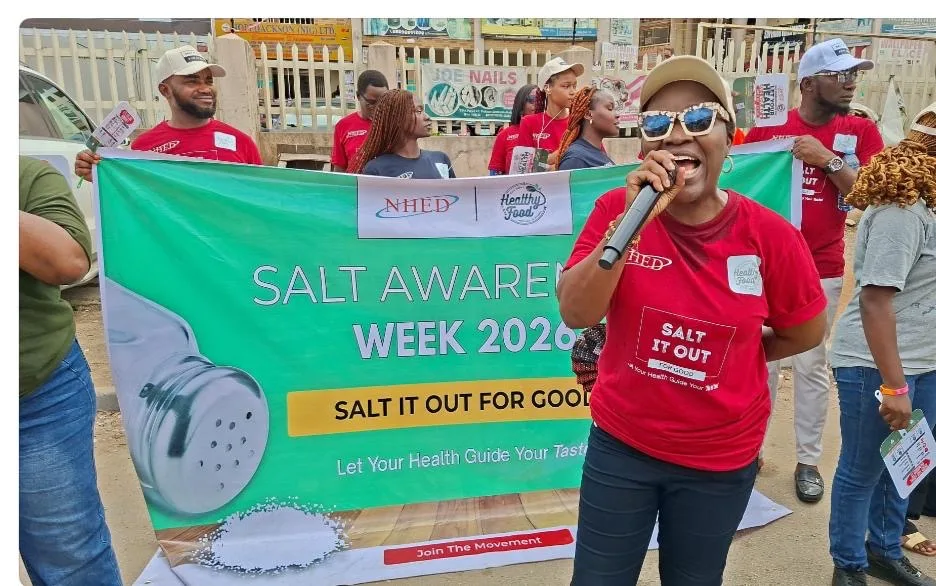
The call was made on Thursday in Abuja during a press briefing organised to commemorate the 2026 World Salt Awareness Week.
The groups warned that Nigerians are increasingly exposed to unhealthy levels of sodium through processed and packaged foods, often without adequate nutrition information to guide healthier choices.
Speaking during the briefing, the Country Director of the Network for Health Equity and Development, Dr Aminu Sokpo, said excessive salt consumption has become a major public health concern requiring urgent government intervention.
Commonly consumed products such as seasoning cubes, instant noodles, processed snacks, bread, fast foods and processed meats contribute significantly to sodium intake among Nigerians. They increase the risk of hypertension, stroke and cardiovascular diseases.
Reducing excessive salt consumption is one of the simplest, most affordable and most effective public health interventions for preventing avoidable illnesses and deaths, Sokpo said.
He called on the Federal Government to strengthen food policies. They should improve front-of-pack nutrition labelling and support sustained public awareness campaigns to help consumers make informed dietary choices.
Sokpo also stressed the need for stronger collaboration among government agencies, civil society organisations, the media and the food industry. This collaboration should promote healthier food environments.
Also speaking, Technical Lead at NHED, Dr Jerome Mafeni, warned that hypertension continues to pose a growing health challenge in Nigeria. It's driven partly by unhealthy food environments and increasing consumption of processed foods high in sodium.
The burden of hypertension in Nigeria can't be separated from the food environments consumers are exposed to daily, he said.
Many Nigerians unknowingly consume excessive sodium because large amounts of salt are hidden in processed and packaged foods sold across the country.
Mafeni advocated sodium reduction initiatives, clearer nutrition information and policies that encourage healthier food systems.
Speaking on behalf of Corporate Accountability and Public Participation Africa, Bukola Odele emphasised the importance of consumer protection, accountability and stronger food policies in promoting healthier diets.
She noted that consumers deserve access to clear and understandable nutrition information. This information enables informed food choices and protects public health.
The Coalition for Healthy Food Advocacy reiterated that reducing excessive salt consumption requires collective action. It involves government agencies, civil society organisations, the media, the food industry and consumers themselves.
The advocacy comes amid mounting concern over the rising prevalence of hypertension and cardiovascular diseases in Nigeria.
According to the World Health Organisation, excessive sodium intake is one of the leading risk factors for hypertension, stroke and heart disease globally.
Although the WHO recommends that adults consume less than five grams of salt daily, recent studies indicate that average salt consumption among many Nigerians exceeds recommended levels. This excess is largely due to increased consumption of processed and packaged foods.
A recent comparative study on packaged foods in Nigeria found that many products exceeded the World Health Organisation’s sodium benchmarks. Sodium levels in several food categories are higher than similar products sold in some African countries.
Health experts warn that without stronger regulations, improved nutrition labelling and sustained public education, Nigeria could face an even greater burden of hypertension and other diet-related illnesses in the coming years.
Key Facts
- The World Health Organisation recommends consuming less than five grams of salt daily.
- Average salt consumption among many Nigerians exceeds recommended levels.
- Excessive sodium intake is a leading risk factor for hypertension, stroke and heart disease globally.
- Many Nigerians unknowingly consume excessive sodium due to hidden salt in processed and packaged foods.
- The Coalition for Healthy Food Advocacy urges collective action to reduce excessive salt consumption.
The Nigerian government has been urged to take immediate action to address the rising cases of hypertension and cardiovascular diseases in the country.
The call for action is not just a matter of public health, but also an economic imperative. The cost of treating these diseases can be catastrophic for individuals and families.
The Federal Government is expected to heed the call of the Civil Society Organisations and take concrete steps to strengthen food regulations. They should promote healthier food environments in Nigeria. It's crucial that they don't delay in addressing this issue, as it won't only improve public health but also reduce the economic burden on individuals and the country as a whole.