

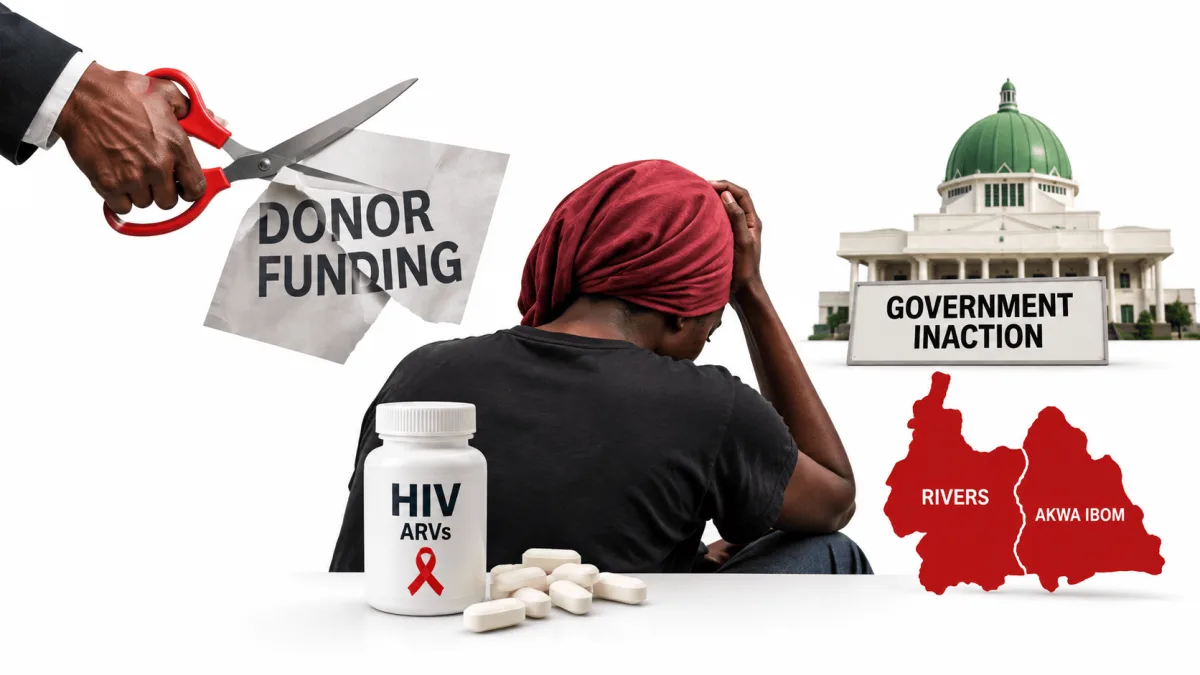
Imagine planning for a rainy day, building a strong umbrella and a sturdy shelter, only to leave them locked away when the clouds gather. That’s what’s happening in Akwa Ibom and Rivers states with their HIV/AIDS response. Long before international donors started packing their bags, these states put laws in place, laws that were supposed to be the umbrella and shelter. They recognised that foreign aid wouldn't last forever and planned for a future where governors would lead the charge, governments would fund programmes locally, and legal protections would ensure nobody feared seeking help.
But on the ground, it looks like those plans are just gathering dust. A deep dive by PREMIUM TIMES shows that many of the important mechanisms created by these laws aren't working as intended. And as donor-funded community services start to disappear, it begs the question: if the institutions meant to keep things running aren't even functioning properly before the money runs out, what hope is there when it eventually goes completely?
In Akwa Ibom, the law is quite clear. It says the State Council on HIV/AIDS, chaired by the governor himself, is the top boss for fighting the epidemic. With the deputy governor as vice-chair, plus other big names like the Secretary to the State Government, Head of Service, relevant commissioners, and the head of the State Agency for the Control of AIDS (SACA), this council is supposed to be the engine. It’s meant to provide leadership, find money, get everyone working together, and make sure the state’s HIV strategy is on track and actually working.
And this isn't just a suggestion; the law demands this council meets at least every three months. Yet, when PREMIUM TIMES asked for records of these meetings between January 2023 and June 2026, the Akwa Ibom government came up empty. No details on how many meetings happened, what was decided, or what steps were taken to get the state ready for less donor cash. A thorough check of government websites and official publications also found no sign of these crucial quarterly HIV council meetings.
When pressed, the Commissioner for Health, Ekem Emmanuel, gave a vague answer. He said Governor Umo Eno does hold “meetings on HIV/AIDS,” but then punted the responsibility for details about the number of meetings and their outcomes to SACA. When asked directly about keeping track, he seemed to shrug it off, stating he wasn’t the Health Commissioner back in 2023 and couldn’t be expected to remember such details.
On July 7th, PREMIUM TIMES sent a detailed list of 12 specific questions to Enobong Akpan, the Programme Manager at SACA. They wanted to know about meeting records, budgets, how the HIV law was being followed, and the state’s readiness for reduced donor support. Mr. Akpan confirmed he got the enquiry and promised to reply once he was back in Akwa Ibom from a meeting. But despite follow-ups, silence. He never responded.
The Akwa Ibom law doesn't stop at the state capital. It also mandates the creation of Local Action Committees on HIV/AIDS in all 31 local government areas. These committees, led by the local council chairpersons, are supposed to be the eyes and ears on the ground. They should be rallying communities, coordinating prevention and treatment efforts locally, boosting awareness, and getting funding from their council budgets. The idea is to make sure the HIV response reaches everyone, right down to the grassroots, before they even need to see a doctor.
However, interviews with people from the Network of People Living with HIV/AIDS in Nigeria (NEPWHAN) in Akwa Ibom, community activists, and local government insiders suggest these committees aren't doing their job. “We have tried engaging local governments, particularly in areas with high HIV prevalence, but the response has been poor,” said Elizabeth Udo, the Akwa Ibom State Coordinator for NEPWHAN. PREMIUM TIMES could also not find any evidence of recent HIV projects directly run by the local governments under this legal framework.
Adding to the lack of transparency, it's incredibly difficult to check how local governments are spending their money. This is partly because, as PREMIUM TIMES has previously reported, most of the 31 councils aren't publishing their budgets or other financial documents, which is a clear violation of the state's fiscal responsibility law.
While the situation in Rivers State is not fully detailed here, the source indicates a similar pattern where the Rivers State Agency for the Control of AIDS Law has been established, suggesting a parallel structure that may also be facing similar operational challenges.