

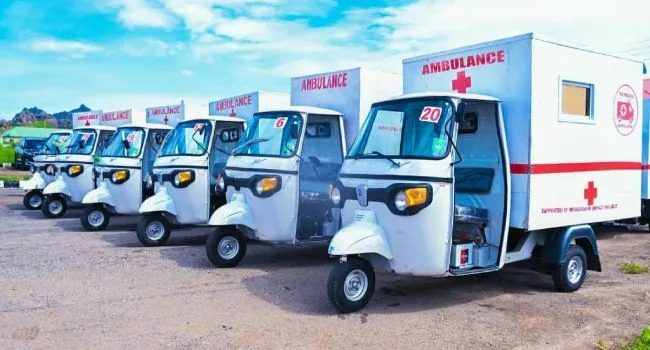
The Federal Government has officially upgraded the Riyom General Hospital in Plateau State to a National Trauma Centre. This move is designed to drastically improve emergency medical response and ensure more people get life-saving care when they need it most. This isn't just a name change; it comes with a fleet of 15 ambulances deployed to the state, which is part of the big push under the National Emergency Medical Services and Ambulance System (NEMSAS).
Dr. Kachollom Daju, Permanent Secretary for the Federal Ministry of Health and Social Welfare, announced the upgrade during the launch on Monday. She represented the Coordinating Minister, Prof. Muhammad Ali Pate. Dr.
Daju highlighted how this would strengthen emergency services. The deployment includes five regular ambulance buses and ten tricycle ambulances, which are perfect for navigating tricky rural roads. The state government, under Governor Caleb Manasseh Mutfwang, gave the go-ahead. They ceded the Riyom General Hospital for this federal project. His Deputy, Ngo Josephine Chundung Piyo, received the ambulances, calling it a massive investment in saving lives.
The NEMSAS plan has a clear structure. It will work with the Plateau State Emergency Medical Services and Ambulance Services (PLASEMSAS) to offer free emergency transport within the state. Then there's the Federal Tertiary Facility Pathway. This promises 48 hours of free emergency treatment for vulnerable patients. For the really remote areas, the Rural Emergency Services and Transport for Maternal and Newborns (REST-M) will focus on getting pregnant women and newborns to safety.
This is especially important in hard-to-reach spots. Governor Mutfwang stated this aligns perfectly with his administration's plan to remove barriers like distance, cost, and lack of transport for medical care.
This isn't the first ambulance push for Plateau. Governor Mutfwang mentioned that the state had already bought five ambulance buses to get PLASEMSAS started. They'd also supplied tricycle ambulances to Jos East and Riyom local government areas under a different initiative for mothers and newborns. He promised the Federal Government that these new vehicles would be well-managed and maintained. This will ensure they keep running smoothly.
Dr. Pokop Bupwatda, the Chief Medical Director of Jos University Teaching Hospital (JUTH), stressed how crucial faster response times are for patients needing immediate, specialised care. He pledged 24-hour operations at the Riyom centre to match the 48-hour free treatment promise.
Plateau State’s health landscape has seen some improvement lately. The Commissioner for Health, Dr. Nicholas Baamlong, shared that the state started its own emergency ambulance system in August 2025. Their rural initiative has already clocked over 2,000 emergency transports in just six months. More than half of those were in Jos East and Riyom.
He pointed to a dramatic drop in maternal mortality in those areas during that time. The state’s overall ratio fell from 905 to about 500 deaths per 100,000 live births. The new conventional ambulances from the FGNEMSAS will be stationed at key facilities: JUTH, National Orthopaedic Hospital, Jos, FMC Wase, Plateau State Specialist Hospital, and the new National Trauma Centre in Riyom. The tricycle ambulances are expected to be the real heroes in the villages. They'll bridge the gap where larger vehicles can't go.
They'll also cut down on those critical delays that often prove fatal.
Upgrading Riyom General Hospital into a National Trauma Centre means a dedicated hub for handling severe injuries and coordinating referrals across the state. It’s a concrete step towards ensuring that accidents, obstetric emergencies, and other critical situations get a faster, more organised response. The aim is clear: get people the help they need, when they need it, no matter where they are in Plateau.