

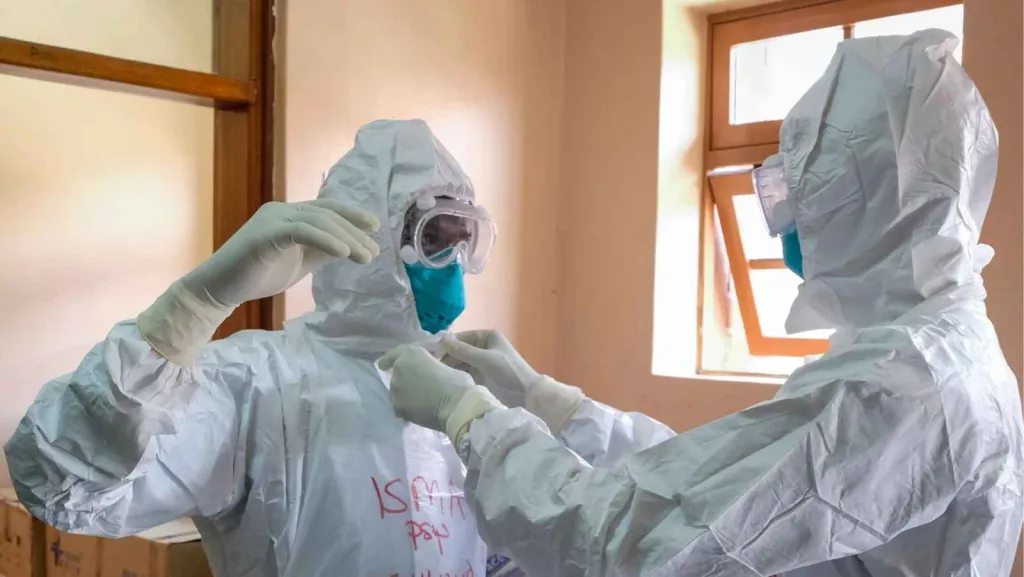
The Democratic Republic of Congo has officially declared a fresh Ebola outbreak, sparking fears of a new pandemic across Africa. The latest outbreak is once again exposing the difficult intersection of public health, insecurity, and survival in Africa. For Nigeria, the threat is once again drawing dangerously close, with many of the lessons from the 2014 Ebola outbreak seemingly forgotten. In 2014, an infected traveler walked quietly into Lagos from Liberia, triggering one of the country's gravest public health emergencies. The late Dr.
Stella Adadevoh's firm decision to detain the index patient is widely credited with preventing a far wider national catastrophe. However, experts argue that Nigeria isn't ready for another pandemic, with many of its healthcare systems still lacking the necessary infrastructure to respond to an outbreak.
Prof. Oyewale Tomori, a renowned virologist, warned that Nigeria risks confusing past success with present safety, saying 'we must stop behaving as though because we defeated Ebola in 2014, we're automatically safe today.' Tomori stressed that the 2014 success was built on urgency, not infrastructure maturity, and that many of those advantages have weakened. He noted that Nigeria needs a multi-diagnostic lab and reagents that can detect all infectious diseases, not just specific ones. Nigeria can't rely on past successes to keep it safe, Tomori emphasized. The country's healthcare system won't be able to respond effectively to an outbreak without significant improvements.
Prof. Oladapo Ashiru, the founding President of the Academy of Medical Sciences, also warned that Nigeria continues to repeat the same cycle of reactive health management instead of sustaining long-term epidemic preparedness. He stated that the country often mobilises aggressively during outbreaks, only to abandon critical structures once the immediate danger fades. Nigeria doesn't have a long-term plan in place to deal with epidemics, Ashiru said. The country's approach to public health is largely reactive, and it won't be enough to keep Nigerians safe.
Dr. Casmir Ifeanyi, a Public Health Analyst, expressed deep concern over Nigeria's laboratory and diagnostic capacity, describing it as one of the weakest aspects of the country's preparedness system. He attributed the challenge to years of underinvestment in medical laboratory infrastructure and personnel. Nigeria's laboratory capacity is a major weakness, Ifeanyi said. The country hasn't invested enough in its medical laboratory infrastructure, and it's showing.
Nigeria won't be able to detect and respond to outbreaks effectively without better labs and more personnel.
The experts insisted that the lesson isn't about remembering 2014 but about rebuilding the systems that made survival possible. They said that in public health, memory doesn't stop transmission, but only systems do. Nigeria's memory of the 2014 outbreak won't be enough to keep it safe, they emphasized. The country needs to rebuild its public health systems to prevent future outbreaks. It's not just about remembering the past, but about building a safer future.
Nigeria can't afford to wait until the next outbreak to take action - it needs to start rebuilding its systems now.