

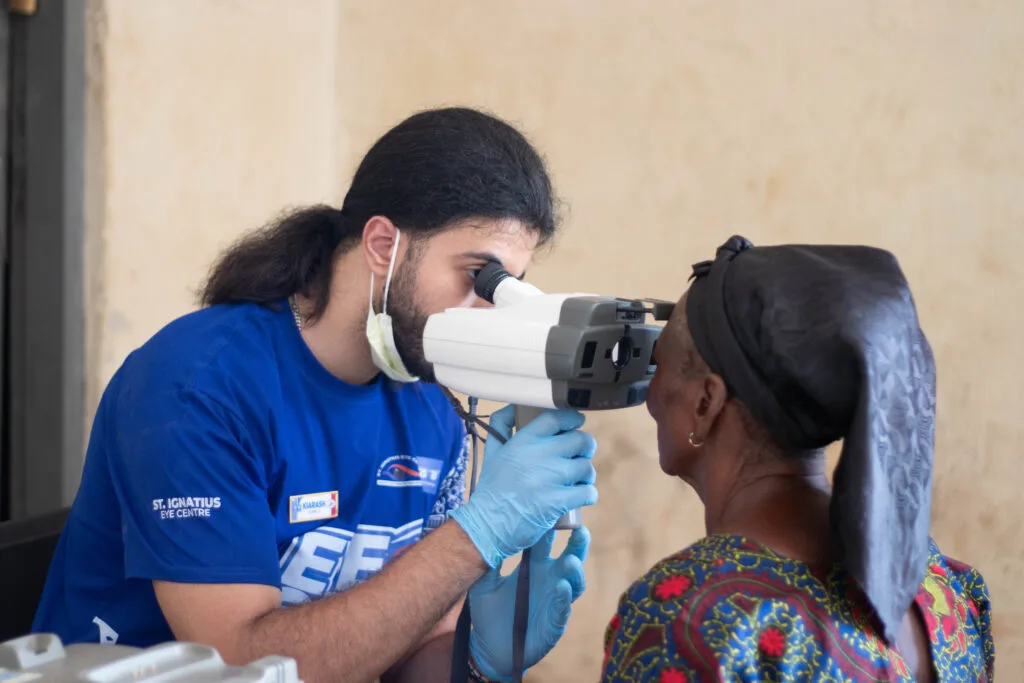
Over 500 people were left without access to free eye care in Ghana’s Bono Region, sparking calls for the National Health Insurance Scheme (NHIS) to cover prescription glasses and low-vision aids. The St. Ignatius Eye Centre, in partnership with 20/20 Mission, organised a four-day free eye care outreach, but its capacity was overwhelmed as 867 people were screened within the period.
Lead optometrist Dr Christian Ntsiful Anderson explained that the outreach camp was structured around mass screening, early detection, and referral systems. This approach aimed to prevent avoidable blindness rather than just treating walk-in cases.
Most conditions identified, including uncorrected refractive errors, cataracts, and presbyopia, were highly treatable but often left unaddressed until they severely impaired vision. This, according to Dr Anderson, is a result of a persistent shortage of eye care professionals in Ghana. The country remains below the World Health Organisation’s recommended optometrist-to-population ratio, a gap that is more pronounced in rural areas.
Dr Ignatius Yeboah, the Chief Executive Officer of St. Ignatius Eye Centre, noted that while NHIS covers basic eye examinations, it does not cover spectacles or low-vision aids. 'We can keep running camps, and we will. But camps treat the symptom temporarily. If we want to take the fight against preventable blindness in this country to the next level, the system has to change so that a prescription for glasses is something every Ghanaian can acquire without breaking the bank,' Dr Yeboah said.
Organisers argue that expanding coverage is not only a health issue but also an economic one. Global estimates suggest vision impairment costs the global economy hundreds of billions of dollars annually in lost productivity, with most cases linked to preventable or treatable conditions. Interventions such as corrective lenses and cataract surgery are among the most cost-effective in global healthcare, especially in low- and middle-income countries.
The NHIS coverage expansion is part of the broader commitment to strengthen eye care delivery in the Bono Region. Plans include expanding future screenings, deepening partnerships with Ghanaian institutions, and supporting local research. Organisers maintain that integrating corrective eyewear into NHIS coverage is the single most important policy shift needed to bridge the country’s vision care gap and reduce preventable blindness.
The St. Ignatius Eye Centre and its partners are calling on the government to revisit NHIS coverage and include prescription glasses and low-vision aids. They argue that this would benefit not only individuals but also the economy as a whole.
Ghanaian-led research will guide future outreach programmes and inform policy change. Data from the exercise will also contribute to strengthening advocacy for extending coverage to prescription glasses and low-vision aids.
In addition to the economic benefits, expanding coverage would have a significant impact on the health of Ghanaian citizens. According to Dr Anderson, Ghana remains below the World Health Organisation’s recommended optometrist-to-population ratio, which affects rural areas disproportionately.
The NHIS expansion would benefit individuals and the economy as a whole. Ghanaian-led research will inform future advocacy and policy changes.