

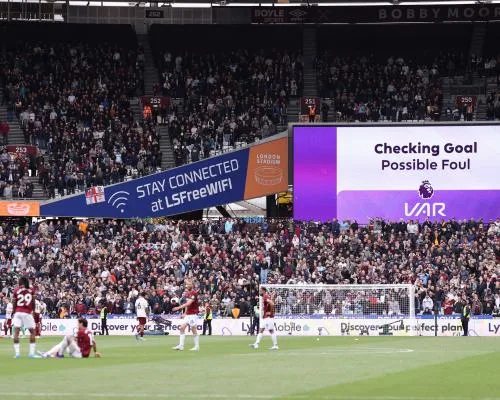
The Premier League is on the verge of a significant decision regarding the use of Video Assistant Referee (VAR) technology. As it stands, the league is set to reject the expansion of VAR powers, which would have allowed the video assistant referee to rule on the award of corners and second yellow cards. This decision comes after talks with the Professional Game Match Officials (PGMO), the refereeing body responsible for overseeing the sport in England. The PGMO has advised against the expansion, citing concerns over the potential increase in match duration and the added pressure on match officials.
The Premier League's decision is notable, given that the International Football Association Board (Ifab) approved a regulation change in February that would have permitted the use of VAR in these situations. However, Ifab made the new law discretionary, allowing leagues and competitions to decide whether to adopt it. The Premier League's decision will be made at the annual general meeting next month, where the clubs will have the final say. It's worth noting that the PGMO's guidance is not binding, but it's unlikely that the clubs will overrule the refereeing body's advice.

The potential expansion of VAR powers has been a topic of debate in recent months. Fifa, the governing body of international football, has taken a different view, with the chair of its referees committee, Pierluigi Collina, and the president, Gianni Infantino, expressing concerns that an incorrect corner decision could have a decisive influence on a World Cup game. This is particularly relevant in the knockout stages, where a single mistake could have significant consequences. However, the Premier League's concerns are more focused on the potential disruption to the game and the added pressure on match officials.
The Premier League's decision may also be influenced by the potential impact on broadcast partners. With the league's matches already being broadcast around the world, any significant increase in match duration could lead to scheduling conflicts and decreased viewer engagement. The clubs are also aware of the potential consequences of overloading the VAR system, which could lead to further controversy and debate. As it stands, the Premier League is set to maintain the status quo, with VAR being used only to rule on goals, penalties, and direct red cards.
Key Facts
- The Premier League is set to reject the expansion of VAR powers next season.
- The decision will be made at the annual general meeting next month.
- The PGMO has advised against the expansion, citing concerns over match duration and pressure on match officials.
- Ifab approved a regulation change in February that would have permitted the use of VAR in certain situations.
- The Premier League's decision may be influenced by the potential impact on broadcast partners.
- Fifa has taken a different view, with concerns that an incorrect corner decision could have a decisive influence on a World Cup game.
Background on VAR
The use of VAR in football has been a topic of debate since its introduction in 2018. The technology is designed to assist referees in making decisions, particularly in situations where a mistake could have significant consequences. However, the use of VAR has not been without controversy, with many arguing that it has disrupted the flow of the game and led to increased controversy. The Premier League's decision to reject the expansion of VAR powers is likely to be seen as a response to these concerns.

The history of VAR in the Premier League is complex. The technology was first introduced in the 2019-2020 season, with the aim of reducing errors and improving the accuracy of refereeing decisions. However, the implementation of VAR has not been without its challenges. Many fans and players have expressed frustration with the system, citing delays and inconsistencies in decision-making. The Premier League has attempted to address these concerns, with changes to the VAR protocol and increased training for referees.
The use of VAR in other leagues and competitions has also been a topic of debate. Some leagues, such as the Bundesliga and La Liga, have implemented VAR more extensively, with the technology being used to rule on a wider range of decisions. However, other leagues, such as the Premier League, have taken a more cautious approach. The decision to reject the expansion of VAR powers is likely to be seen as a reflection of the Premier League's more conservative approach to the technology.
The Role of the PGMO
The PGMO plays a crucial role in the implementation of VAR in the Premier League. As the refereeing body responsible for overseeing the sport in England, the PGMO is responsible for advising the Premier League on refereeing matters. The PGMO's guidance on the expansion of VAR powers is significant, as it reflects the concerns of referees and other stakeholders. The PGMO's chief refereeing officer, Howard Webb, is expected to discuss the decision on Sky Sports' Match Officials Mic'd Up, providing further insight into the reasoning behind the PGMO's advice.
The PGMO's role in the Premier League is multifaceted. The organization is responsible for training and developing referees, as well as providing guidance on refereeing matters. The PGMO also works closely with the Premier League to implement changes to the VAR protocol and address concerns around the technology. The PGMO's advice on the expansion of VAR powers is likely to be influential, given the organization's expertise and experience in refereeing matters.
The PGMO's decision to advise against the expansion of VAR powers is also significant, given the potential consequences for the sport. The organization's concerns around match duration and pressure on match officials are valid, and reflect the potential risks of overloading the VAR system. The PGMO's guidance is likely to be seen as a pragmatic response to the challenges posed by the technology.
The Impact on Fans and Broadcasters
The Premier League's decision to reject the expansion of VAR powers is likely to have significant implications for fans and broadcasters. The potential increase in match duration and the added pressure on match officials could lead to decreased viewer engagement and scheduling conflicts. The Premier League's broadcast partners are likely to be concerned about the potential impact on their schedules and revenue.
The fans' perspective on the use of VAR is complex. Many fans have expressed frustration with the technology, citing delays and inconsistencies in decision-making. However, others have argued that VAR has improved the accuracy of refereeing decisions and reduced errors. The Premier League's decision to reject the expansion of VAR powers is likely to be seen as a response to the concerns of fans and broadcasters.
The potential consequences of the Premier League's decision are significant. The rejection of the expansion of VAR powers could lead to a decrease in the use of technology in the sport, with potential consequences for the accuracy of refereeing decisions. However, the decision could also be seen as a pragmatic response to the challenges posed by the technology, and a reflection of the Premier League's commitment to maintaining the integrity of the game.
The View from Fifa
Fifa has taken a different view on the expansion of VAR powers. The governing body of international football has expressed concerns that an incorrect corner decision could have a decisive influence on a World Cup game. This is particularly relevant in the knockout stages, where a single mistake could have significant consequences. Fifa's president, Gianni Infantino, and the chair of its referees committee, Pierluigi Collina, have both expressed support for the expansion of VAR powers.
The use of VAR is a complex issue, and one that requires careful consideration. As Pierluigi Collina noted, 'the most important thing is to ensure that the technology is used in a way that improves the accuracy of refereeing decisions, without disrupting the flow of the game.' The Premier League's decision to reject the expansion of VAR powers is likely to be seen as a response to these concerns, and a reflection of the league's commitment to maintaining the integrity of the game.
Fifa's view on the expansion of VAR powers is significant, given the organization's role in governing the sport. The use of VAR in the World Cup is likely to be a topic of debate, with potential consequences for the sport as a whole. The Premier League's decision to reject the expansion of VAR powers is likely to be seen as a response to the challenges posed by the technology, and a reflection of the league's commitment to maintaining the integrity of the game.
The Future of VAR
The future of VAR in the Premier League is uncertain. The decision to reject the expansion of VAR powers is likely to be seen as a response to the concerns of fans and broadcasters, as well as the challenges posed by the technology. However, the use of VAR is likely to continue, with potential consequences for the sport as a whole. The Premier League's commitment to maintaining the integrity of the game is likely to be a key factor in the development of VAR, with the league working to address the challenges posed by the technology.
The potential consequences of the Premier League's decision are significant. The rejection of the expansion of VAR powers could lead to a decrease in the use of technology in the sport, with potential consequences for the accuracy of refereeing decisions. However, the decision could also be seen as a pragmatic response to the challenges posed by the technology, and a reflection of the Premier League's commitment to maintaining the integrity of the game. As the use of VAR continues to evolve, it's likely that the Premier League will play a key role in shaping the future of the technology.
The use of VAR in other sports is also likely to be a topic of debate. The technology has been used in sports such as rugby and cricket, with potential consequences for the accuracy of refereeing decisions. The Premier League's decision to reject the expansion of VAR powers is likely to be seen as a response to the challenges posed by the technology, and a reflection of the league's commitment to maintaining the integrity of the game. As the use of VAR continues to evolve, it's likely that the Premier League will play a key role in shaping the future of the technology.