

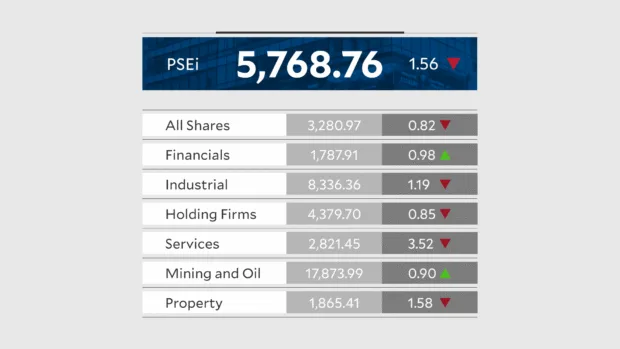
The Market Dive
The Philippine Stock Exchange Index (PSEi) didn't just stumble this Friday—it took a hard hit, closing at 5,768.76 points. This represents a sharp drop of 1.56 percent, wiping out 91.18 points in a single day of trading. For anyone watching their retirement fund or their side-hustle investments, this is the kind of red ink that ruins a perfectly good Friday. The exchange felt the pressure early, dragging the index down to an intraday low of 5,766.82 before the bell rang.
This isn't just a random bad day at the office for the PSE; it marks a significant milestone. The index sits at its lowest level since November of last year. Sentiment in the financial world can turn quickly, and today's drop is a sobering reminder of this reality. The market is currently dancing on a knife's edge, and this latest downturn is a clear indication of its precarious state.
Why Everyone Is So Tense
Michael Ricafort, the chief economist at Rizal Commercial Banking Corp., attributes the PSEi's decline to a one-two punch. First, there's the lingering anxiety over the conflict between the United States and Iran. News reports suggest negotiators might have finally reached a tentative deal to extend a ceasefire, but the market remains skeptical. It doesn't like uncertainty, and the potential for a supply chain disruption in the Middle East is even more unsettling.
Additionally, there's the technical side of the headache: the MSCI index rebalancing. Think of MSCI as the world's librarian for stock markets; when they decide to reshuffle which stocks belong in their popular global trackers, money managers have to sell and buy massive blocks of shares to keep up. This mandatory reshuffling often leads to heavy, frenzied trading that pushes prices around regardless of how a company is actually performing. It’s like a forced musical chairs game where the music stopped and everyone realized they were holding the wrong seat.
“Also, it was the index’s lowest level in more than six months, or since Nov. 28, 2025," Michael Ricafort noted.
What This Means for Your Pocket
If you're wondering why this matters from your balcony in Makati or your office in Cebu, it's about the broader confidence in the Philippine economy. When the PSEi drops this low, it usually means foreign investors are pulling their cash out to park it in safer places, like US treasury bonds or gold. This makes the peso a bit more vulnerable and makes imported goods, from your favorite tech gadgets to fuel, feel just a little bit more expensive.
We haven't seen a slump this bad since the Middle East conflict first erupted back on February 28. That date serves as a grim marker for how the local market has struggled to find its footing ever since global oil prices started acting unpredictable. The PSEi had been trying to build some momentum throughout the early months of 2026, but the combination of geopolitical risk and mechanical index shifts has acted like a drag chute on that growth.
The Market's Reset
The MSCI rebalancing is a scheduled event, but it rarely happens without drama. Institutional investors, including big banks and pension funds, are required to follow these index adjustments to the letter. This means even if a company is a solid local player, it might get dumped simply because it no longer fits the arbitrary criteria of the index provider. It's annoying, but it's part of the game when you play in the big leagues.
For the ordinary investor, the best advice remains the same: keep your head. Panic selling when the market hits a six-month low is how you turn a temporary paper loss into a permanent real-world loss. We're seeing a major reset of asset prices, but history suggests that these corrections eventually bottom out. Until the US-Iran situation gets fully resolved and the dust settles on the MSCI trades, expect the next few sessions to be just as bumpy as today.