

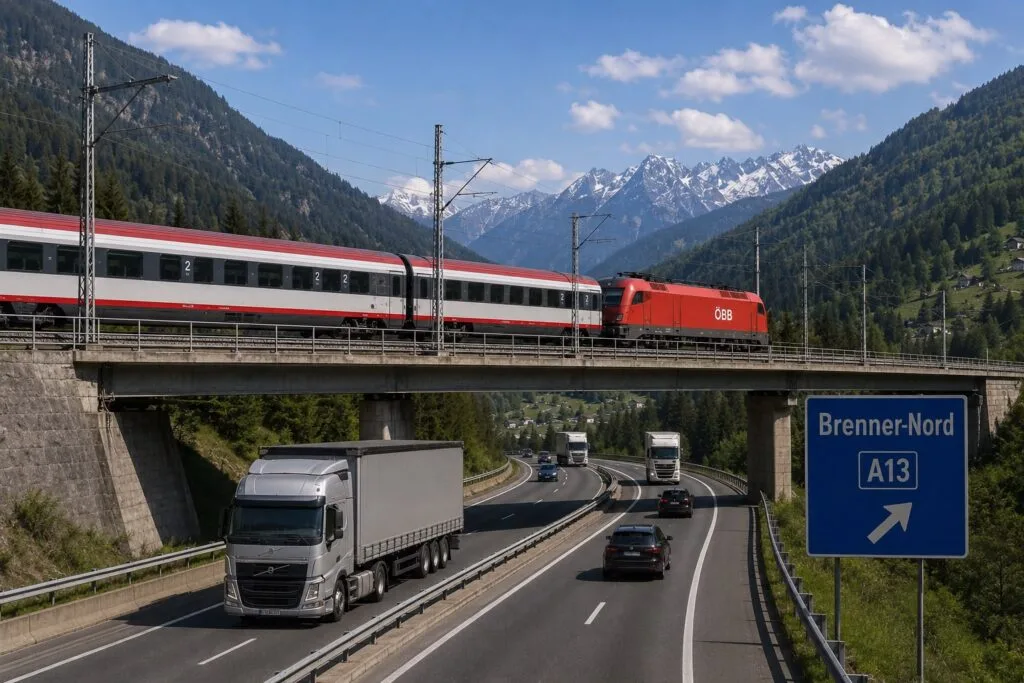
The Brenner Pass, one of Europe's busiest Alpine freight corridors, is at the centre of a legal dispute between Austria and Italy. Every day, thousands of trucks cross the pass, carrying goods between Germany, Austria, and Italy. The Austrian transport organisation VCÖ reports that more than 2.4 million heavy goods vehicles used the route in the previous year.
Austria's western state of Tyrol has introduced measures to reduce congestion, noise, and air pollution caused by heavy truck traffic. These include restrictions on certain freight categories, limits on night-time driving, and traffic controls during peak periods. Austrian authorities argue that the measures are necessary to protect the health of residents in Alpine valleys, where the surrounding terrain can trap pollutants.
Italy, backed by transport operators and business groups, argues that the restrictions delay deliveries, increase logistics costs, and disrupt cross-border trade. The dispute has reached the Court of Justice of the European Union, where an Advocate General recently concluded that several of Austria's measures are incompatible with EU law because they disproportionately restrict the free movement of goods.
The Brenner case illustrates a wider challenge facing Europe. The European Union is pursuing ambitious climate goals while seeking to maintain an open, competitive economy. Yet climate policy and economic integration can pull in different directions, particularly when national environmental measures affect businesses and supply chains across borders.
The effects of the Brenner dispute may extend beyond Europe, including exporters in Africa whose products travel through European logistics networks before reaching global markets. Many transport specialists argue that expanding rail freight is the most sustainable long-term solution.
The Brenner Base Tunnel, currently under construction between Austria and Italy, is expected to shift freight from road to rail, thereby reducing emissions and preserving one of Europe's most important trade corridors.
What does this mean for Africa's exports?
The Brenner corridor is a vital route for European commerce. Delays can increase transport costs, disrupt production schedules, and affect manufacturers, retailers, and consumers across the continent. The effects may also extend beyond Europe, including exporters in Africa whose products travel through European logistics networks before reaching global markets.
A wider challenge for Europe
The European Union is pursuing ambitious climate goals while seeking to maintain an open, competitive economy. Yet climate policy and economic integration can pull in different directions, particularly when national environmental measures affect businesses and supply chains across borders.
EU Court's ruling to influence transport policy
Whatever the European Court of Justice ultimately decides, its ruling is likely to influence transport and environmental policy across the European Union. More broadly, the Brenner dispute highlights one of the EU's defining policy challenges: reducing emissions without undermining the free movement of goods, which underpins the EU's economy.
Key Facts
- The Brenner Pass carries over 2.4 million heavy goods vehicles annually.
- Austria's measures have been criticised for disproportionately restricting the free movement of goods.
- The Brenner Base Tunnel is expected to shift freight from road to rail, reducing emissions.
- The dispute highlights a wider challenge facing Europe: balancing climate policy with economic integration.
- The EU Court's ruling will likely influence transport and environmental policy across the European Union.