

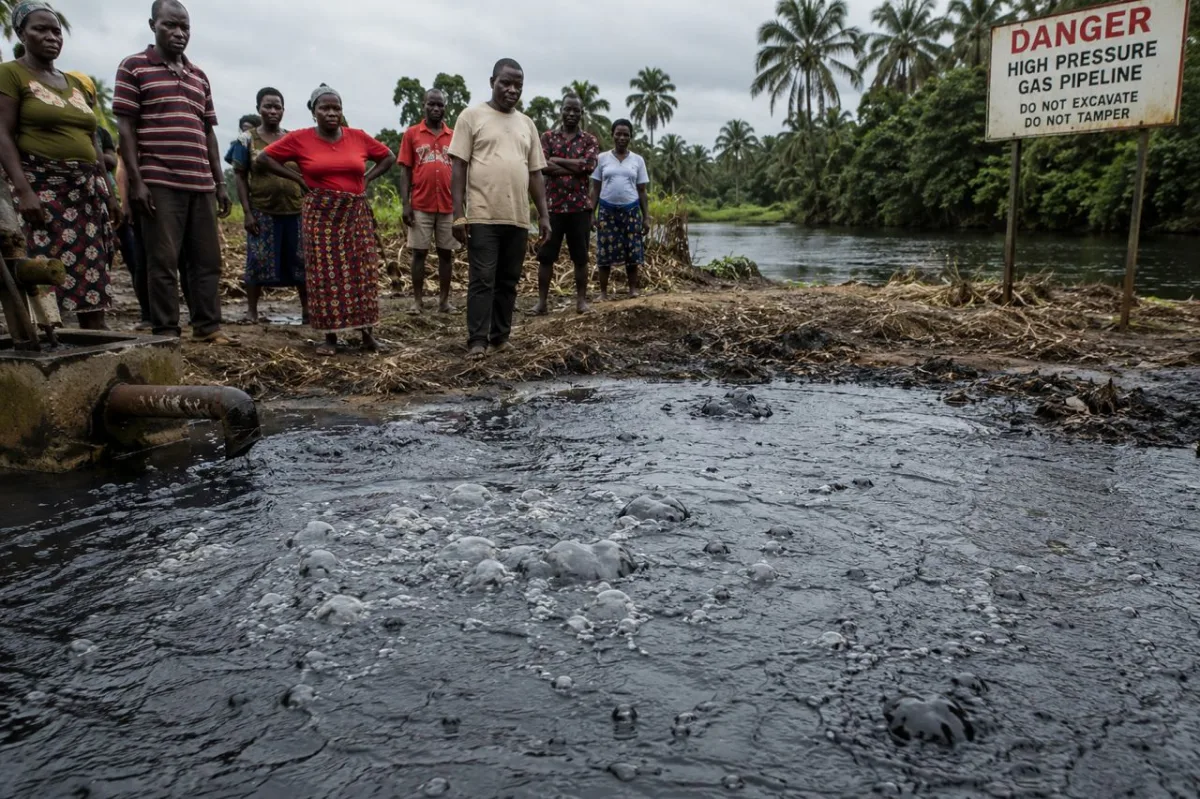
In late 2025, residents of Bille, a riverine community in Rivers State, woke up to an unsettling sight and smell. From abandoned mono pumps and shallow wells, gas suddenly started bubbling to the surface, pushing through ageing pipes buried underground for decades. The air filled with a sharp rotten-egg stench while water frothed and hissed around the openings.
What initially appeared to be an isolated incident soon spread across the community. The constant sound of bubbling gas and the low rumble rising from beneath the ground became part of daily life.
"Since October 2025, we observed that this abandoned mono pump started boiling and bubbling. We invited people from the government parastatal to come and put an end to it, but to no avail," Josiah Sunday, a resident, told PREMIUM TIMES during a June visit to the community.
Nearly 10 months later, the problem has worsened. Beyond continuous exposure to the escaping gas, residents report widespread damage to mangroves and aquatic ecosystems. The populations of periwinkles and fish that support local livelihoods are declining.
Bille is located in Degema Local Government Area of Rivers State. It's accessible only by water and sits about 50 minutes from Port Harcourt, the state capital. Fishing is the dominant occupation in the densely populated island settlement.
On the journey to the community, PREMIUM TIMES encountered several military checkpoints. Armed personnel monitored approaching boats while passengers were instructed to raise their hands for inspection.
Upon arrival, this reporter observed multiple spots on the river surface where gas appeared to be escaping continuously. Water bubbled intensely, resembling boiling liquid. Nearby signposts indicated the presence of high-pressure gas pipelines transporting crude oil and natural gas.
Bille houses Oil Mining Lease (OML) 18, a major onshore oil and gas block in the eastern Niger Delta covering approximately 1,035 square kilometres. It contains several oil and gas fields, including Cawthorne Channel, Akaso and Alakiri.
Shell Petroleum Development Company originally developed the asset before it was acquired by Eroton Exploration and Production Company in 2014. However, years of operational disputes, declining production and ageing infrastructure have left much of the oilfield system abandoned or poorly maintained.
Industry records show that OML 18 production between 2016 and 2023 declined from about 30,000 barrels per day to zero. Ownership and operational control changed hands amid disagreements among partners.
In 2023, the Nigerian National Petroleum Company Limited and OML18 Energy Limited, both non-operating partners of the joint venture, announced the removal of Eroton as the operator, citing the Joint Operating Agreement.
Much of the infrastructure installed in the 1960s and 1970s is now believed to have deteriorated significantly.
Recent evidence published by the BBC showed that Shell continued operating the Bille oilfield and the Nembe Creek Trunk Line despite internal concerns regarding environmental risks and infrastructure integrity. The disclosures emerged from legal proceedings filed by Niger Delta communities seeking accountability for pollution linked to more than 100 oil spills recorded between 2011 and 2013.
Residents and environmental advocates believe the current crisis is linked to failures within abandoned oil and gas facilities.
During the visit, PREMIUM TIMES observed gas escaping through rivers, shallow wells, boreholes and surrounding land surfaces. Water gushing out of some dug borehole spots suddenly changed to black in containers, suggesting a mixture of crude oil in the flowing water. The surrounding premises of the water have turned rusty brown and greasy, while the water, upon exposure to air, suddenly changes to black.
The situation has contaminated water sources and created what experts describe as a highly volatile environment.
"It's an emergency. And I think the concerned authorities will treat it as such," reacted Adeniyi Sanyaolu, Professor of Applied Mycology/Phytopathology and Environmental Biotechnology at the University of Uyo in Akwa Ibom State.
He described the gas seepage in the Bille community as a serious environmental problem commonly associated with oil and gas production when operators fail to comply with regulations. He explained that if the wells in the community had been properly decommissioned after abandonment, the current situation would likely not have occurred.
Where facilities remain active, he says urgent maintenance and overhaul of ageing pipelines, valves, and joints are necessary to stop the leaks. According to him, the continuous release of gas poses significant threats to both life and the environment.