

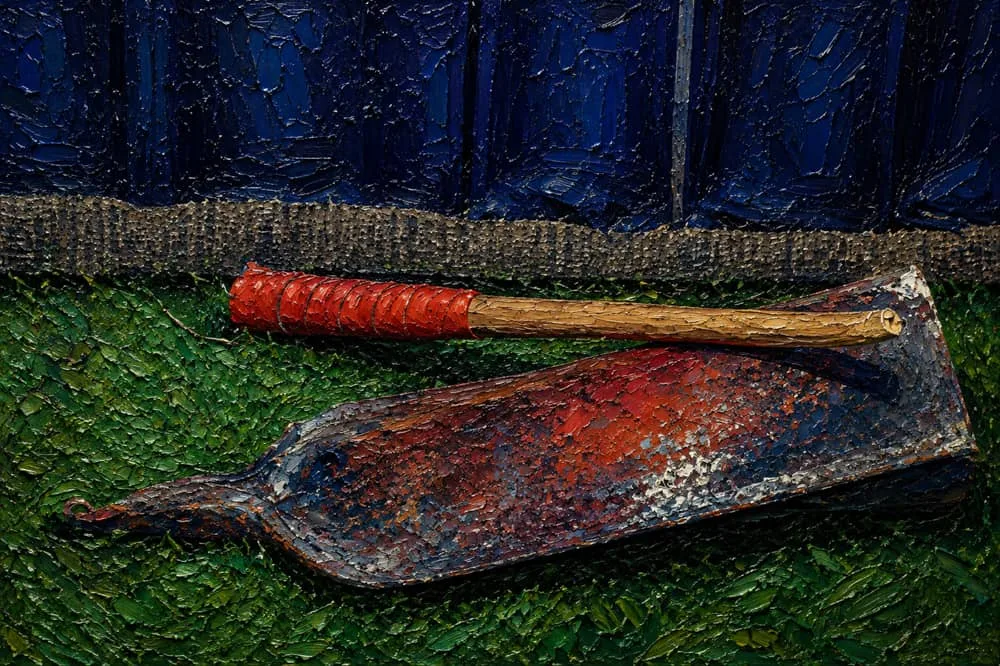
A Nigerian artist is staging a courtroom inside an art gallery — but the witnesses are shekeres, talking drums, and agogos. And they're testifying about culture.
Tobiloba Awogbemila, a painter and fine art photographer with a legal background, opened his exhibition "Rhythms of Home – Musical Collection" against the backdrop of global violence. The show uses the language of law — exhibits, testimonies, cross-examinations — to argue that African cultural heritage isn't a static possession but a living, breathing performance.
Awogbemila believes law and art are "interconnected systems of observation." He tags his paintings like legal exhibits. One piece is titled "No Witness." In the gallery, viewers step into what feels like a courtroom session, surrounded by works that read as evidence of communal life.
Take "Voice of the Shekere." The shekere hangs still on canvas — but its texture vibrates. The silence becomes a voice. Look closely, and the piece reads like an elegy for traditional practices the younger generation remembers but no longer performs. It's the aftermath of a memorable event, the sound that lingers after the music stops.
In "Drums of the Heart," musical instruments are grouped like family members in conversation. The canvas doesn't just trigger rhythm; it becomes a communal voice. "Shekere Family Tree" shows beads, colours, and ascending sizes of lineage footprints — a visual argument that the family is indispensable for transmitting culture.
Awogbemila uses thick layers of paint like layered time. Hands on instruments, imagined performances, and nocturnal devotion emerge from a deep blue ground he calls a sacred field. The field is filled with worship objects: beads, ropes, gourds, straps. These objects aren't props. The artist crafts them as persons, playing agency roles in close-up compositions — remembering, communicating, testifying.
The series leans heavily on Yoruba culture-specific images: talking drum, shekere, agogo, bata. But the themes are universal. Trauma is depicted as evidence. Culture recurs in wearable objects. Dark colours against light ones create a serene atmosphere of solemnity, reverence, and devotion.
What makes this collection different from typical historical artifacts is that it doesn't idealise an imagined past. Instead, it documents musical objects and instruments as they exist today — mirroring interdependence, continuity, and social positioning. Awogbemila prioritises communal instruments rooted in common identity, suggesting that belonging is transmitted through feeling, touch, and bonding.
Works in the series include "Voice of the Shekere," "Drums of the Heart," and "Shekere Family Tree." The "No Witness" series involves interrogatory descriptions, evidences, and testimonies — all framed in legal terms.
Awogbemila's legal training shapes every piece. He treats each painting as a courtroom exhibit, each viewer as a juror. The question he poses: Is culture being preserved, or is it dying on the witness stand?