

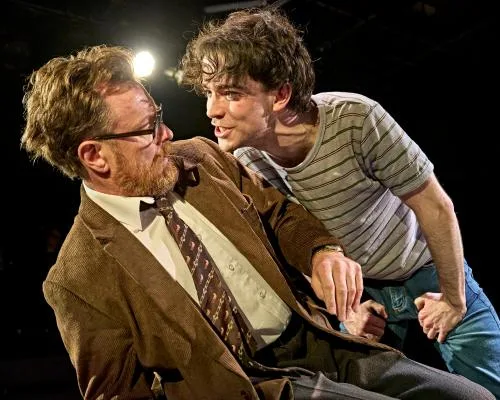
In a shocking turn of events, 17-year-old Alan Strang blinds six horses, leaving everyone wondering why. This isn't a summary of the play Equus - it's the real-life crime that inspired Peter Shaffer to write the story. Lindsay Posner's revival of Equus showcases absolute power shifts, homoerotic desire, and the muscular allure of a stallion with precision.
Noah Valentine is taut and stringy as Alan Strang, the disturbed teenager who commits the horrific act. He didn't explain in court why he did it, so Alan winds up in therapy with Toby Stephens' rumpled psychiatrist Martin Dysart. As their sessions progress, Alan gets hooked on the attention, savouring the rush of retelling his story. Martin, on the other hand, begins to lose his power over the boy and his own sense of self.
At the back of the stage stands a line of six silent men, their bare chests streaked with black. These are our horses, their strength shimmering as they roll into position to form one powerful animal under the care of James Cousins' swirling movement direction. The ensemble of horses makes this possible, but it's Valentine who convinces. His performance contains both the maturity of intense devotion and the foolish imaginings of a lonely child looking for something to believe in.
The play came about after Shaffer learned the bare bones of this real-life crime. He then imagined how and why it came to be. Posner's production leans into the question of where we place blame. Colin Mace's stoic father lumped it into the lap of Alan's mother, a downtrodden Emma Cunniffe. But in Stephens' shrink, we see something deeper and more destructive as he worries about ridding Alan of his demons. This is a question of what a life is worth if it's lived without a world-burning devotion.
The boy watches the shiftings of their bodies with awe as he rubs down their flanks and leaps, naked and nimble, on to the shoulders of Ed Mitchell, our majestic head horseman.
Performer Paul Pyant's lighting shines off the men's bodies in a physicalisation of Alan's sexual reverence of these creatures. This isn't just a play about horses; it's about the human desire for connection and the devastating consequences of its absence. The story is as relevant today as it was in 1973 when the play was first written. It's clear that the themes of Equus haven't changed much over time, and that's what makes it so powerful.
As the play runs until July 4 at Menier Chocolate Factory in London, it's essential to consider the context in which it was written. The early 1970s were a time of great social change, with the rise of counterculture and the questioning of traditional values. This context is crucial in understanding the themes of Equus and the reasons behind its enduring popularity. We can't ignore the fact that the play was written during a time of significant social upheaval.
The fact that Equus has been revived multiple times since its premiere is a testament to its timeless themes and the power of its storytelling. As we watch the play unfold, we're forced to confront the darker aspects of human nature and the devastating consequences of unchecked desire. It's a play that will leave you questioning the very fabric of our society and the values we hold dear. We won't be able to look away from the harsh realities that Equus presents.
- The play Equus was written by Peter Shaffer in 1973.
- The story is based on a real-life crime where a 17-year-old boy blinds six horses.
- The play explores themes of desire, desperation, and the human need for connection.
- The current production is directed by Lindsay Posner and stars Noah Valentine as Alan Strang.
- The play runs until July 4 at Menier Chocolate Factory in London.
Given the complexity of the play and its thought-provoking themes, it's no wonder that Equus has become a classic of modern theatre. As we reflect on the story and its characters, we're reminded of the importance of empathy and understanding in breaking down the barriers that separate us. The play may be a product of its time, but its message is timeless, and its impact will be felt long after the curtain falls. The play's themes and characters won't be forgotten, and they'll continue to resonate with audiences for years to come.