

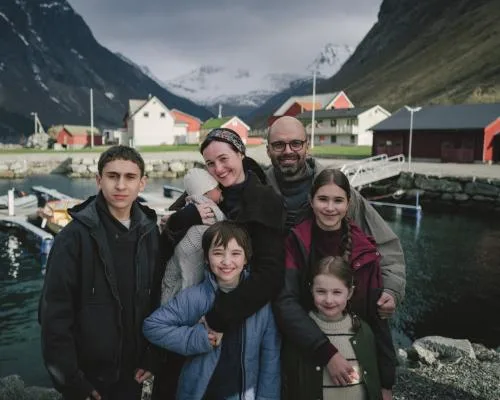
At the Cannes film festival, a shocking moment unfolded as Romanian director Cristian Mungiu's new film Fjord premiered. The movie, which stars Renate Reinsve and Sebastian Stan, tells the story of a family's struggles with child abuse allegations.
The film begins with a disquieting scene where Mihai, played by Sebastian Stan, has just punished his teenage daughter. The school staff notices that the children have marks and bruises, leading to a gentle but pointed questioning of the parents.
Cristian Mungiu is a renowned Romanian director, known for his stunning film 4 Months, 3 Weeks and 2 Days, which won the Palme d'Or in 2007. However, his latest film Fjord seems to be an odd phenomenon, where Mungiu, along with other directors like Kantemir Balagov and Ryusuke Hamaguchi, is making coproduction movies outside their home turf and mother tongue with big foreign stars. Mungiu's decision to make a film outside his home turf is interesting, and it's clear that he's trying something new.
The story follows Mihai and his wife Lisbet, a Norwegian woman, who move to a remote village in Norway due to Mihai's job as a software engineer. They're strict fundamentalist conservative Christians and are welcomed by their non-Christian neighbors, the school's headteacher and his wife. They don't have any issues with their neighbors at first, but things take a turn when the child abuse allegations surface.
As the investigation into the child abuse allegations unfolds, the film takes a complicated turn. The children are taken into provisional care pending a hearing and criminal trial. This situation becomes more complex with the introduction of the neighbors' rebellious teen daughter and the elderly disabled father. The introduction of these characters adds a new layer to the story, and it's clear that Mungiu is trying to say something about the system.
The film's technique is interesting, with Mungiu using enigmatic long shots and avoidance of close-ups. He's trying to create a sense of distance between the audience and the characters, and it's an interesting choice. However, the story lacks the rewarding complexity that Mungiu is known for, and the film fails to deliver a blazing truth about the relationships. It's not that the film doesn't have any interesting moments, but it doesn't quite come together.
One of the intriguing aspects of the film is the way it invites the audience to sympathize with the children and side against the patriarch, Mihai. Yet, it also makes the audience question the system and its treatment of Mihai and his family. The film raises some important questions, but it doesn't provide any clear answers. The audience is left to ponder the issues, and it's clear that Mungiu is trying to spark a discussion.
The matter isn't resolved in court or in the film, and we're left with a strangely inert and suspense-free finale at the ferry terminal. It's a disappointing ending, and it's clear that Mungiu was trying to create a sense of uncertainty. However, it doesn't quite work, and the audience is left feeling unsatisfied.
The film's failure to impress at the Cannes film festival is a disappointment, considering Mungiu's previous work. The movie's lack of complexity and its inability to deliver a compelling truth about the relationships make it an anticlimactic watch. Mungiu's fans won't be impressed, and it's clear that he didn't quite live up to his previous standards.
The film's cast, including Renate Reinsve and Sebastian Stan, delivers a good performance. However, the story and the direction fail to make an impact. The film's technique, although interesting, isn't enough to save the movie from its overall lack of complexity. The cast does its best with the material, but it's not enough to make the film memorable.
The Cannes film festival is known for showcasing the best of world cinema. However, this year's festival has seen a trend of auteurs making coproduction movies outside their home turf and mother tongue with big foreign stars. This trend has resulted in some interesting but ultimately disappointing films, including Fjord. It's not that these films are bad, but they don't quite live up to the standards of the festival.
In the end, Fjord is a disappointing film that fails to live up to Mungiu's previous work. The movie's lack of complexity and its inability to deliver a compelling truth about the relationships make it an anticlimactic watch. The film had potential, but it didn't quite come together. It's a shame, because Mungiu is a talented director, and he's capable of better.
The film's premiere at the Cannes film festival has sparked a discussion about the trend of auteurs making coproduction movies outside their home turf and mother tongue with big foreign stars. While this trend has resulted in some interesting films, it's also led to some disappointing ones, including Fjord. The discussion is ongoing, and it's clear that Mungiu's film has added to the conversation.
As the film festival comes to a close, it's clear that Fjord isn't the only film to have failed to impress. However, Mungiu's film is a disappointment, considering his previous work and the expectations that come with it. The festival has seen some great films, but Fjord isn't one of them. It's a shame, because Mungiu is a talented director, and he's capable of better.
The film's failure to impress at the Cannes film festival is a reminder that even the best directors can have an off day. However, it's also a reminder that the film festival is a platform for directors to experiment and try new things. Mungiu won't be discouraged, and he'll likely try again. He's a talented director, and he's got a lot to offer.
Fjord is a disappointing film that fails to live up to Mungiu's previous work. The movie's lack of complexity and its inability to deliver a compelling truth about the relationships make it an anticlimactic watch. However, the film's premiere at the Cannes film festival has sparked a discussion about the trend of auteurs making coproduction movies outside their home turf and mother tongue with big foreign stars. The discussion is ongoing, and it's clear that Mungiu's film has added to the conversation. The film festival is a platform for directors to experiment, and Mungiu's film is a reminder that even the best directors can try new things.
Key Facts
- Fjord premiered at the Cannes film festival
- The film is directed by Cristian Mungiu
- The movie stars Renate Reinsve and Sebastian Stan
- The story follows a family's struggles with child abuse allegations
- The film's technique is interesting, with Mungiu using enigmatic long shots and avoidance of close-ups
- The movie's lack of complexity and its inability to deliver a compelling truth about the relationships make it an anticlimactic watch