

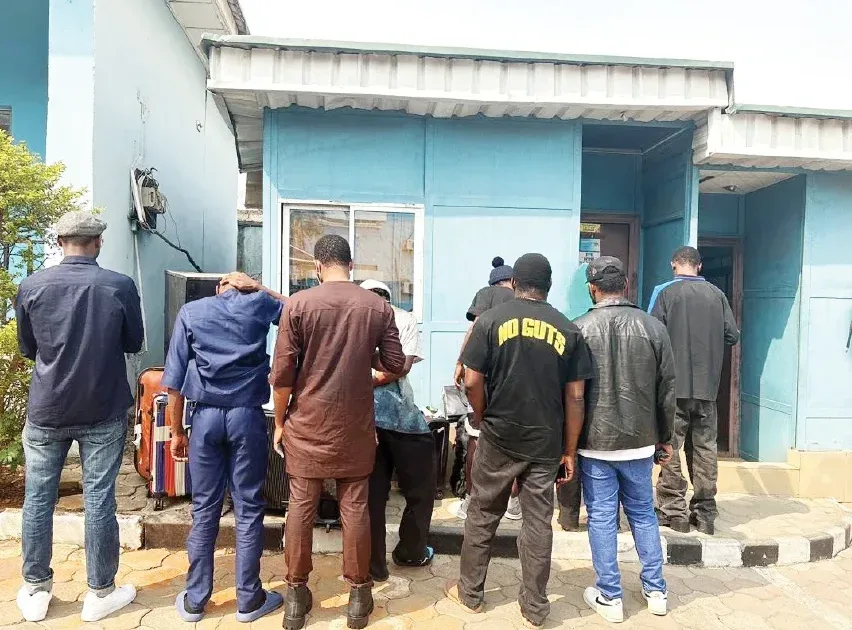
It began with a lie, a promise of a better life, but for Sabiu, it ended in a hellhole. Lured by an online job offer, the 26-year-old from Borno State was sold for $5,000 into a cyber-slave camp in Laos, a country in Southeast Asia. His passport was confiscated, his savings vanished, and armed guards ensured he and others were forced to scam strangers online. Sabiu’s story, uncovered by STEPHEN ANGBULU, is just one among many Nigerians caught in this brutal trade.
Sabiu’s journey into this nightmare started in 2023 with a scholarship to study engineering in China. However, he quickly discovered the scholarship only covered one year of Mandarin language classes, leaving him to foot the bill for the remaining four years of his degree. His father urged him to return home, but Sabiu, desperate to leave Nigeria, refused. He found work teaching English to private students and as a cargo inspector, but his student visa prohibited legal employment. When Chinese immigration cracked down, his meagre income dried up.
Everything changed when Sabiu met Wang Xu, a Chinese businessman in Guangzhou. Wang Xu, speaking fluent English, listened to Sabiu's struggles and offered him a three-month contract as a telecom representative in Laos, helping tourists subscribe to local phone networks. It sounded legitimate, and Sabiu, driven by desperation, accepted without hesitation.
"Everything sounded legit. He told me people in Laos do not speak English, so tourists need help subscribing to their SIM cards. I was like, okay, I am interested," Sabiu recalled. "My desperation took over me. I didn't think twice."
This was exactly the kind of bright, skilled Nigerian youth that traffickers in Asia's cybercrime underworld are targeting. According to a senior operative from the National Agency for the Prohibition of Trafficking in Persons (NAPTIP), these criminal networks seek out intelligent young people with IT skills and good health records. Between November 2024 and early 2025, the agency noted a significant increase in such trafficking cases.
After arriving in Laos, Sabiu was taken to a compound in Bokeo Province. His dreams of a better future evaporated. He was forced to participate in online scams, defrauding people for money. His passport was gone, and any hope of leaving was crushed when his boss revealed he had paid $5,000 to buy him. The stark reality was that he wasn't an employee; he was property.
Life inside the compound was brutal. Sabiu was starved. He slept on bus station benches when he couldn't afford rent and scavenged for leftover food. He even attempted suicide by drinking poison mixed with pineapple juice, but it only resulted in severe diarrhoea. Yet, he survived. He managed to scrape together a living for a while by selling marijuana to other displaced Africans, buying it at 30 yuan and selling it for 50 yuan. This was a small profit that felt like dignity.
During this period of extreme hardship, Sabiu found himself chatting with ChatGPT, seeking a way to end his suffering. The AI, unable to provide direct answers, instead recommended support agencies. These recommendations eventually led him to the International Organization for Migration (IOM). This connection offered a glimmer of hope in his otherwise bleak existence.
His fragile economy crumbled when his Laotian friend, who supplied him with marijuana, was arrested. This pushed him back into scavenging and desperation. The experience in the cybercrime compound cost him his scholarship, his savings, and nearly his life, leaving him haunted by the knowledge that he had been bought and sold.
“I had paid $5,000 to buy you.”