

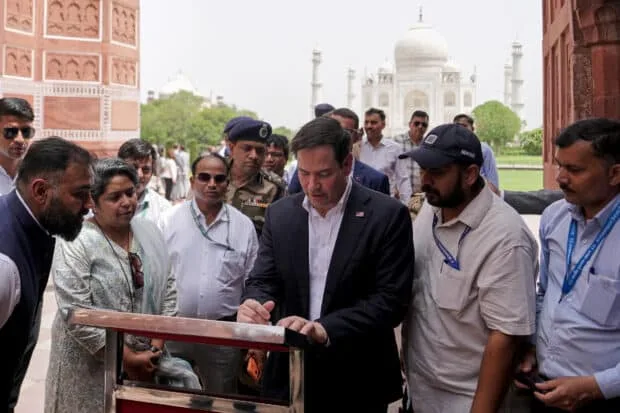
The US Secretary of State, Marco Rubio, is in New Delhi, India, to meet with the foreign ministers of Australia, India, and Japan. They're gathered to revive the so-called Quad security alliance, a move that's viewed with suspicion by China. This meeting is happening just 10 days after US President Donald Trump paid a friendly state visit to China.
It's not just any ordinary meeting. Rubio's decision to meet the Quad foreign ministers is seen as a symbolic step to show the US is committed to the alliance. The US wants to demonstrate its commitment to the Quad alliance. There's a big question mark over how long this alliance will last. The US and its allies have had disagreements over Iran, and there are questions about the US's commitment to the alliance.
They don't see eye-to-eye on Iran, which has created tensions between the US and its allies.
So, who is Marco Rubio? He's the US Secretary of State, appointed by President Donald Trump. Rubio has been a key figure in shaping the US's foreign policy, and his visit to India is seen as a crucial step in strengthening the Quad alliance. Rubio's visit is crucial because it shows the US is committed to the alliance. But what's the Quad alliance all about?
It's a security alliance between the US, Australia, India, and Japan, formed to counter China's growing influence in the region. The alliance aims to promote stability and security in the Indo-Pacific region.
The Quad alliance has been in the works for a while now. It was first proposed in 2007, but it didn't gain much traction until recently. The alliance is seen as a way to promote stability and security in the Indo-Pacific region, which is increasingly being dominated by China. China's growing influence in the region has been a source of concern for many countries. China isn't happy about the Quad alliance.
It sees the alliance as a threat to its growing influence in the region. China won't be happy about the alliance, and it's likely to respond in some way.
'The Quad alliance is a key part of our strategy to promote stability and security in the Indo-Pacific region,' said a US State Department spokesperson.
The Quad alliance is facing some challenges. The US and its allies have had disagreements over Iran, and there are questions about the US's commitment to the alliance. The US's decision to pull out of the Iran nuclear deal has created tensions with its allies. It's unclear how the Quad alliance will navigate these tensions. They're facing challenges, and it's unclear how they'll overcome them.
But what does this mean for the people directly affected by the Quad alliance? For one, it's a sign that the US is committed to promoting stability and security in the region. The Quad alliance is seen as a way to counter China's growing influence, which has been a source of concern for many countries in the region. The alliance is also expected to promote economic cooperation and trade between the member countries. It's expected to have a positive impact on trade and economic cooperation.
The meeting in New Delhi is just the beginning. The Quad alliance is expected to meet again later this year to discuss further cooperation and strategies. The alliance will meet again later this year. The focus is on reviving the alliance and promoting stability in the region. It's a complex issue, and it's unclear how it will all play out.
But one thing is for sure - the Quad alliance is a key part of the US's strategy to promote stability and security in the Indo-Pacific region. The alliance is crucial to the US's strategy.
Key Facts
- The Quad alliance is a security alliance between the US, Australia, India, and Japan.
- The alliance was first proposed in 2007.
- The US Secretary of State, Marco Rubio, is meeting with the foreign ministers of Australia, India, and Japan to revive the alliance.
- The Quad alliance is seen as a way to counter China's growing influence in the region.
- The US and its allies have had disagreements over Iran, and there are questions about the US's commitment to the alliance.
The Quad alliance is a complex issue, and it's unclear how it will all play out. But the alliance is a key part of the US's strategy to promote stability and security in the Indo-Pacific region. The US is committed to reviving the alliance and promoting cooperation between the member countries. With the meeting in New Delhi, it's clear that the US is committed to the alliance. The US won't give up on the alliance easily.
The implications of the Quad alliance are far-reaching. It's a sign that the US is committed to promoting stability and security in the region, and it's a way to counter China's growing influence. The alliance has significant implications. But it's also a complex issue, and it's unclear how it will all play out. The Quad alliance is facing challenges, and it's unclear how it will navigate these challenges. The alliance is facing many challenges, and it's unclear how it will overcome them.
The meeting in New Delhi is just the beginning. The Quad alliance is expected to meet again later this year to discuss further cooperation and strategies. The alliance will meet again later this year to discuss cooperation and strategies. The US is committed to promoting stability and security in the region, and it's clear that the Quad alliance is here to stay. The question is - what's next for the Quad alliance?
The future of the alliance is uncertain, but the US is committed to making it work. For now, the focus is on reviving the alliance and promoting cooperation between the member countries. The US and its allies will work together to make the alliance a success.