

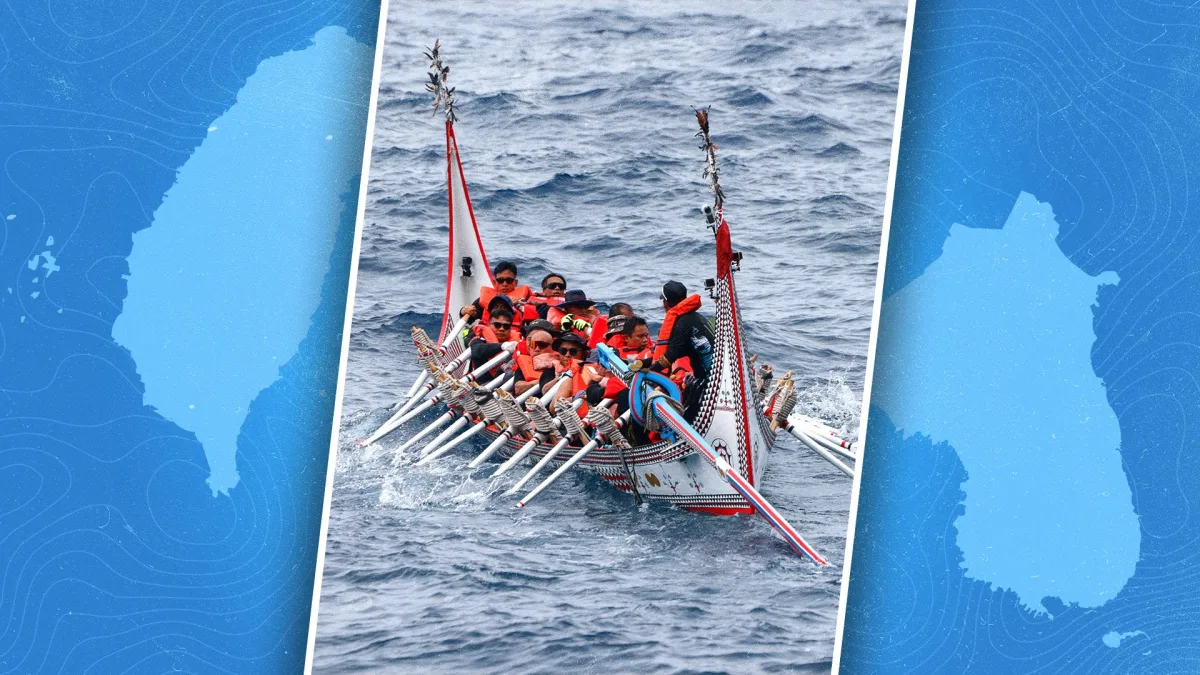
A Tao vessel crossed from Lanyu to Batanes on June 16, 2026, renewing a relationship between the Tao and Ivatan peoples that was interrupted by colonialism.
A relationship between the Tao people of Taiwan's Orchid Island and the Ivatan people of the Philippines' Batanes islands has been rekindled after a historic boat voyage on June 16, 2026. The voyage highlighted the complexities of Austronesian connections and the importance of preserving cultural relationships.
The Tao people have a rich history of trade, marriage, and conflict with the Ivatan, as told through stories and memories passed down through generations. These stories speak of friendship between Tao and Ivatan men, and of quarrels that ended visits across the Bashi Channel. The languages of the two groups remain more than 80 percent mutually intelligible, and their elders continue to recognize kin across the water.
However, this relationship was interrupted by colonialism, which turned corridors into borders. Batanes came under Spanish rule, while Orchid Island was pulled into Qing, Japanese, and later Republic of China (Taiwan) administrations. The Bashi Channel, once a route, became a line between states, enforced by empires and the paperwork of sovereignty.
The June 2026 voyage was not a return to an abstract Austronesian past, but rather a renewal of Tao–Ivatan relations. It serves as a reminder that our histories are not fixed or frozen in time, but rather dynamic and lived through the experiences of our communities.
Philippine media's emphasis on the term 'Austronesian connection' can sometimes reduce named peoples to a model, rather than recognizing their distinct cultures and histories. Taiwanese media, on the other hand, focused on ancestral sea routes, shared heritage, and maritime exchange, highlighting the importance of relationships and cultural exchange.
This story is particularly relevant in Taichung's Sqoyaw, Heping District, where we are currently collaborating with the Tayal community to uncover their histories. Like the Tao and Ivatan, the Tayal were separated from their past by colonial and state systems, which made their histories harder to reach.
In Sqoyaw, our archaeological and ethnographic collaboration aims to work against the erasure of Tayal memory and history. We are uncovering multiple occupations, including terraces pointing to long-term cultivation and slope management, and piled stone structures indicating former house areas or retaining walls.
By recognizing the distinct cultures and histories of our communities, we can work towards a more nuanced understanding of our shared past and promote cultural exchange and understanding.
Key Facts
- The Tao vessel crossed from Lanyu to Batanes on June 16, 2026.
- The languages of the Tao and Ivatan remain more than 80 percent mutually intelligible.
- The Bashi Channel, once a route, became a line between states during colonialism.
- The Tayal people of Taichung's Sqoyaw were separated from their past by colonial and state systems.
- Our archaeological and ethnographic collaboration in Sqoyaw aims to uncover Tayal memory and history.