

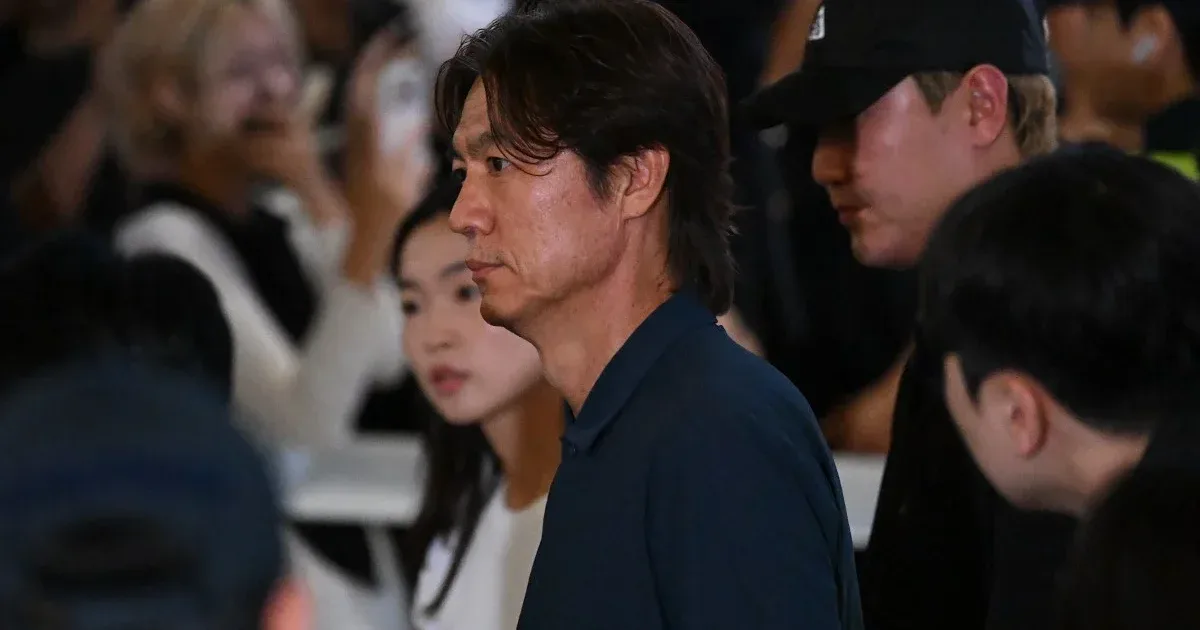
The single sharpest fact is that South Korean football fans greeted the returning World Cup squad with a hostile reception, targeting coach Hong with boos and chants.
Hong, a former national team defender, resigned on Sunday after South Korea finished the group stage with one win and two losses, dashing hopes of a deep run led by captain Son Heung-min. The Round of 32 had appeared within reach until a shock 1-0 defeat to lower-ranked South Africa in their final group match ended their campaign.
Fans booed and chanted 'Hong out!' as he made his way out of the airport, but applauded the players who followed behind him. 'Thanks for all your hard work!' one fan shouted as the players emerged, in stark contrast to the jeers aimed at Hong. Police cordoned off a route extending from inside the terminal to the waiting bus outside, as several dozen protesters gathered nearby.
The protesters held banners reading 'South Korean football is dead' and 'Hong, you must quit.' Hong's post-match admission that he was struggling to understand what had gone wrong did little to stem the criticism.
Hong's decision to leave Son on the bench in the first half for the decisive match against South Africa baffled and angered many supporters. 'I was very shocked that he benched Son against South Africa,' Song Min-kyung, a 20-year-old university student, told AFP at the airport. 'I think that was the beginning of everything that went wrong at this World Cup.'
Questions had already lingered over the Korea Football Association's 2024 decision to appoint Hong to be in charge, with critics arguing the selection process lacked transparency even before the World Cup campaign unravelled.
Hong, 61, has a long tenure in South Korean football. He was appointed as the national team coach in 2000 and has been at the helm since then except for two short stints.
Key Facts
- The 2026 World Cup was the first time South Korea failed to qualify for the knockout stage since 1990.
- The team finished the group stage with one win and two losses.
- Hong's decision to leave Son on the bench in the first half for the decisive match against South Africa was widely criticized.
- The protesters at the airport held banners reading 'South Korean football is dead' and 'Hong, you must quit.'
- Hong resigned on Sunday after South Korea's first-round exit.
Hong walked silently out of the arrival gate at Incheon International Airport under heavy media scrutiny, declining to answer reporters' questions. Fans, however, were not so quiet. 'We ruined this festival that only comes once every four years,' said one fan, Kim Gi-mo, who came to the airport to voice his frustration. 'I came here to see the person responsible for that,' he added.
The Korea Football Association did not organize an official welcome ceremony for the returning squad. This is not the first hostile reception for Hong. In 2014, angry supporters threw Korean sweets at the team after they returned from Brazil, where they were eliminated in the group stage during Hong's first spell as national team coach.
Hong's post-match admission that he was struggling to understand what had gone wrong did little to stem the criticism. And his Sunday resignation did little to satisfy Kim, who questioned the sincerity of Hong's decision.
'I question whether his resignation was sincere, given his attitude when he made the announcement,' Kim told AFP.
South Korean media had labelled the 2026 squad a 'golden generation', featuring internationally established players such as former Tottenham Hotspur captain Son, Bayern Munich defender Kim Min-jae and Paris Saint-Germain midfielder Lee Kang-in. Expectations were high, with many fans believing the team could reach the Round of 16.
The captain turns 34 next month. He is expected to retire after the World Cup.
A South African newspaper, however, wrote that South Korea's failure to reach the knockout stage was not unique. It stated only 12 teams from Africa had qualified for the World Cup, and South Korea was one of the 12 from Asia.
The article concluded that South Korea's failure to reach the knockout stage should be placed into perspective.