

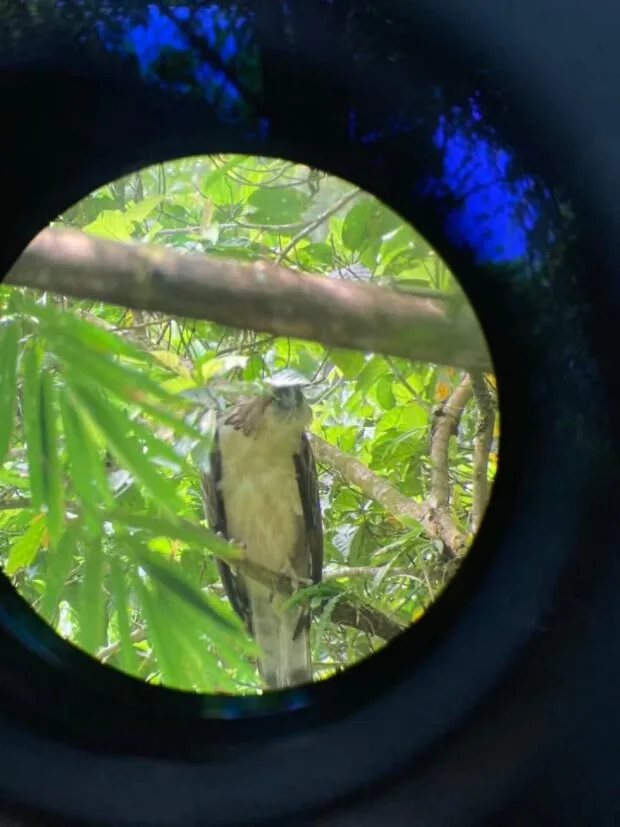
Philippine Eagle Lakpue Sights in Leyte's Forests for Second Time
A free-living Philippine eagle behaves like a wild eagle when he's not staying close to houses or roads and is instead using the forest interior, as seen with Lakpue, a 23-year-old male Philippine eagle who's been spotted in Leyte's forests for the second time since its release from captivity last September. This tells us that he is indeed behaving like a wild eagle." — Dr. Jayson Ibañez, PEF director for operations.
Lakpue has been spotted in Leyte's forests for the second time since its release from captivity last September. This marks a significant milestone for the reintroduction program, which aims to release up to 18 eagles into Leyte's forests over the next five years.
According to the Philippine Eagle Foundation (PEF), Lakpue was taken from its nest in July 2003 at Mt. Busa in Maitum, Sarangani province, and later brought under the care of the PEF, which leads the repopulation effort. The eagle was released on September 30, 2025, in Barangay Kagbana, Burauen, after six months of acclimatization.
Lakpue has been actively hunting within the Marabong watershed, its preferred hunting ground, and frequently roams the Anonang-Lobi mountain range. The eagle's current activity range spans about 613 hectares, according to PEF biologists and field technicians. Lakpue has been living in the wild for eight months and has been using its hunting skills within the Marabong watershed.
Dr. Jayson Ibañez, PEF director for operations, said Lakpue's calm behavior during the sighting suggests stability in its new environment. The eagle was preening and gliding, showing an indication of his ability to adapt to his surroundings. Ibañez also noted that Lakpue's presence in the Marabong watershed and along tributaries such as the Pangalaw-an River indicates healthy adaptation.
Lakpue's successful release reflects how far the reintroduction efforts have evolved through years of learning, adaptation, and collaboration. The reintroduction program is a testament to the strong collaboration among forest guards, field technicians, DENR personnel, police partners, local government units, and local communities whose commitment helped make Lakpue's release possible, according to Ibañez.
PEF aims to release up to 18 eagles in Leyte over the next five years, mostly sourced from Mindanao and possibly Samar. Villagers in Barangay Kagbana recalled seeing an eagle pair in 2007, last in 2012 before Yolanda, and a lone sighting in 2017, believing the population was wiped out by the typhoon. However, the recent sightings of Lakpue indicate that the population may not be as wiped out as believed.
This development is seen as a positive sign for the reintroduction program, which aims to rebuild the population of the critically endangered species in the wild. Lakpue's presence in the Marabong watershed and along tributaries such as the Pangalaw-an River indicates healthy adaptation, according to Dr. Ibañez. The PEF has been working tirelessly to rebuild the population of the Philippine eagle in the wild, and Lakpue's sighting is a significant step towards achieving this goal.
The PEF has been conducting research and conservation efforts for the Philippine eagle since the 1980s. In 2024, the organization launched the Leyte reintroduction program to rebuild the population of the critically endangered species in the wild.
Key Facts
- Lakpue, a 23-year-old male Philippine eagle, has been spotted in Leyte's forests for the second time.
- The eagle has been living in the wild for eight months and has been actively hunting within the Marabong watershed.
- Lakpue's current activity range spans about 613 hectares.
- The Philippine Eagle Foundation aims to release up to 18 eagles in Leyte over the next five years.
- The reintroduction program aims to rebuild the population of the critically endangered species in the wild.
- The PEF has been conducting research and conservation efforts for the Philippine eagle since the 1980s.