

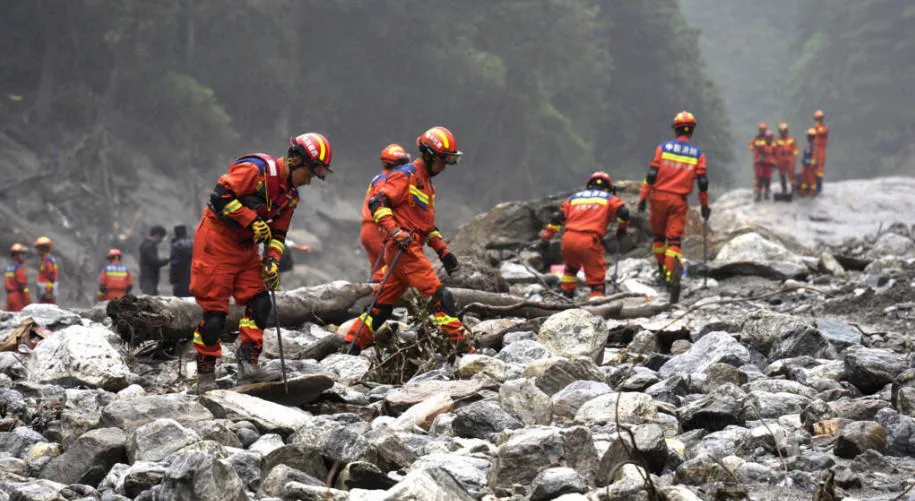
Rescuers in Nepal and China are in a desperate race against time, digging through leg-sucking mud and battling rising floodwaters to find thousands of people missing after a massive wall of water and debris swept through the Himalayas on Wednesday. The latest figures show a staggering 3,044 people unaccounted for, with the confirmed death toll at 750 and reports suggesting some bodies may have been carried as far downstream as India.
The disaster, which struck the China-Nepal border, was triggered by a colossal glacial collapse. The US Geological Survey confirmed that a glacier on the southern slope of Lirung Peak in Nepal fractured, sending an ice-rock avalanche tumbling down. This torrent of ice and rock formed a massive debris flow that travelled more than 20 kilometres before slamming into Gyirong Port in China's Tibet Autonomous Region.
In Nepal, army troops and engineers are focused on a tunnel at the Trishuli 3A hydroelectric site, where workers are believed to be trapped. They've managed to insert a pipe and are sending air into the passage, according to Nepali Home Minister Sudan Gurung. However, relentless rain and surging river levels are making these rescue attempts incredibly difficult. Disaster authorities are urging teams to proceed with extreme caution.
This region is a hub for major energy infrastructure projects, and tragically, 933 hydropower workers are among those listed as missing in Nepal. The scale of the human tragedy is immense, with survivors facing the agonizing wait to learn the fate of their loved ones. In Nepal’s Nuwakot district, a survivor named Buddhi Ram Dangol sadly reported, “All the settlements near the river were swept away. There is nothing left.”
At an army base in Bidur, serving as a makeshift rescue command centre, desperate relatives crowded around lists of rescued individuals. Kalka Sharda was among them, scanning the names with a heavy heart, searching for her son.
Beyond the local communities, the disaster has impacted a diverse group of people. Nepal’s disaster authority has reported 589 foreigners missing, including trekkers and Hindu pilgrims en route to Tibet’s sacred Mount Kailash. The Isha Foundation, an organisation led by Indian spiritual guru Sadhguru, confirmed in an Instagram post that 80 of its members were on a group trip in the affected area. Sadly, there are “no encouraging indications of survivors at the immigration office area.”
International aid has begun to pour in. The United States and Canada have pledged $3.6 million each in humanitarian assistance to Nepal. The UK has offered $6.8 million, while the UN has released $2.5 million in emergency funding. The European Union committed $2.3 million, and the International Federation of Red Cross and Red Crescent Societies (IFRC) has allocated over $1 million. It has also launched an appeal for $31 million.
Nepal's economy, already under strain, faces a monumental reconstruction bill estimated to run into billions of dollars. Foreign Minister Shisir Khanal has appealed for specialised help. This includes heavy-lift drones and advanced technology to locate trapped individuals. He also requested forensic testing kits for body identification and freezer units for storage, noting that bodies submerged in water decompose much faster.
The deluge also created massive new lakes, posing a further risk of flooding. Chinese and Nepali foreign ministers discussed sharing satellite and hydrological data. In Tibet, rescue operations in the hardest-hit area of Gyirong were temporarily halted due to the danger from a newly formed lake. However, Chinese state broadcaster CCTV reported late Saturday that the lake was “discharging naturally” and had been “essentially drained,” according to China’s ministry of water resources. Xinhua reported that 2,141 rescuers were deployed near the Gyirong site.
Across the border, China's state broadcaster CCTV reported 16 deaths and 546 people missing in Tibet. Authorities there have evacuated 555 stranded tourists and 499 Chinese residents. In India, officials recovered seven bodies from rivers flowing from Nepal, believed to be victims of the flood.
The UN climate chief, Simon Steill, issued a statement calling the event a “devastating reminder of how fragile these mountain environments can be.”