

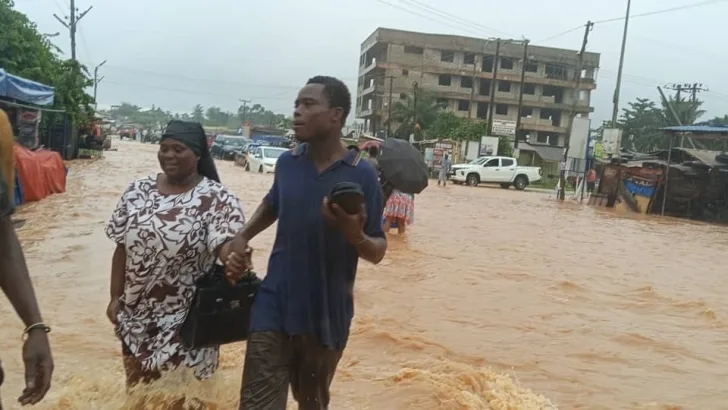
A 20-month-old toddler lost his life and three women sustained injuries in a rain-induced landslide in Cape Coast on Friday. The incident occurred after hours of relentless rainfall, which also caused widespread flooding across the city.
The landslide occurred in Tantri, Cape Coast, at about 4:45 p.m. on Friday, when a section of a nearby hillside gave way, sending debris crashing onto three structures situated below the slope. The victims, Elizabeth Kyerede, 43, Maame Badua, 25, Ella, 17, and little Hanson Mensah, aged 20 months, were trapped beneath the rubble and had to be rescued by residents.
They were taken to the Ewim Polyclinic for treatment, but Hanson Mensah was pronounced dead on arrival. Ella, who suffered a severe head injury, was later transferred to the Cape Coast Teaching Hospital for further medical attention.
The family head, Richard Joachim, speaking to Graphic Online, described the incident as unprecedented in the area, noting that residents had never experienced a mudslide of such magnitude before. According to him, the four victims had gathered in one room during the heavy rains when the hillside suddenly collapsed onto the building.
He explained that other relatives occupying nearby rooms were alerted by a loud crashing sound and rushed outside, only to discover that portions of the structure had been buried under mud and debris. Residents immediately launched a rescue effort and transported the victims to the health facility.
Mr. Joachim indicated that although three buildings were affected, the remaining two structures fortunately had no occupants at the time of the incident. Personnel from the Ghana National Fire Service later arrived at the scene to assist with emergency response efforts, while the Cape Coast Metropolitan Chief Executive, George Justice Arthur, visited the bereaved family to offer his sympathies.
The heavy rains that caused the landslide also caused widespread flooding across the city, displacing many residents, stranding commuters, and causing severe traffic congestion in parts of the metropolis. Overflowing drains and choked waterways forced large volumes of water into residential areas and business premises, worsening the impact of the rains.
Portions of the University of Cape Coast campus were also flooded, with the Casford area being the worst-hit. The situation was further aggravated by plastic waste and other debris carried by the floodwaters, highlighting growing concerns over poor waste disposal and its contribution to urban flooding.
'This is an unprecedented situation in the area,' Mr. Joachim said. 'We've never experienced a mudslide of this magnitude before.'
The heavy rains that battered Cape Coast on Friday, June 19, left several parts of the metropolis flooded, disrupting transportation, business operations, and academic activities, while raising fresh concerns about the city's recurring flood challenges.
The rains, which began at about 7:00 a.m., persisted for several hours, inundating roads, homes, and public spaces across the metropolis and making movement difficult for both motorists and pedestrians. Among the hardest-hit areas were the Electricity Company of Ghana (ECG) enclave, the Cape Coast Sports Stadium area, sections of the road leading to the Cape Coast Teaching Hospital (CTH), the Ghana National College vicinity, and the University of Cape Coast.
Floodwaters submerged portions of major roads, causing traffic congestion and forcing some drivers to seek alternative routes while others struggled to navigate the waterlogged streets. At the University of Cape Coast, sections of the campus, including the area behind the Sandwich Lecture Block, Science Roundabout, Zenith Bank area, Ayensu, parts of Sasakawa, were affected by the flooding.
The situation prompted university authorities to issue a safety advisory urging students and staff to remain indoors where possible and avoid unnecessary movement until conditions improved. The advisory followed concerns over the rising floodwaters and the dangers associated with crossing submerged roads and walkways.
Residents and commuters described the situation as one of the most challenging rainstorms experienced in recent months, with some pedestrians wading through floodwaters to access workplaces, schools, and business centers.
Along the Cape Coast Teaching Hospital stretch, motorists experienced significant delays as portions of the road became submerged, slowing traffic and creating long queues during peak hours. The Cape Coast Stadium enclave and surrounding communities also recorded substantial flooding, with stagnant water occupying sections of roads and open spaces long after the rains had subsided.
Businesses were not spared. Some traders delayed opening their shops while others reported reduced patronage as customers struggled to move around the city. Residents attributed the persistent flooding to choked drains, poor drainage infrastructure, and uncontrolled development in some parts of the metropolis.
They called on city authorities to intensify efforts to address the recurring flood challenges and improve waste management in the city.
Key Facts
- 20-month-old toddler, Hanson Mensah, died in the landslide.
- Three women, including 17-year-old Ella, were injured and taken to the hospital.
- The landslide occurred in Tantri, Cape Coast, after hours of relentless rainfall.
- The rains also caused widespread flooding across the city, displacing many residents and stranding commuters.
- The University of Cape Coast campus was also flooded, with the Casford area being the worst-hit.
- Residents attributed the persistent flooding to choked drains, poor drainage infrastructure, and uncontrolled development in some parts of the metropolis.