

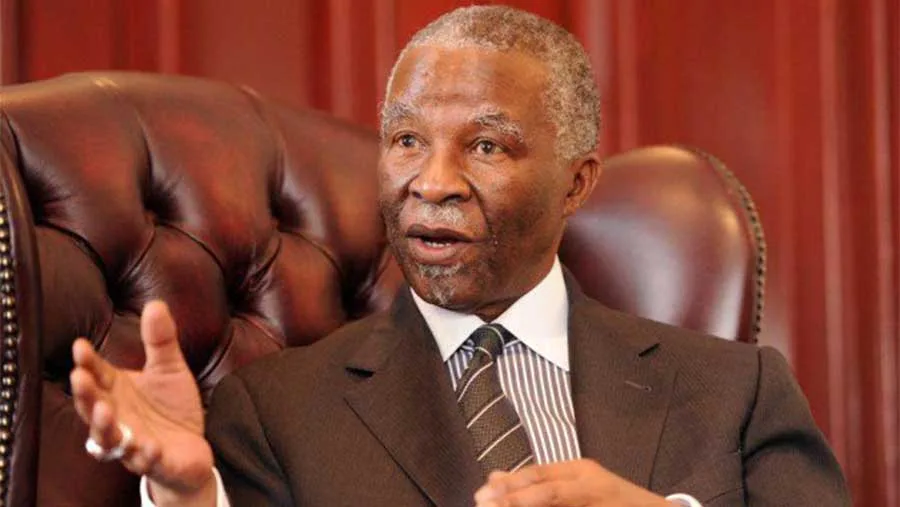
Former South African President Thabo Mbeki has credited Nigeria's democratic stability over the last 27 years to one man: General Abdulsalami Abubakar.
Mbeki said Abubakar's short time as head of state between 1998 and 1999 did more than just end military rule — it set up the structures that have kept civilian governments in power and made peaceful handovers possible.
He spoke on Saturday at the public presentation of three books honouring Abubakar as part of the elder statesman's 84th birthday celebrations. Mbeki couldn't attend in person because of a family bereavement, so he delivered a keynote address.
"His tenure is significant not only for its brevity but also for the lasting impact it created in the history of democratic transition in Africa," Mbeki said.
Abubakar became head of state in June 1998 after the sudden death of General Sani Abacha. Nigeria was under international pressure and facing deep political crisis. Instead of holding on to power, Abubakar announced a short transition programme that led to civilian rule in May 1999.
Mbeki said Abubakar resisted the temptation to stay in power. "He placed the interests of his country first and overcame the temptation and allure of power," the former South African leader stated.
Abubakar's administration set up the constitutional and electoral reforms that produced the 1999 Constitution and created the Independent National Electoral Commission (INEC). Those institutions still form the backbone of Nigeria's Fourth Republic.
Mbeki noted that Abubakar's work went beyond Nigeria. He has been one of Africa's most respected mediators, involved in peace negotiations and election observation in Liberia, Sierra Leone, Sudan, South Sudan, Niger and The Gambia.
Mbeki said he worked closely with Abubakar under the African Union on peace efforts in Sudan and South Sudan. "Several countries and international bodies sought his wisdom and experience in resolving conflicts and strengthening democratic institutions," he said.
The former South African president said Africa's democratic future depends on leaders willing to follow Abubakar's example — strengthening institutions, respecting constitutional processes and putting national interest above personal ambition.
He acknowledged that many African countries still struggle with electoral disputes, governance problems and violent conflicts. But he pointed to South Africa, Ghana, Senegal, Liberia and Sierra Leone as examples of democratic progress.
Mbeki stressed that democracy, peace and security are essential for Africa's development. He said sustainable progress can't happen without accountable governance and strong institutions.
"The duty of advancing democratic governance and building peace and security in Africa must be a generational endeavour. We must educate and inspire our young people to embrace leadership founded on service and integrity," Mbeki said.