

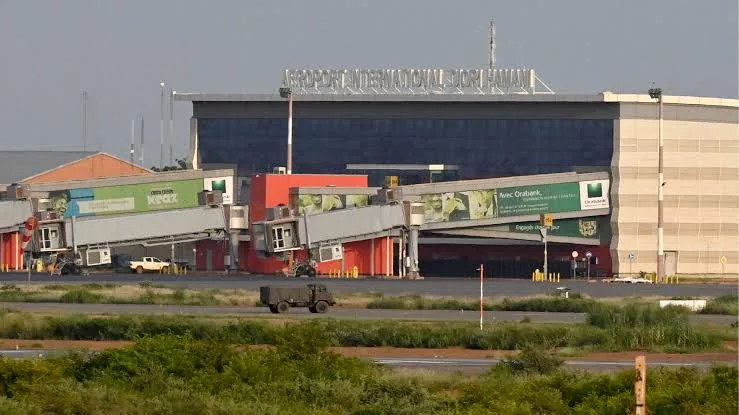
Gunfire rang out for hours at the airport in Niger's capital, Niamey, early on Thursday — just five months after jihadists launched a major attack on the same sensitive site.
Residents said the shooting started around 6 a.m. local time (0500 GMT) at the airport entrance, where a security checkpoint stands. The firing went on for hours before stopping by mid-morning.
“I heard the first shots around 6 o’clock. The shooting was coming from the airport entrance,” one resident told AFP by phone.
Another resident said assailants had moved into the Route Tchanga neighbourhood near the airport. Locals there were trying to chase them away with sticks and machetes.
“No more shots can be heard in the airport; the situation is under control,” a taxi-motorbike driver said. “The military went down into certain neighbourhoods around the airport to sweep the area; they're receiving help from residents who are hunting down bandits with sticks and machetes.”
One resident who was due to travel said soldiers told him it was impossible to take the plane.
A heavy military presence remained at the airport after the shooting stopped.
The January attack that changed everything
In January, the Diori Hamani international airport and an adjoining military drone base were targeted in an attack claimed by the Islamic State in the Sahel (EIS). Nigerien forces and their Russian allies repelled the strike. Twenty assailants were killed and four soldiers wounded.
The attack was a shock because violence had mostly been confined to other parts of the vast Sahel country, not the capital.
Junta leader Abdourahamane Tiani, who seized power in a July 2023 coup, admitted on state television that “a flaw in the system” had “enabled the attack.” Its aim, he said, “was to destroy all of the air capabilities” of the army.
The uranium cargo and
the demolitions
The airport is highly sensitive. Between December and January, a large cargo of concentrated uranium was blocked at the site while waiting for export. No movement of that cargo has been identified since.
In recent weeks, authorities began tearing down thousands of illegally built homes next to the airport, saying the shanty towns had been infiltrated by jihadists. The demolitions affected 26,000 people living in four neighbourhoods that occupy nearly a quarter of the airport area.
The airport perimeter fence has been extended, and more than 350 security cameras installed inside and outside the perimeter.
Niger's long struggle with jihadist violence
Niger and its military-ruled neighbours — Burkina Faso and Mali — have faced a decade of violence from jihadist groups linked to Islamic State and Al-Qaeda.
Tiani came to power after toppling democratically elected President Mohamed Bazoum. He's struggled to stop deadly attacks.
In April, the Al-Qaeda-linked Group for the Support of Islam and Muslims (JNIM) and the Tuareg-dominated Azawad Liberation Front (FLA) carried out an unprecedented assault against the ruling junta in neighbouring Mali.
Niger has moved away from former colonial power France and sought support from other partners, including Iran, Turkey and Russia.