

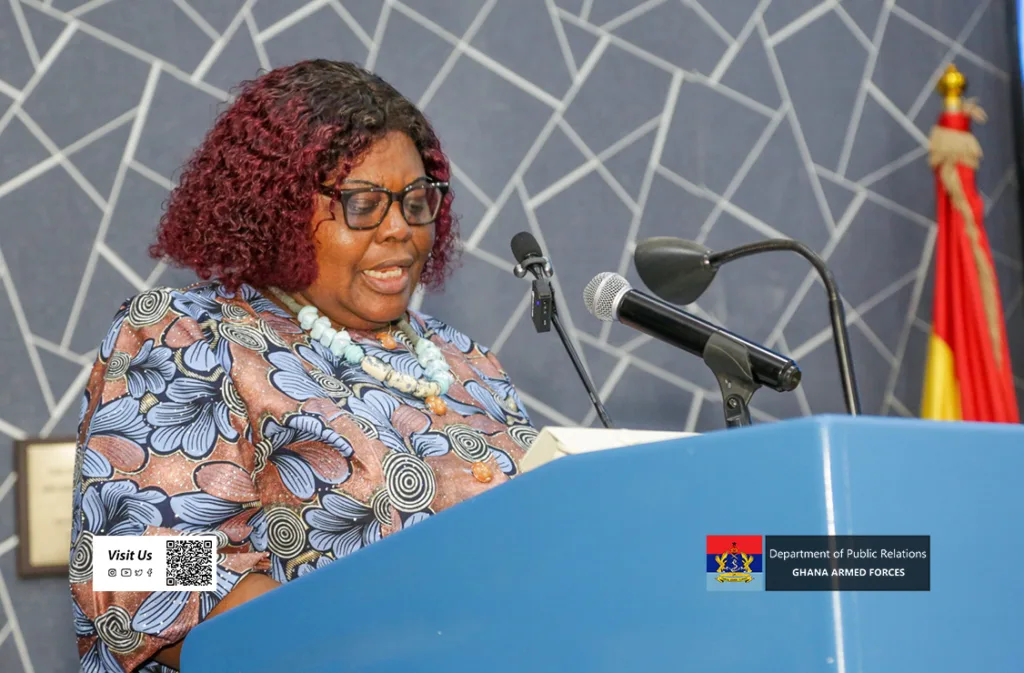
"At this rate, we may soon see food targeted not on supply lines but in the fields, and only because they may provide sustenance for the feeding of troops to enable troop deployment in war," warned Justice Henrietta Mensa-Bonsu, former Judge of the International Criminal Court.
And speaking at the Kofi Annan International Peacekeeping Training Centre (KAIPTC) 15th Graduation Ceremony for the Joint Master’s Course 2026 at Schroder Hall in Accra on Friday, Justice Professor Mensa-Bonsu, urged graduating peace and security scholars to apply their knowledge to help address the complex conflicts confronting nations.
The former Supreme Court Justice noted that international affairs were currently experiencing significant uncertainty, with traditional assumptions about global security being challenged. She said that after the end of the Cold War in the early 1990s, many scholars and policymakers anticipated a more peaceful world due to the decline of bipolar rivalry and proxy conflicts.
However, she argued that those expectations had not materialised, as renewed geopolitical competition, the emergence of new powers and shifting economic alliances had altered the global order. "Unipolarity quickly revealed itself as illusory in the face of Russia’s renewed assertiveness, particularly in Eastern Europe, Central Asia and Africa, as well as the rise of new powers and economic blocs challenging established hegemonic arrangements," she stated.
Addressing the graduates as scholars of peace and security, Justice Mensa-Bonsu said proxy wars and internal conflicts had remained major features of international relations despite a decline in traditional interstate wars. She pointed to conflicts in the former Yugoslavia, Darfur, Liberia, Sierra Leone and South Sudan as examples of crises that exposed weaknesses in the international system's ability to prevent mass violence and protect civilians.
She acknowledged the contribution of peacekeeping operations, particularly the United Nations Mission in Liberia (UNMIL), which she said helped restore peace in Liberia after years of conflict. "At least I can say with pride that UNMIL brought peace to Liberia," she said. However, she noted that other interventions had achieved only temporary stability, citing Darfur as an example where peace collapsed after international engagement weakened.
She said the failure of the international community to prevent the 1994 genocide in Rwanda and the fall of Srebrenica demonstrated serious shortcomings in global responses to atrocities. "The continuing crisis in DR Congo still remains a blot on the world’s conscience, and coupled with a sense of powerlessness in the face of unspeakable atrocities in Sudan, there is little room for optimism or complacency," she added.
Justice Mensa-Bonsu warned that modern warfare was increasingly being shaped by technological advances, including drones and unmanned weapons systems, which were changing the relationship between combatants, battlefields and decision-making.
So, she expressed concern that civilians, who are protected under international humanitarian law, were increasingly becoming vulnerable as the definition of legitimate military targets expanded.
She cautioned that economic assets, including energy infrastructure, were increasingly being viewed as strategic targets because of their role in financing wars. "At this rate, we may soon see food targeted not on supply lines but in the fields, and only because they may provide sustenance for the feeding of troops to enable troop deployment in war," she warned.
She said the development of autonomous weapons raised difficult questions about human control over warfare. "The current worry is whether these technologies will always rely on human intellect or develop on trajectories of their own," she said.
According to her, the responsibility of the next generation of peace and security professionals would be to ensure that technological advancement did not undermine humanity’s ability to regulate conflict.
The Sahel region was described by Justice Mensa-Bonsu as one of the clearest examples of the changing nature of modern conflict, arguing that the situation could not be reduced to simple narratives of religious or cultural confrontation.
She noted that armed groups often pursued strategic alliances based on convenience, including cooperation between groups with previously opposing interests. And she highlighted the dangers of extremism, citing the rise of violent groups in the region as a major concern.
At the end of her speech, Justice Mensa-Bonsu called on the graduating scholars to apply their knowledge to help address the complex conflicts confronting nations.