

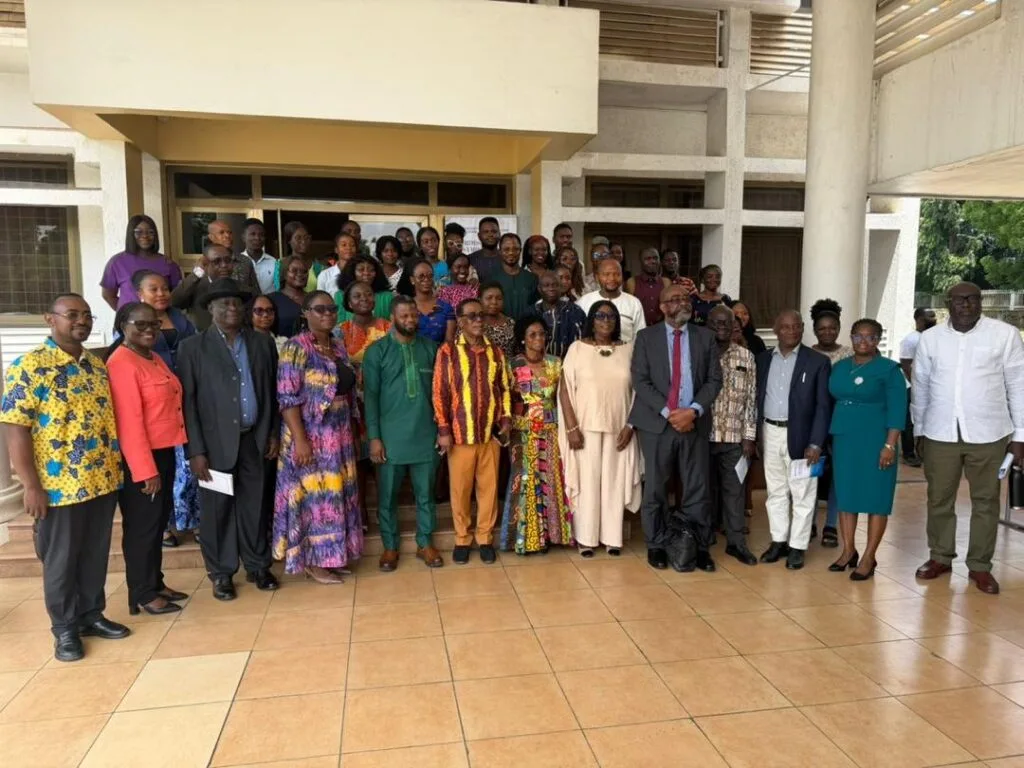
Professor Joseph Awetori Yaro, Provost of the College of Humanities, has made a passionate plea for Ghana to incorporate indigenous languages into its governance structure, arguing that it is crucial for democratic participation. Speaking at the GAAS Main Auditorium during the interdisciplinary symposium on "Access to Justice and Democratic Participation: The Role of Language," he noted that language is not a neutral instrument, but a structure of power that determines who can access rights and who is excluded from them. He highlighted that English, the official language of state administration, is only understood by about 20% to 25% of Ghanaians, which leaves a significant majority unable to fully engage with courts, parliament, and other key democratic institutions.
The symposium, which brought together scholars from law, linguistics, political science, anthropology, and media studies, underscored the growing concern over the role of language in shaping access to justice and democratic participation in Ghana. Professor Yaro pointed out that civic education delivery is a key concern, with the National Commission for Civic Education (NCCE) often relying heavily on English, which limits effective outreach to rural communities and informal sector workers. He emphasized that civic education should be delivered in languages that citizens understand, as indigenous languages such as Twi, Ga, Ewe, and Dagbani are essential to grassroots participation.
Indigenous languages play a vital role in Ghana's governance structure, particularly through radio, community engagement, and digital platforms. However, participants at the symposium warned that formal state communication has not kept pace with this linguistic reality. Professor Yaro cautioned that court interpreters play a decisive role in shaping legal meaning, especially in tonal languages where subtle variations can alter meaning significantly. He warned that weak regulation and limited professionalisation of interpretation services pose risks to fairness in judicial outcomes, particularly when testimonies are filtered through translation.
Professor Yaro called for a series of reforms, including expanded use of indigenous languages in civic education, professional certification of court interpreters, integration of local languages into education systems, stronger support for language institutions, and investment in technology that better reflects African linguistic realities. He stressed that language should be understood not as a barrier but as the foundation of democratic citizenship. "Without inclusive communication," he said, "democracy remains incomplete." The symposium aimed to address the significant language barrier that affects 75% of Ghanaians and hindered their ability to fully participate in democratic processes.
The use of indigenous languages in governance can enhance democratic participation and reduce inequality. It can also empower communities that have historically been marginalized by language barriers. However, the Ghanaian government has not adequately addressed this issue, and language remains a significant obstacle to inclusive governance. By incorporating indigenous languages into governance, Ghana can move closer to achieving true democratic participation and equality for all citizens.
In his speech, Professor Awetori emphasized the importance of language in governance, saying: ">Language is not a neutral instrument, it determines who can claim rights, who is heard, and whose voice is recognized in the public sphere.<"
Key Facts:
- Only 20% to 25% of Ghanaians are proficient in English.
- Indigenous languages such as Twi, Ga, Ewe, and Dagbani are essential to grassroots participation.
- The National Commission for Civic Education (NCCE) often relies heavily on English, limiting effective outreach to rural communities and informal sector workers.
- Court interpreters play a decisive role in shaping legal meaning, especially in tonal languages.
- Weak regulation and limited professionalisation of interpretation services pose risks to fairness in judicial outcomes.
In a bid to address the significant language barrier that affects 75% of Ghanaians and hindered their ability to fully participate in democratic processes, Professor Yaro calls for the use of indigenous languages in governance to make democracy more inclusive. Ghana's failure to address this issue has led to inequality and marginalized communities that have historically been excluded from democratic processes.
The use of indigenous languages in governance can empower communities that have been historically marginalized by language barriers. It can also enhance democratic participation and reduce inequality. By incorporating indigenous languages into governance, Ghana can move closer to achieving true democratic participation and equality for all citizens.