

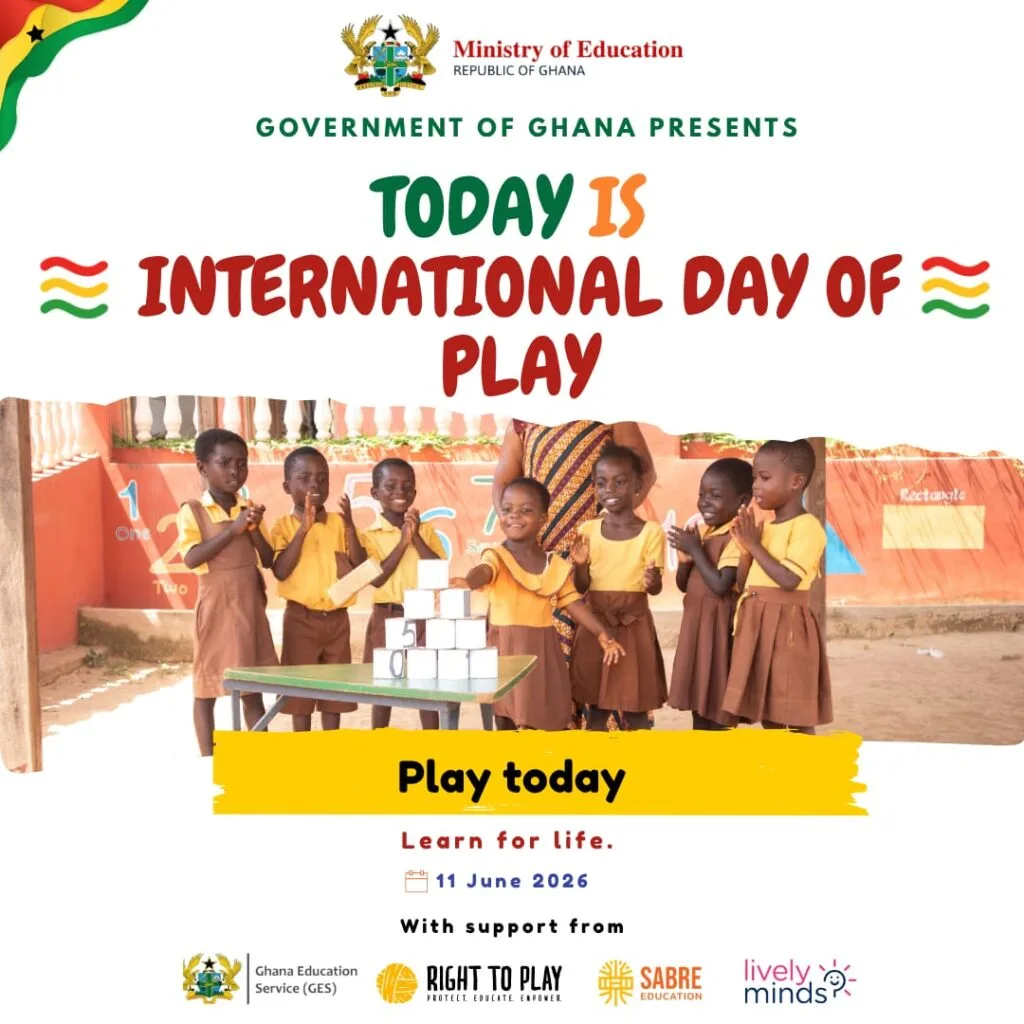
The Ghanaian Ministry of Education is reaffirming its commitment to strengthening early childhood education through play-based learning. The programme aims to improve academic performance and overall child development by allowing children to learn through exploration, storytelling, games, movement, creativity, and interaction. According to the Ministry, Ghana is currently scaling up Play-Based Learning (PBL) across all public kindergartens nationwide to improve teaching and learning outcomes at the early childhood level.
The Ministry has partnered with development partners Sabre Education, Lively Minds, and Right to Play, who have expressed their commitment to the cause by highlighting that play is not separate from learning, but a core part of how young children develop foundational skills in their early years.
So, what exactly is Play-Based Learning? It's an approach that allows children to learn through exploration, storytelling, games, movement, creativity, and interaction, whereas traditional methods rely on rote memorization. Research consistently shows that play-based approaches improve both academic performance and overall child development, while also building confidence, curiosity, resilience, and teamwork skills.
But how exactly does it work? Research consistently shows that play-based approaches improve both academic performance and overall child development, while also building confidence, curiosity, resilience, and teamwork skills. The key is creating an environment where children are free to explore and learn without being confined by rigid structures.
The initiative is expected to ensure that all children, regardless of location, have access to engaging and inclusive learning environments. To achieve this, Ghana is training approximately 30,000 kindergarten teachers to deliver play-based lessons in line with the national curriculum. These teachers will be equipped with the skills and knowledge to create engaging learning environments that put children at the forefront of their educational journey.
And that's not all – the Ministry is also expanding a parental engagement model aimed at strengthening learning at home. Officials say that parents and caregivers play a crucial role in early learning through simple daily activities such as storytelling, singing, counting objects, drawing, and conversation. These activities help improve children’s language development, confidence, and school readiness, and reinforce classroom learning in a practical and accessible way.
But how can the community get involved? Communities were encouraged to support schools with low-cost or no-cost learning materials such as bottle tops, cardboard, fabric, sticks, clay, containers, and simple furniture. This can be used to enhance interactive learning in classrooms. The Ministry has called on parents and communities to support schools by actively engaging with teachers, attending PTA meetings, and reinforcing play-based learning at home.
As part of the initiative, the Ministry is also expanding a parental engagement model aimed at strengthening learning at home. This model aims to improve children’s language development, confidence, and school readiness, and reinforce classroom learning in a practical and accessible way. By working together, we can ensure that every child in Ghana receives a strong educational foundation through joyful, inclusive, and play-based learning.
The Ministry has reaffirmed its commitment to ensuring that every child in Ghana receives a strong educational foundation through joyful, inclusive, and play-based learning. Ghana joins global partners in celebrating efforts to embed play at the heart of early childhood education and to give every child the strongest possible start in life.
Key Facts
- The Ministry is training approximately 30,000 kindergarten teachers to deliver play-based lessons in line with the national curriculum.
- The Ministry is expanding a parental engagement model aimed at strengthening learning at home.
- Communities were encouraged to support schools with low-cost or no-cost learning materials such as bottle tops, cardboard, fabric, sticks, clay, containers, and simple furniture.
- The Ministry has reaffirmed its commitment to ensuring that every child in Ghana receives a strong educational foundation through joyful, inclusive, and play-based learning.
- Ghana joins global partners in celebrating efforts to embed play at the heart of early childhood education and to give every child the strongest possible start in life.