

Project Details
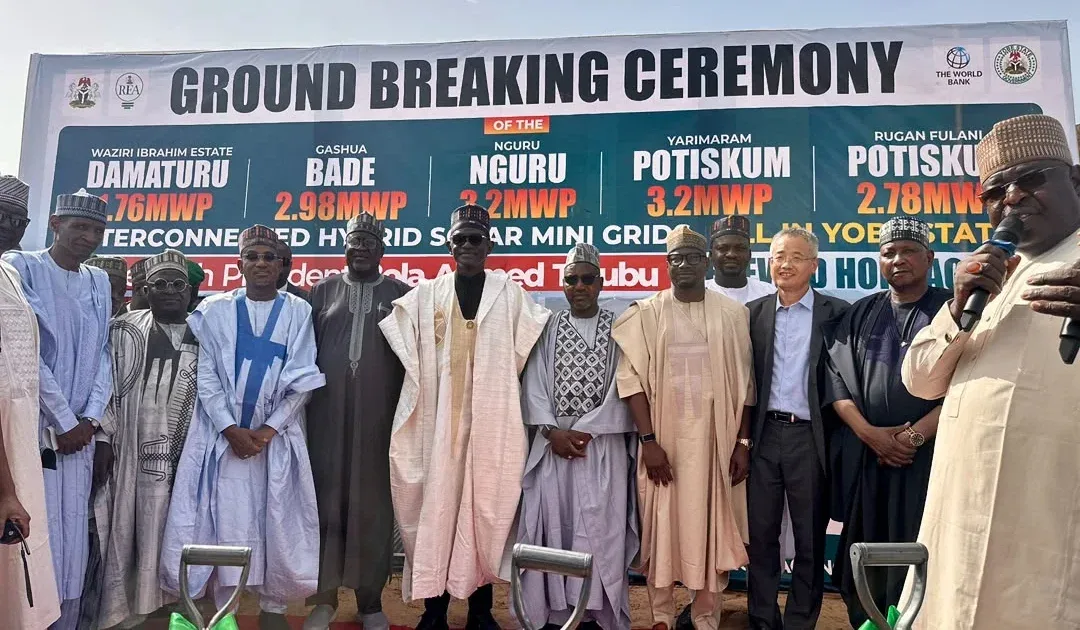
The Federal Government has flagged off the construction of a 13.92-megawatt peak interconnected hybrid solar mini-grid project in Yobe State to improve electricity access, support businesses, and stimulate economic activities. The project, being implemented by the Rural Electrification Agency with support from the World Bank, was inaugurated on Wednesday across five locations in Damaturu, Potiskum, Nguru, and Bade Local Government Areas.
### Who's Behind the Project The project includes a 1.76MWp solar plant at Waziri Ibrahim Estate in Damaturu, a 2.98MWp facility in Gashua, a 3.20MWp installation in Nguru, as well as two plants in Potiskum comprising a 3.20MWp facility at Yarimaram and a 2.78MWp installation at Rugan Fulani. The project also entails the installation of 40 distribution transformers to strengthen electricity distribution in the benefiting communities.
### Yobe State Governor's Praises Speaking at the groundbreaking ceremony on Wednesday, Yobe State Governor, Mai Mala Buni, described the initiative as one of the largest interconnected hybrid solar mini-grid investments in Northern Nigeria. He said the project would provide reliable electricity to thousands of households, markets, schools, hospitals, agricultural enterprises, and small businesses across the state. According to him, the investment will also drive industrial growth, encourage entrepreneurship, create jobs for youths and women, improve healthcare services, and enhance agricultural productivity.
### How the Project Will Work The Managing Director and Chief Executive Officer of the Rural Electrification Agency, Dr Abba Abubakar Aliyu, said the interconnected hybrid mini-grids were designed to integrate with existing distribution networks to provide reliable and affordable electricity to homes, businesses, and public institutions. He explained that the projects would reduce energy costs while improving power supply to commercial and residential clusters, thereby unlocking economic opportunities. Aliyu disclosed that the projects stemmed from a Memorandum of Understanding signed between the REA and the Yobe State Government following the REA-Yobe Strategic Roundtable held in June 2025 to expand electricity access and attract private sector investment.
### What's Next According to him, the agency had 14 additional electricity projects with a combined capacity of 15.3MWp in the pipeline across the state, expected to provide about 23,870 new electricity connections. The projects will serve communities including Jawur Katamma, Dibbwol, Dogonkuka, Malori, Turmi, Zangaya, Dole, and Falimaran, as well as the Federal Polytechnic, Damaturu. He added that expansion projects are also planned for Gashua, Nguru, Waziri Ibrahim, Yarimaram, and Rugan Fulani.
### Context Yobe State has been implementing various initiatives to improve electricity access, including electrifying over 450 rural communities and restoring electricity to communities affected by insurgency. The state has also connected Gulani and Yunusari Local Government Areas to the national grid and installed over 17,000 solar-powered streetlights. The state is currently domesticating the Electricity Act 2023 through the proposed Yobe State Electricity Law to strengthen the regulatory framework and attract private investment into the power sector.
### Background The 13.92-megawatt solar mini-grid project is one of the largest of its kind in Northern Nigeria. The project is expected to provide reliable power to thousands of households and small businesses, driving economic growth and job creation in the state.
### Quotes
'We are not merely connecting communities to electricity. We are connecting them to opportunity. We are creating an environment where businesses can grow, young people can innovate, farmers can process more of what they produce, healthcare facilities can provide better services, and local economies can flourish.'
- Dr Abba Abubakar Aliyu, Managing Director and Chief Executive Officer of the Rural Electrification Agency.