

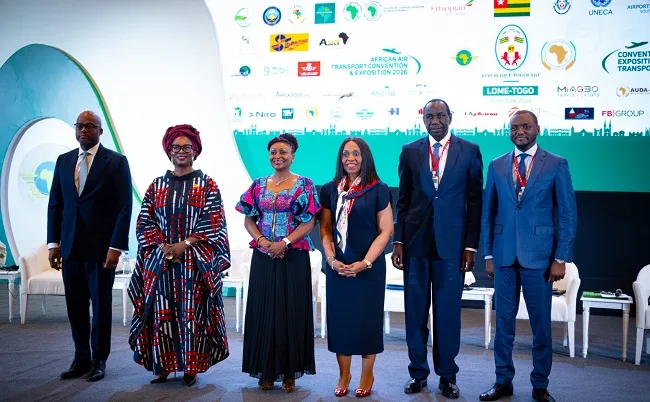
African leaders, aviation regulators, and industry stakeholders gathered in Lomé, Togo, on Monday to push for a borderless aviation market. The inaugural Air Transport Convention focused on the Single African Air Transport Market (SAATM)—an initiative designed to create a seamless and interconnected aviation sector across Africa.
The convention brought together big names in African politics and aviation. Former Nigerian President Olusegun Obasanjo, Togolese President Faure Gnassingbé, Rwandan President Paul Kagame, and Funke Adeyemi, Secretary-General of the African Civil Aviation Commission (AFCAC), all attended. Their presence showed growing political support for removing barriers that still limit air travel within Africa.
AFCAC officials opened discussions by stressing the importance of fully implementing SAATM. They described it as a key driver for trade, tourism, investment, and regional integration. Speakers noted that while the initiative has made good progress over the past seven years, its roots go back to the Yamoussoukro Decision of 1999, which first laid the groundwork for liberalising Africa's air transport market.
Former President Obasanjo called on African leaders to move beyond declarations and commitments. He urged them to take concrete steps to unlock the vast economic opportunities of a unified air transport system. Speaking in French, President Gnassingbé stressed the need to speed up air transport integration. He said Africa's connectivity ambitions haven't kept pace with what citizens and businesses expect.
"For too long, the promise of connectivity has moved more slowly than the aspirations of African citizens and businesses," Gnassingbé said. "Yet we know what is possible. We know that when airlines improve, markets expand. When mobility is eased, tourism grows."
Adeyemi said the convention is anchored on the vision of SAATM and the African Union's Agenda 2063. She said it reflects a collective commitment by African countries to deepen collaboration, promote innovation, and accelerate the transformation of the aviation sector.
According to her, the gathering provides an opportunity for stakeholders to develop a shared roadmap towards a more connected, competitive, and modern air transport industry. Such an industry, she said, can unlock Africa's economic potential and advance regional integration.
SAATM was launched in 2018 by the African Union. It aims to fully liberalise air transport in Africa by removing restrictions on traffic rights, airline ownership, and market access. Currently, only 37 of Africa's 55 countries have signed up. The goal is to create a single market where airlines can fly freely across the continent, similar to the European Union's aviation market.
For Nigeria, this matters a lot. Nigeria is Africa's largest economy and most populous country. Its national carrier, Nigeria Air, launched in 2023 after years of false starts. A fully implemented SAATM would allow Nigerian airlines to fly to any African city without needing bilateral agreements for each route. It would also mean cheaper tickets for passengers and more competition among airlines.
But challenges remain. Many African countries still protect their national carriers by restricting foreign airlines. Infrastructure at many airports is poor. And safety oversight varies widely across the continent. These are the barriers the convention aims to address.
Key Facts
- SAATM launched in 2018 by the African Union
- Based on the 1999 Yamoussoukro Decision
- 37 of 55 African countries have signed up
- Only 8% of global air passenger traffic is in Africa
- Intra-African air travel accounts for less than 1% of global aviation revenue
- First SAATM convention held in Lomé, Togo, on June 15, 2026
- Key attendees: Olusegun Obasanjo, Faure Gnassingbé, Paul Kagame, Funke Adeyemi