

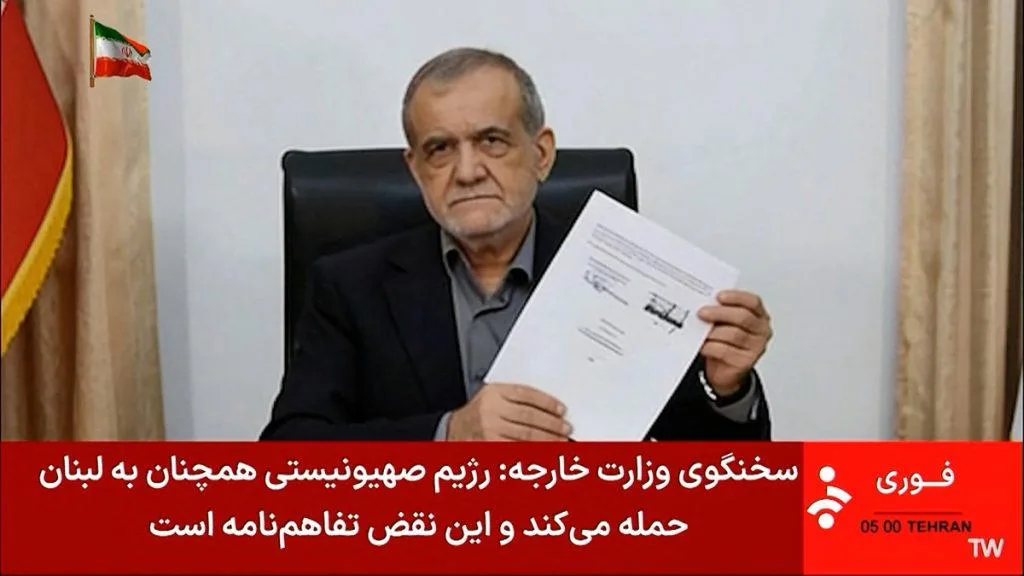
The United States lifted its naval blockade of Iranian ports on Thursday, hours after President Donald Trump signed a peace deal with Iran to end weeks of all-out war. Three Saudi oil tankers immediately sailed through the Strait of Hormuz, and oil prices tumbled.
The deal, signed by Trump and Iranian President Masoud Pezeshkian, triggers a 60-day period for talks on wider issues — especially Iran's nuclear programme. But nobody's sure about what happens next.
Vice President JD Vance said he planned to go to Switzerland for "technical negotiations" with Iran "this weekend" rather than Friday, as earlier announced. But he added that the plan "could change." In Iran, the Tasnim news agency said "nothing has been confirmed" about the Iranian delegation's trip.
The two countries haven't had diplomatic relations since Iran's 1979 Islamic revolution. So the idea of a signing ceremony and face-to-face talks in Switzerland on Friday was already in doubt.
"I don't have any hope that this is a lasting agreement. Maybe after the 60 days they start fighting again," said Mina, a 54-year-old psychologist from Tehran.
Under the deal, Washington commits to immediately waive oil sanctions that have been crushing Iran's economy. Once a final agreement is reached on Iran's nuclear programme, the US will help release a $300 billion reconstruction fund supported by regional nations.
US officials also said Iran would dilute its enriched uranium stocks — possibly by "down-blending on site" under UN nuclear watchdog supervision. Iran's ballistic missile programme wasn't mentioned in the deal, despite Israel's push to dismantle it.
The war lasted five weeks until a ceasefire in early April. It killed 13 US service members and used up a huge chunk of US ammunition stockpiles. Iran had blockaded the Strait of Hormuz at the start of the conflict, and the US imposed its own blockade on Iranian ports in response.
Now American forces have allowed at least 12 ships to pass through, Vance said. Before the war, the strait saw around 120 transits per day, according to shipping journal Lloyd's List. The loaded LNG vessel Mraikh became the first French ship to make the transit since the conflict began.
The deal has unsettled some of Trump's allies at home. US Senator Bill Cassidy, a fellow Republican, called it the "worst foreign policy blunder in decades."
"Iran's nuclear ambitions weren't curbed, and they've learned that threatening the Strait of Hormuz works," Cassidy said.
Trump hit back at the G7 summit, saying he was prepared to "bomb the hell" out of Iran if they violated the agreement. On social media, he wrote: "These fools, who think I haven't been tough enough on Iran, when the Stock Market Just Hit A RECORD HIGH, and Oil prices are 'tumbling' down, are either jealous, bad people, or stupid."
In Iran, hardliners have criticised the deal, calling the war an "imposed war" and comparing it to the 1980-1988 conflict with Saddam Hussein's Iraq.
Agnes Lavallois, president of France's Institute for Research and Studies on the Mediterranean and the Middle East, said the Americans "wanted just one thing — the reopening of the Strait of Hormuz." She added: "The other issues that were put forward to justify this war aren't relevant at all anymore."
The deal also mentions Lebanon, but it's unclear whether the war between Israel and Hezbollah on that front will be discussed in the next 60 days. Israel's Prime Minister Benjamin Netanyahu stressed the importance of maintaining close ties with the US, saying "the struggle isn't over yet."