

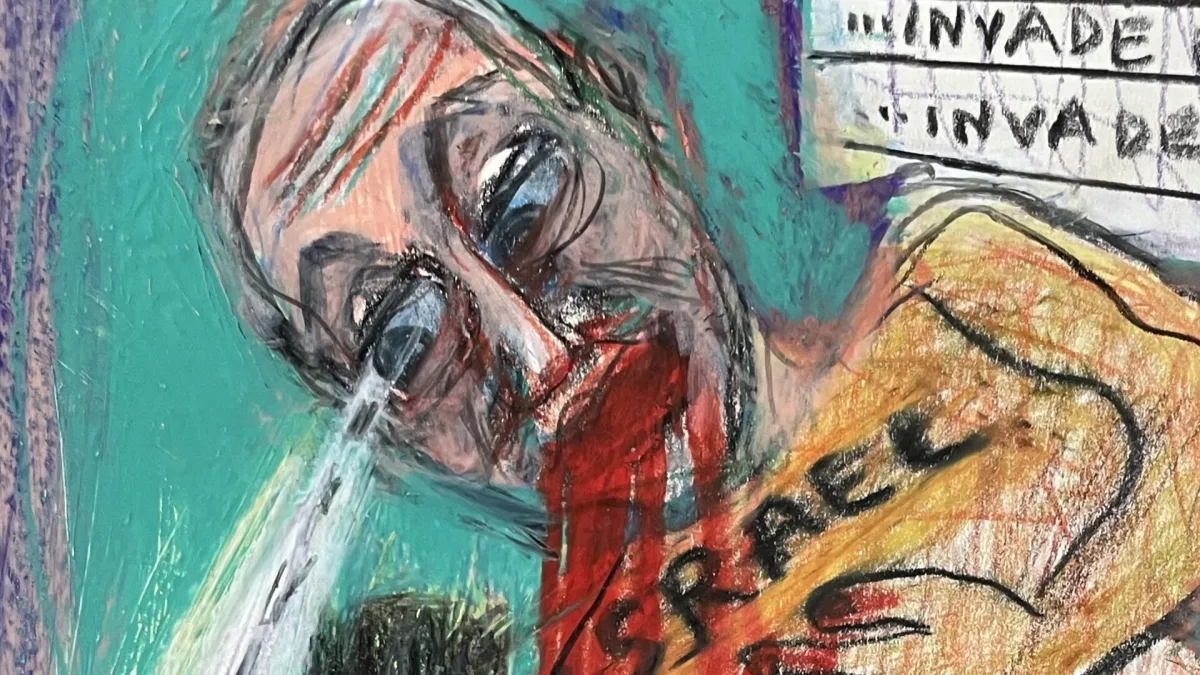
A British artist, Matthew Collings, has found himself at the centre of controversy after his exhibition, 'Drawings Against Genocide', was cancelled following protests and outrage.
The exhibition, which was set to be held in London, featured drawings that depicted Israeli violence against Palestinians. Matthew Collings, the artist behind the exhibition, has defended his work, stating that it's been falsely portrayed as anti-Semitic. He believes his work isn't anti-Semitic, but rather a critique of Israeli actions against Palestinians.
Matthew Collings is a British artist known for his thought-provoking and often controversial works. He's been involved in various exhibitions and projects throughout his career, but 'Drawings Against Genocide' has sparked the most significant backlash so far.
The cancellation of the exhibition has raised questions about freedom of expression and the limits of artistic freedom. Matthew Collings argues that his work isn't anti-Semitic, but rather it highlights the injustices faced by Palestinians.
The issue here isn't about being anti-Semitic, but about highlighting the injustices faced by Palestinians,
Matthew Collings said in a statement. He didn't intend to offend anyone, but rather to spark a conversation about the conflict.
The exhibition's cancellation has also sparked a debate about the role of art in politics and the responsibility of artists to address sensitive issues. Some have praised Matthew Collings for his courage in tackling a difficult subject. Others have condemned him for what they see as a biased and inflammatory portrayal of the conflict. They don't agree with his perspective, and they won't support his work.
The Israeli-Palestinian conflict is a complex and sensitive issue. Both sides have suffered significant losses and injustices. The conflict has been ongoing for decades, with periods of relative calm punctuated by outbreaks of violence. It's a situation that can't be resolved easily.
In recent years, the conflict has gained increased international attention. Many countries and organizations are calling for a peaceful resolution. The United Nations has been involved in efforts to broker a peace agreement, but so far, a lasting solution has proved elusive. They're still working towards a resolution, but it's taking time.
As the debate surrounding 'Drawings Against Genocide' continues, the cancellation of the exhibition will likely affect Matthew Collings' career and the wider art world. The exhibition has sparked a necessary conversation about the role of art in addressing sensitive and controversial issues. It's a conversation that's long overdue, and it's one that won't be resolved quickly.
The conversation around the exhibition continues, and it's essential to look at the broader context of the Israeli-Palestinian conflict. The conflict has a long and complex history. Both sides have legitimate claims and grievances. They're complex issues that can't be ignored.
The conflict has had a devastating impact on civilians. Many Palestinians are facing significant hardships and injustices. The international community has a responsibility to support efforts to broker a peaceful resolution. Artists like Matthew Collings have a role to play in highlighting the issues and sparking necessary conversations. They can help raise awareness and promote understanding.
Key Facts
- The exhibition 'Drawings Against Genocide' was cancelled after protests and outrage.
- The exhibition featured drawings that depicted Israeli violence against Palestinians.
- Matthew Collings, the artist behind the exhibition, has defended his work, stating that it's been falsely portrayed as anti-Semitic.
- The cancellation of the exhibition has raised questions about freedom of expression and the limits of artistic freedom.
- The Israeli-Palestinian conflict is a complex and sensitive issue, with both sides having suffered significant losses and injustices.
The situation is complex, and there aren't any easy answers. But by supporting artists like Matthew Collings and encouraging necessary conversations, we can work towards a better understanding of the issues. We can also work towards a more peaceful resolution to the conflict. It's a goal that's worth working towards, and it's one that won't be achieved quickly.
The art world continues to grapple with the implications of the exhibition's cancellation. The conversation around 'Drawings Against Genocide' is far from over. As we move forward, it's essential to approach the issue with sensitivity and respect. We must also commit to understanding the complexities of the conflict. It's the only way we can make progress and find a resolution that works for everyone.