

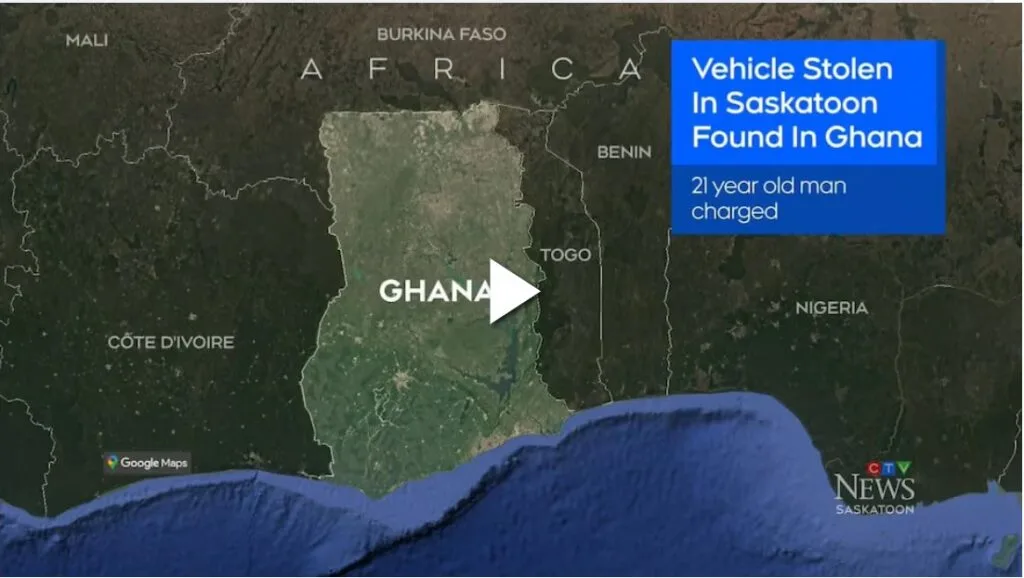
A stolen luxury vehicle in Canada has been traced to Ghana, exposing an international vehicle theft operation that spanned multiple countries. The stolen Land Rover was acquired through alleged identity fraud before being transported across Canada and eventually shipped to West Africa. It was purchased from a motor vehicle dealership in Saskatoon, a city located in the Canadian province of Saskatchewan.
According to the Saskatoon Police Service, the acquisition of the vehicle occurred on January 14, 2025, when a man from the neighbouring province of Alberta visited the dealership and completed the purchase of the vehicle using a stolen identity. The man's actions were uncovered after a detailed probe into the circumstances surrounding the sale and movement of the vehicle began.
Police discovered that the transaction had been carried out using a stolen identity. This prompted further investigations to uncover how the suspect obtained the identity. The probe revealed that the Land Rover was transported to British Columbia shortly after it was acquired. Working closely with the Edmonton Police Service and the Canada Border Services Agency, investigators uncovered evidence indicating that the vehicle had been loaded for export and was destined for Ghana. The discovery was made after the vehicle was tracked from Saskatoon to the port city of Vancouver, where it was scheduled to be shipped to Ghana.
A second alleged fraud involving another luxury vehicle was also uncovered during the ongoing investigation. It turned out that on February 3, 2025, a BMW X5 was fraudulently purchased from a separate dealership in Saskatoon. The suspect, a 21-year-old man, travelled from Alberta and used a Quebec driver's licence during the transaction. Checks revealed that the licence had previously been reported lost in Quebec and had allegedly been altered before being used in the vehicle purchase.
The suspect was later flagged by authorities after concerns emerged regarding the authenticity of the identification document. Following collaborative investigations by police agencies, the suspect was eventually arrested in Edmonton. He now faces several criminal charges, including fraud exceeding $5,000, theft of a motor vehicle, possession of another person's identity document, personation, use of a forged document, and breach of court-imposed conditions.
The case highlights the growing sophistication of identity-related crimes and the increasingly international nature of vehicle theft and fraud schemes. Authorities emphasize the importance of cooperation among police agencies, border authorities, and international partners in combating organized fraud and recovering stolen assets. They stress the significance of sharing intelligence and best practices between law enforcement agencies.
The case also underscores the need for increased vigilance in the used car market, as well as the requirement for more stringent checks on identification documents to prevent fraudsters from exploiting loopholes in the system. Additionally, law enforcement agencies must work closely with vehicle manufacturers and dealerships to identify and prevent the theft and resale of stolen vehicles.
The Saskatoon Police Service has pledged to continue investigating the case and to work closely with international partners to recover the stolen vehicles and bring the perpetrators to justice. They emphasized the importance of international cooperation in combating transnational crime. In a statement, the Saskatoon Police Service noted: 'We are committed to working closely with our international partners to disrupt and dismantle these complex crime networks.'
The investigation has shed light on the sophisticated networks involved in international vehicle theft and fraud schemes. These networks often use stolen luxury vehicles for various nefarious activities, including money laundering and other forms of organized crime. The economic impact of these crimes can be significant, with losses in the millions of dollars.
The international community must work together to address the root causes of these crimes and to develop effective responses to prevent and combat transnational crime. To do so, law enforcement agencies must continue to work together and share intelligence and best practices. The collaboration of law enforcement agencies across the globe is essential for the recovery of stolen vehicles and the dismantling of these criminal networks.
A thorough investigation into the circumstances surrounding the movement of the stolen vehicles will continue. This investigation, along with efforts to prevent and combat transnational crime, requires the cooperation of international partners. The public is encouraged to report any suspicious activities to the authorities.