

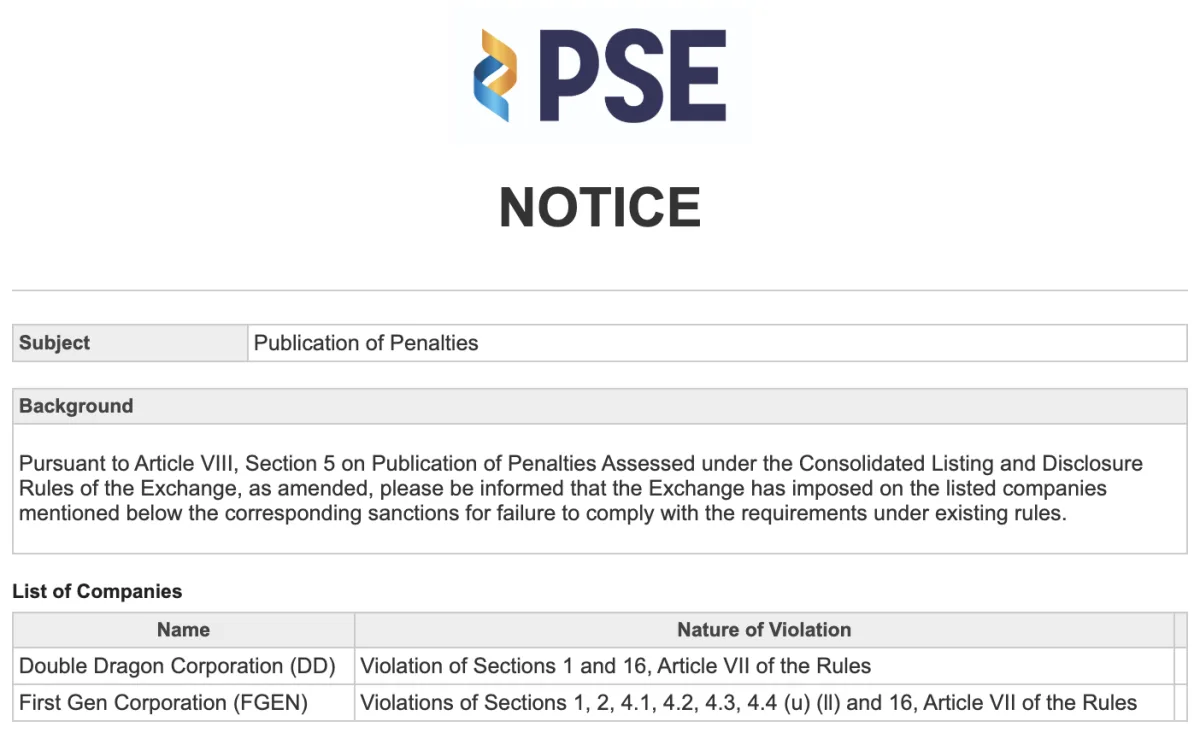
The Philippine Stock Exchange has now put its own language on the Lopez cousins' war. In a Publication of Penalties notice dated July 9, 2026, the exchange sanctioned First Gen Corporation for breaking the rules that govern what a listed company must tell the investing public, and when.
The controversy the PSE sanction now touches is a 3-part structure that First Gen built with Enrique Razon, the country's richest man, and its biggest bank, BDO Unibank. This structure includes the sale of a 60% stake in its gas business to Razon-led Prime Infrastructure for an agreed P50 billion (adjusted to P48.8 billion at closing); an investment in Prime's pumped-storage hydropower projects, announced on February 13 as roughly P75 billion for a 40% interest and signed in March as a 33% interest worth about P62 billion; and P24.75 billion in committed BDO financing supporting the hydro acquisition.
All three instruments carry change-of-management triggers tied to Federico 'Piki' Lopez's continued leadership. Two of them allow Prime to require First Gen to sell its remaining hydro and gas stakes back at a 25% discount if he is removed, an exposure First Gen itself has quantified at approximately P23.5 billion, while the third allows BDO to declare a default that can cascade through the outstanding loans of the wider First Philippine Holdings group, the parent of First Gen.
The PSE’s notice of disclosure violations is terse. It lists First Gen alongside another sanctioned company but does not identify which disclosures triggered the sanction, does not state the amount of the penalty, does not specify the period covered, and does not say whether First Gen contested the findings or intends to appeal.
Penalties for disclosure violations under the exchange’s rules typically take the form of fines. A story update will follow when more information becomes available.
The notice provides the exchange's own checklist, which maps closely onto the disclosure timeline this series has documented:
1. Material information must be disclosed fully, fairly, accurately, and on time. 2. All investors must have equal access to it. 3. Listed companies must disclose material information within 10 minutes of its occurrence. 4. Communicating material non-public information selectively is prohibited. 5. The test for what counts as material must be applied. 6. Specific events presumed material include board or stockholder resolutions approving material acts and the borrowing of significant funds outside the ordinary course of business. 7. Once a company learns that a prior disclosure was inaccurate or incomplete, it must correct or update that disclosure, again within 10 minutes.
The roughly 60-day delay First Gen had before revealing the change-of-management triggers to the market has quantified an exposure of approximately P23.5 billion.
The question then was simple: at what point does a P23.5 billion change-of-management architecture stop being a private comfort clause and start being material information the market is entitled to see?
What the notice says, and what it does not, suggests the exchange has concluded that the timing and completeness of First Gen’s disclosures are no longer just a family grievance.
First Gen chairman and CEO Federico 'Piki' Lopez built the 3-part structure with Enrique Razon, BDO Unibank, and Prime Infrastructure.
Rappler's analysis first traced the architecture in April when it emerged that First Gen announced the hydro deal without initially telling investors that the change-of-management penalty structure sat in the fine print, information the market saw only weeks later, after the majority cousins went public.