

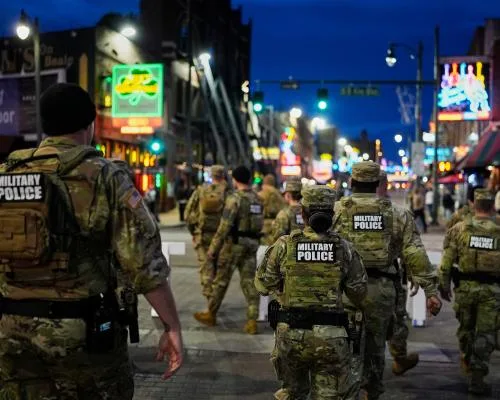
Federal agents deployed to Memphis on the orders of Donald Trump are under the microscope for what critics describe as a campaign of systematic intimidation. The American Civil Liberties Union of Louisiana has launched a lawsuit targeting both state and federal officials, claiming these officers have traded badge-carrying professionalism for cowboy tactics while policing the city's streets.
Launched last September, the initiative was supposed to be a savior for a city struggling with high violent crime rates. Governor Bill Lee gave the green light, activating the National Guard and flooding the area with 2,000 state and federal police personnel. While the White House insists the mission has been a roaring success, the people on the ground tell a much darker story about how that safety is actually being enforced.
When I'm home alone and I hear a branch snap, my heart drops. The presence of these unmarked vehicles outside my home gives me a scary, uneasy feeling that has taken away my peace inside my own home.
Hunter Demster, the lead litigant in this legal battle, isn't just complaining about a few bad apples; he's documenting a pattern of harassment. He alleges that a masked agent in a black Ford Expedition once swerved toward him, narrowly missing him by a mere two inches while he stood on a median. Other activists claim they've been tailed by these same unmarked cars and had their homes placed under constant, invasive surveillance.
It's not just the activists getting the heat. James West, a retired anesthesiologist, found his Global Entry status—a decade-long privilege for frequent travelers—yanked away shortly after he started snapping photos of the taskforce. The official reason provided by US Customs and Border Protection was as chilling as it was vague, hinting he might be suspected of conduct related to terrorism simply for documenting police activity in a public space.
Then there's the case of Jessica Chodor. When she tried to record an interaction, Trooper Suzore allegedly tackled her to the ground with enough force to leave her shaken, leading to 27 hours in a jail cell with a broken toilet. The authorities eventually dropped the charge of resisting official detention, but for Jessica, the experience of being pinned down simply for announcing she was filming for social media has left a lasting mark.
The tension has been amplified by the controversial 2025 Halo Law. This piece of legislation makes it an arrestable offense to get within 25 feet of an officer if you refuse to back off when told. The ACLU argues that officers are essentially treating this distance as a moving target, telling observers that 25 feet is wherever they say it is or that it applies to the furthest vehicle in a line, effectively using the law as a weapon to clear public areas of any witnesses.
The Halo Law's vague language allows officers to justify their actions, and the ACLU claims this creates a culture of aggression and intimidation. This isn't the first time the United States has seen federal authorities clash with locals, but the scale here is massive.
Critics argue that Tennessee officials are manipulating crime statistics to justify the taskforce's presence. While they claim crime is down by 43 percent compared to last year, this figure ignores the broader, nation-wide downward trend in violence that has been happening since 2022. By tying the city's statistics so closely to this specific taskforce, the government is trying to justify a military-style presence that many residents feel has done more to disrupt their lives than to fix the underlying issues of poverty or gang activity.
Gadyaces S Serralta, the director of the US Marshals Service, currently sits as the chair of this taskforce. Despite the mounting lawsuits and the detailed accounts of pretextual traffic stops—where police pull over cars for minor, made-up infractions to search them—the agency has remained tight-lipped, declining to comment on the allegations. With over 7,000 arrests made since the project began, the sheer volume of detainees suggests that the net being cast is wide, and the legal fallout from these aggressive tactics is only just beginning to surface in the courts.
Over 7,000 people have been arrested since the project started, with 1,000 illegal weapons seized, and 150 missing children reunited with their families. However, the number of murders in Memphis last year was fewer than 200, and the reported drop in overall crime is 43 percent.