

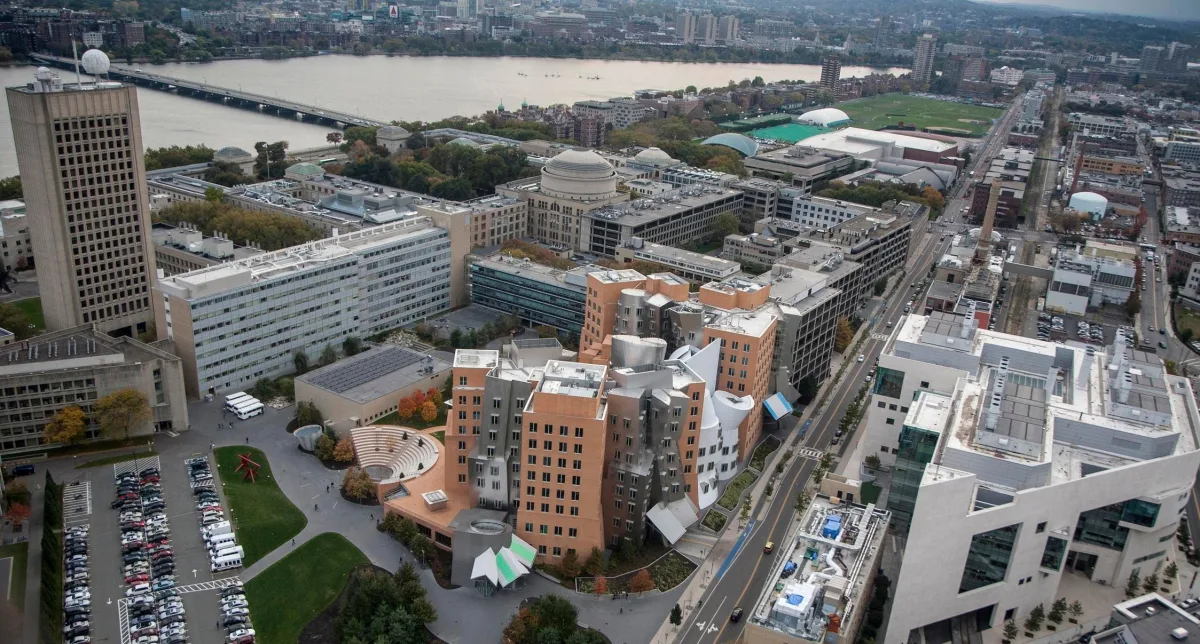
The single sharpest fact about the Stata Center is that it was made possible by Ray Strata, its namesake, who has a fascinating story to tell. Ray Strata recently sat down with a colleague at an April event at MIT, where he shared the story of how the Stata Center came to be.
Ray Strata's journey to building the Stata Center began with his early focus on physics, which later shifted to electrical engineering. He did his thesis in the instrumentation lab, where he worked on precision measurement of nonlinearities of strapped down gyroscopes.
“Today, you know, the gyroscope is instrumental in the smartphone,” he said. But at that time, most gyroscopes were for transportation. They're now used in a lot of different areas, and that's because they're so versatile.
Strata's career in business began with an aversion to authority, which led him to start his own company. He decided that having his own company would be the best way to avoid having a boss. This motivation drove him to build a successful business, which eventually led to the creation of the Stata Center. He didn't want to work for someone else, so he took matters into his own hands.
The Stata Center is a 430,000-square-foot academic complex with a 290,000-square-foot underground garage, and it dates back to 2004. It houses some of the most important departments at MIT, including the Computer Science and Artificial Intelligence Lab (CSAIL), which is directed by Daniela Rus. The lab is known for its work on vanguard projects like liquid AI models. It's a cutting-edge field, and the lab is at the forefront of it.
And what about the challenge of creating a precision rate table and working on operational amplifiers? Strata explained that these were some of the key challenges he faced in his early days. He also talked about the importance of integrating parts into subsystems or systems, rather than just focusing on perfecting the performance of individual parts. It's not just about making one part work well - it's about making all the parts work together.
In remembering the process of building a business, Strata made an interesting analogy:
“Giving birth to a company is, I guess, the closest thing to giving birth to a baby,” he said. It's a difficult process, but it's also incredibly rewarding.
The Stata Center has become a central hub for AI development at MIT, and its history is crucial to understanding the story of AI at the institution. It's a story that involves the coming together of different departments and the creation of a space where researchers can work on cutting-edge projects. They're working on some really innovative things, and it's exciting to see what they'll come up with next.
So, what's next for the Stata Center and the researchers working on AI projects? The future looks bright, with ongoing work on liquid AI models and other vanguard projects. As the field of AI continues to evolve, the Stata Center will likely remain at the forefront of development and innovation. It won't be easy, but they're up for the challenge.
Key Facts
- The Stata Center is a 430,000-square-foot academic complex.
- It houses the Computer Science and Artificial Intelligence Lab (CSAIL).
- Ray Strata is the namesake of the Stata Center.
- The center dates back to 2004.
- The lab is known for its work on vanguard projects like liquid AI models.
The story of the Stata Center is one of innovation and collaboration, and it highlights the importance of creating spaces where researchers can come together to work on cutting-edge projects. As AI continues to shape our world, the work being done at the Stata Center will likely have a significant impact on the future of the field. The center's impact won't be limited to MIT - it will be felt around the world.
The Stata Center is not just a physical space, but also a symbol of the collaborative spirit that drives innovation at MIT. The center's history is a testament to the power of bringing people together to work on complex problems, and its future will likely be shaped by the ongoing work of researchers in the field of AI. They're making great progress, and it's exciting to see what they'll accomplish next.
The Stata Center is a hub of artificial intelligence development at MIT, and its history is a fascinating story of innovation and collaboration. As the field of AI continues to evolve, the work being done at the Stata Center will likely play a significant role in shaping the future of the field. It's a field that's constantly changing, and the Stata Center is at the forefront of that change. The researchers at the center are working hard to stay ahead of the curve, and they're making some amazing discoveries along the way.