

The Automated Side Hustle
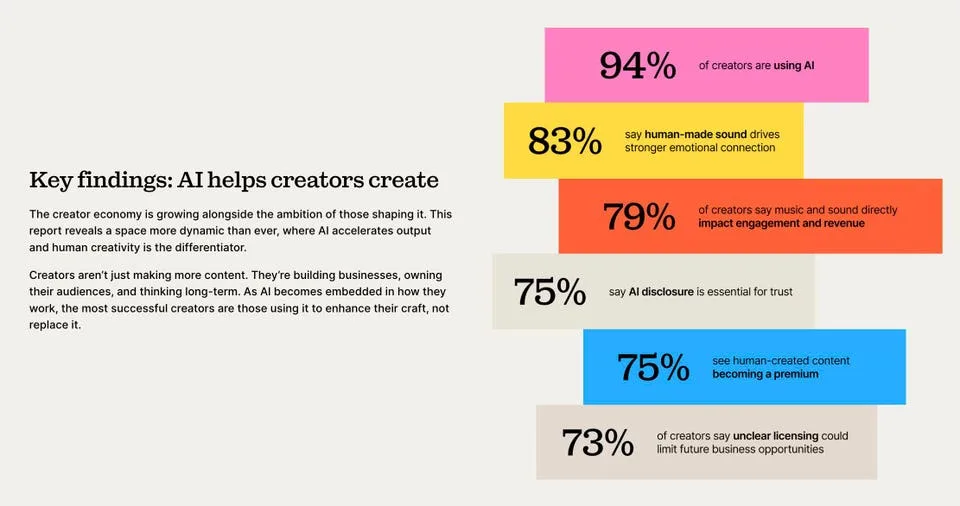
It's almost impossible to scroll through Instagram, Threads, or TikTok for more than a few minutes without stumbling upon a creator sharing their favorite ChatGPT prompts or introducing 'Claude Cowork' as their newest team member. Artificial intelligence has moved from a tech-bro buzzword to a standard piece of equipment for those who make a living online. A 2026 report by Epidemic Sound surveyed 3,000 creators across the US and UK and found that 94% of them are already using AI in some capacity. Roughly 75% of those users expect to increase their usage over the next 12 months as the technology becomes more integrated into their professional ecosystems.
Dividing the Labour
Creators are primarily tasking these bots with the unglamorous parts of their job, with 46% utilizing AI for marketing or administrative tasks like contract drafting. Another 44% are using it to brainstorm ideas or punch up scripts, while 30% are going all-in, producing fully AI-generated content. For a solo creator running a business, AI acts like a budget-friendly employee that doesn’t demand a desk or a lunch break. Lauren Pickett, an Instagram creator with 40,000 followers, views the tool as a high-level partner that helps her refine creative concepts rather than replace her vision.
'AI’s great for admin, like writing and reviewing contracts. I also use it very high-level for creative ideas that I end up refining myself.'
The Red Line of Originality
Becky Pierson Davidson, who runs the community podcast and newsletter Affinity Collective, maintains a rigid boundary between machine work and human craft. She delegates downstream tasks like turning transcriptions into social media show notes and captions to AI, but she keeps the critical thinking and voice firmly in her own court. This sentiment is backed by 82% of creators in the report who feel AI enhances creativity only when used as a responsible assistant rather than a primary driver. For these creators, the manual, low-value work gets offloaded, but the heartbeat of the project stays human.
The Shadow of Ownership
Despite the newfound efficiency, there is a lingering anxiety among the digital professional class regarding what happens to their work behind the curtain. Epidemic Sound found that 93% of creators associate AI with significant risks, ranging from the unauthorized scraping of their content for model training to the potential for AI to clone their voices or mimic their distinct style. These aren’t just hypotheticals, as deepfake and voice-cloning tools are becoming cheaper and more accessible every month. The question of who actually owns a 'style' or a digital persona has become the most urgent conversation in the creator economy right now.
Moral Costs and Environmental Impact
Kary Van Collins, a social impact creator with 21,000 Instagram followers, pushes the conversation further by questioning the ethical and environmental footprint of these massive AI systems. They argue that while condensing a long script or checking a contract clause is convenient, there is a moral weight to the tech that shouldn't be ignored. Even as they occasionally use AI for administrative assistance, they refuse to let it take the wheel on the creative process. For creators in markets like Nigeria, where the digital economy is rapidly growing alongside unstable power and high data costs, this debate touches on whether global AI models even understand the nuance of their specific cultural expressions.
The Risks of AI Ownership
The unauthorized scraping of content for model training, voice cloning, and the potential for AI to mimic distinct styles are all significant concerns for creators. These risks are becoming more pressing as deepfake and voice-cloning tools become cheaper and more accessible every month. Epidemic Sound's report highlights the blurred lines between human ownership and AI-generated content, a conversation that's rapidly gaining urgency in the creator economy.
Finding the Middle Ground
The data suggests a trend of 'cautious delegation' rather than full-scale replacement. Successful creators are using these tools to carve out more time for work that only they can do, ensuring their personal brand remains distinct. If the machine handles the boring, repetitive output, the human creator gets to double down on the voice and personality that earned them their followers in the first place. The relationship between human and algorithm is currently a messy, complicated mix of reliance and suspicion, but the trend line is clear: the future is a hybrid of automated logistics and human-driven passion.
A Path Forward
Ultimately, the creator economy will need to navigate a delicate balance between the benefits of AI and the risks of dependence on these tools. Creators will have to define their boundaries with AI, using it as a responsible assistant rather than a primary driver of their work. This will require a fundamental shift in how we approach ownership, creativity, and the value of human input in the digital age. The future of the creator economy will be shaped by this conversation, and the choices we make now will have far-reaching consequences.