

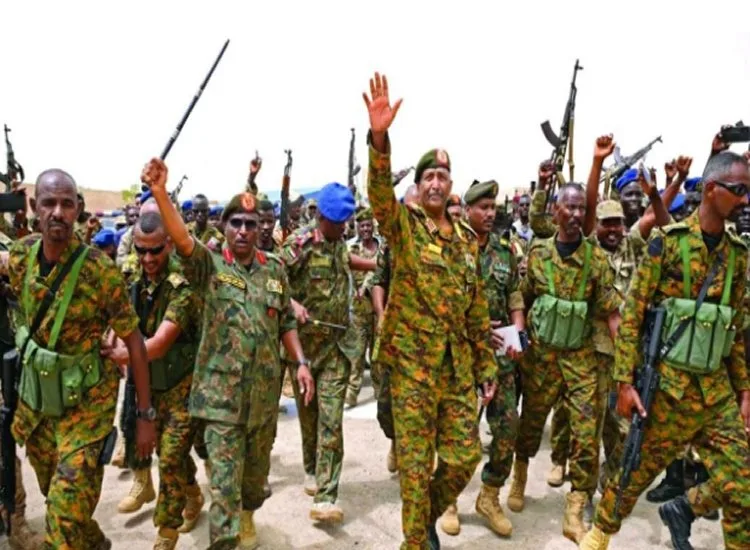
Sudan's Military Unveils Plan for Long Transition
The single sharpest fact is that Sudan's military is planning a five-year transition under army leadership, as revealed in a leaked official document.
The document, which includes direct instructions from the Chairman of the Sovereignty Council, Lieutenant General Abdel Fattah al-Burhan, shows a plan to govern Sudan through military rule for five years. This includes restructuring decision-making centers, limiting international initiatives, and relying on regional alliances to provide political and diplomatic cover for the project.
Lieutenant General Abdel Fattah al-Burhan has been the Chairman of the Sovereignty Council since 2019. He was previously a key figure in the Sudanese Armed Forces, leading the Rapid Support Forces, a paramilitary group that played a crucial role in the conflict in Darfur.
The plan stipulates that the country will be governed by a military government comprising a president and a government of national competencies for five years, followed by general elections. This reflects a move to solidify the military's role in leading the next phase.
The document also included a call for a 'Sudanese-Sudanese' dialogue involving national forces 'whose hands are not stained with the blood of the people,' while rejecting any outcomes from conferences or initiatives held outside Sudan.
Analysts believe this approach represents an attempt to circumvent international and regional pressures aimed at launching a comprehensive political process, and to confine the settlement process within a framework controlled by the military.
Burhan seeks to secure political support for his project by strengthening relations with Saudi Arabia, one of the most prominent regional actors capable of providing political and diplomatic cover for the new authority, in addition to expanding cooperation with the Gulf states.
Sudan's military leadership has a history of relying on regional alliances for support, particularly with Saudi Arabia and the Gulf states. In 2019, the military received significant funding and support from Saudi Arabia, which helped to fuel its campaign against the civilian protests.
The plan also emphasizes enhanced cooperation with Saudi Arabia through the Supreme Council for Strategic Cooperation and Coordination, expanding economic partnerships with Gulf states, and working to reinstate Sudan's membership in the African Union, which would contribute to easing its isolation and international restrictions.
Recent developments indicate a gradual transfer of the peace file from civilian institutions to sovereign and military bodies in Port Sudan, reflecting the military leadership's desire to tighten its control over this file and manage it outside the frameworks established by the transitional period.
The document outlines the project's economic and diplomatic vision, emphasizing the importance of regional alliances and international cooperation in supporting Sudan's development and stability.
At the regional level, Burhan seeks to secure political support for his project by strengthening relations with Saudi Arabia, one of the most prominent regional actors capable of providing political and diplomatic cover for the new authority, in addition to expanding cooperation with the Gulf states.
Experts agree that the project aims to achieve three main objectives: first, to solidify Burhan and the military establishment's hold on the leadership of the state, while re-presenting the army as the sole legitimate authority capable of governing the country during the next phase.
The second objective is to circumvent international and UN initiatives calling for a resumption of the civilian transition process by rejecting external platforms and confining dialogue to within Sudan.
The third objective is to maintain the cohesion of military alliances, particularly with the armed movements in Darfur, and prevent them from adopting independent positions that could affect the arrangements for the next phase or weaken the influence of the Port Sudan authority.