

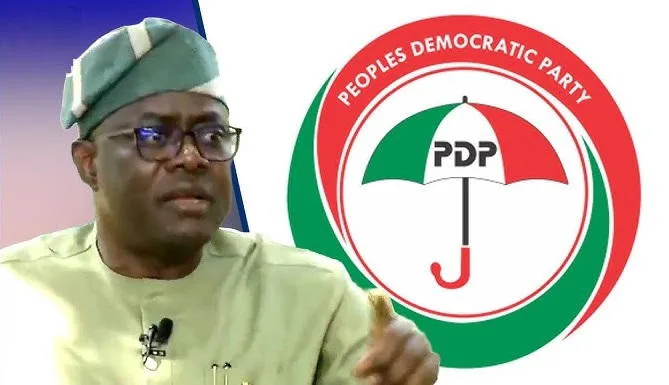
The single most striking fact about Governor Seyi Makinde's latest move is that he's launched a bold alliance between the Peoples Democratic Party (PDP) and the Allied Peoples’ Movement (APM) to take on the All Progressives Congress (APC) in the 2027 presidential election. This move isn't just about Makinde's own presidential ambition, but it's about creating a broader opposition movement that can take on the APC's formidable machinery.
Before we dive into the details of this alliance, let's take a step back and look at how Makinde got here. His emergence as governor in 2019 was a prime example of successful opposition coalition politics in Nigeria. At the time, Oyo politics was deeply fragmented, yet several opposition parties and influential figures decided to close ranks to remove the APC from power in the state. They didn't have a unified front, but they managed to pool their resources together.
Makinde's victory in 2019 was largely due to the coalition's ability to pool grassroots structures, regional influence, and anti-incumbency sentiments into a single electoral force. He didn't win by a small margin - he defeated the APC candidate, Adebayo Adelabu, by polling 515,621 votes against Adelabu's 357,982. This was a significant win, and it showed that coalition politics can work in Nigeria.
Fast forward to 2026, Makinde appears convinced that the same formula can be replicated at the national level. However, the stakes are much higher this time around, and the challenge of building a national opposition coalition is infinitely more complicated than state-level alliances. It won't be easy, but Makinde's determined to make it work.
At a mega rally in Ibadan, Makinde announced the alliance between the PDP and APM, which he hopes will become the foundation of a national political movement ahead of the 2027 general elections. The event was attended by thousands of supporters, and it marked the formal signing of a Memorandum of Understanding between the two parties. This Memorandum of Understanding is a significant step, as it outlines the terms of the alliance and what each party hopes to achieve.
“We are all here at this mega rally to announce the grand alliance between the People’s Democratic Party and the Allied Peoples’ Movement. We must retrace our steps to understand how we arrived at this point in our political history,' Makinde said. He didn't mince words”
— he explained that this alliance is necessary for the growth of Nigeria's democracy.
Makinde framed the emerging alliance as a democratic necessity rather than a narrow partisan arrangement. He argued that Nigeria's democratic foundations are under pressure due to increasing interference in opposition politics nationwide. This interference won't stop unless something's done, and Makinde's trying to do just that. He's trying to create a movement that'll bring about change.
The governor also tapped into public frustration over economic conditions, lamenting that worsening economic and security realities have forced many Nigerians into daily survival struggles. He criticized those in authority for treating public office as private property rather than a responsibility entrusted to them by citizens. They're not doing what they're supposed to do, and Makinde's calling them out.
One of the most striking aspects of Makinde's speech was his effort to redefine opposition politics beyond traditional party structures. He argued that the opposition is no longer limited to politicians or political parties but includes ordinary Nigerians dissatisfied with the direction of the country. It's not just about the parties - it's about the people. They're the ones who'll decide the outcome of the election.
The alliance has generated excitement among opposition leaders, with several of them attending the Ibadan rally to show their support. Former Osun State governor, Prince Olagunsoye Oyinlola, linked the coalition directly to unfulfilled promises made during the 2023 elections. He didn't hesitate to speak his mind - he said that this alliance is a chance for the opposition to make things right.
As the 2027 elections draw near, Makinde's declaration has undoubtedly altered the early political conversation. However, the real test lies ahead: whether opposition parties can sustain unity beyond public declarations, and whether Nigerians can be persuaded that the alliance offers a credible governing alternative. It won't be easy, but it's possible. Makinde's move has shaken up the political landscape, and the outcome will have far-reaching implications for Nigeria's democracy. The next few months will be crucial, and they'll determine the course of Nigeria's history.