

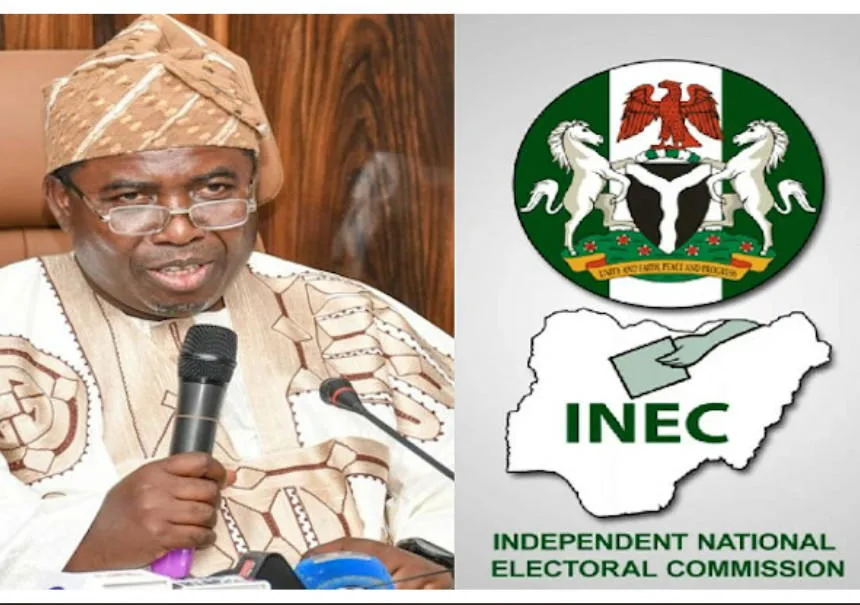
INEC's National Commissioner, Malam Mohammed Haruna, made this disclosure during a cross-sectorial interactive session organised by the Peering Advocacy and Advancement Centre in Africa (PAACA) in partnership with Legis360.
The session, which focused on the just-concluded Ekiti governorship election and INEC's preparations for the 2027 general elections, was an opportunity for Haruna to update stakeholders on the commission's readiness for the upcoming polls.
According to Haruna, INEC had proposed a total budget of N873.78 billion for the 2027 general elections, with substantial allocations dedicated to election operations, technology, and capital expenditure.
The National Commission explained that the development was still within the time limit as per the Electoral Act, 2026, which provides that election funds due to the commission for any general election shall be released 'not later than six months before the next general election'.
Despite the delay, Haruna assured Nigerians that preparations for the 2027 elections were ongoing. He revealed that the commission was already making arrangements for the procurement of new election materials, including the Bimodal Voter Accreditation System (BVAS) and other machines that were damaged, lost or unrecovered during previous elections.
'This N800 billion plus sounds humongous, but when you calculate the average cost per voter, it is about six dollars, which is reasonable for a country such as Nigeria,' Haruna said.
He also disclosed that the commission was planning to conduct mock presidential election exercises to test-run its technology deployment. This, according to him, is part of efforts to avoid a repeat of the technical glitches that affected the INEC Result Viewing (IReV) portal during the 2023 presidential election.
On conflicting court judgments and orders, Haruna said that the trend remained a major challenge to the commission's operations. He cited how last-minute court orders, received between 24 and 48 hours before the Ekiti governorship election, disrupted administrative workflows and the production of election result sheets.
Haruna also addressed recent concerns over a viral report of a data breach, assuring Nigerians that INEC maintains strict data protection and internal accountability protocols.
'Our director of ICT just returned from China regarding procurement because not all the BVAS devices used during the last general elections were recovered. Orders need to be placed, and these things take time,' he said.
Malam Mohammed Haruna is the National Commissioner in charge of Voter Education and Publicity at the Independent National Electoral Commission (INEC). He was appointed to the position in [insert year].
The Peering Advocacy and Advancement Centre in Africa (PAACA) is a non-governmental organisation that focuses on promoting good governance and electoral reforms in Africa.
The Ekiti governorship election was conducted in June 2026, with the All Progressives Congress (APC) candidate, Biodun Oyebanji, emerging victorious.
The Bimodal Voter Accreditation System (BVAS) is an electronic device used by INEC to accredit voters during elections.
The Nigeria Data Protection Commission (NDPC) is a regulatory body responsible for enforcing data protection laws in Nigeria.
The Department of State Services (DSS) is a security agency responsible for protecting national security and internal stability.
The Electoral Act, 2026, is a legislation that regulates the conduct of elections in Nigeria.
The Independent National Electoral Commission (INEC) is the electoral commission responsible for conducting elections in Nigeria.
The National Democratic Congress (NDC) is a political party in Nigeria.
The African Democratic Congress (ADC) is a political party in Nigeria.
The Legis360 is a legislative advocacy group that promotes good governance and electoral reforms in Nigeria.
The PAACA in partnership with the Legis360, organised a cross-sectorial interactive session to discuss the Ekiti governorship election and INEC's preparations for the 2027 general elections.
The 2023 presidential election was conducted in February 2023, with the All Progressives Congress (APC) candidate, Bola Tinubu, emerging victorious.
The 2027 general elections are scheduled to hold in February 2027.
The INEC Result Viewing (IReV) portal is an online platform used by INEC to display election results.
The BVAS devices used during the last general elections were damaged, lost or unrecovered during previous elections.
The INEC maintains strict data protection and internal accountability protocols.
The director of ICT just returned from China regarding procurement because not all the BVAS devices used during the last general elections were recovered. Orders need to be placed, and these things take time.
The INEC Result Viewing (IReV) portal was affected by technical glitches during the 2023 presidential election.
The INEC is planning to conduct mock presidential election exercises to test-run its technology deployment.
The BVAS devices used during the last general elections were not recovered in time, and orders had to be placed for new ones.
INEC is taking steps to engage the relevant judicial authorities on the issue of last-minute court orders.
A similar approach was adopted by the immediate past leadership of the commission under Prof. Mahmood Yakubu ahead of the 2023 general elections.
The INEC maintains strict data protection and internal accountability protocols.
The electoral officer who intentionally leaked sensitive data as part of a personal vendetta against a political actor has been suspended.
The matter has been reported to the Nigeria Data Protection Commission (NDPC).
The Department of State Services (DSS) and the police are finalising criminal investigations.
The electoral officer who leaked sensitive data has been suspended, and the matter is being pursued through the relevant channels.
The Ekiti governorship election was conducted in June 2026, and the results were announced on June 10, 2026.