

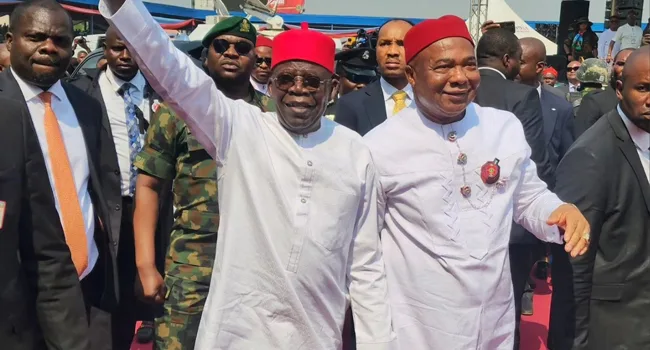
It isn't every day you hear a politician give anyone a perfect grade, but Hope Uzodinma, the Governor of Imo State, did just that this Friday. Speaking at the Presidential Villa during a Sallah celebration and the third anniversary of the administration, the Chairman of the Progressive Governors Forum praised President Bola Ahmed Tinubu, saying his work over the last three years earns a solid "100 per cent" rating.
Hope Uzodinma, a member of the ruling All Progressives Congress, framed his assessment around the dire state of the national economy when the current government took the reins in May 2023. He suggested that the nation was essentially staring into an abyss of bankruptcy before the administration implemented its set of fiscal adjustments. These policies were not merely bureaucratic shifts, but essential survival tactics for a country that was at risk of total collapse, because the old system was unsustainable and consumed public funds meant for schools, hospitals, and infrastructure.
"We've assessed your performance, Mr President," Uzodinma said, "and I’m happy to announce that we've scored it a 100 per cent. You've virtually recovered Nigeria from the brink of collapse to a state of stability and survival."
President Bola Ahmed Tinubu, in his turn at the microphone, acknowledged the harsh nature of his early policies, particularly the removal of the long-standing fuel subsidy. He argued that the old system was a bottomless pit that consumed public funds, and that by killing the subsidy, the government was able to pivot away from a path toward national insolvency, and focus on implementing policies that would benefit the country in the long run.
The View From the State Houses
While the national conversation often fixates on federal figures, the state governors paint a picture of improved fortunes at the subnational level. The influx of redistributed revenues has allowed many states to finally clear long-standing salary arrears, which had crippled local economies for years. This development is a direct result of the governor's new fiscal policies, which have changed the game for state finances.
AbdulRahman AbdulRazaq, the Governor of Kwara State and current Chairman of the Nigeria Governors’ Forum, echoed the sentiment that the new fiscal policies have transformed state finances. He noted that the influx of redistributed revenues has enabled states to pay long-standing salary arrears, invest in new infrastructure projects, and stimulate local growth. The additional resources are being funnelled into so-called "landmark projects" designed to stimulate local growth, reduce the heavy debt burdens that once choked state budgets, and provide a cleaner slate for development.
Vice President Kashim Shettima also chimed in, framing the removal of the subsidy as a historic confrontation with decades of economic distortions. He served as the Governor of Borno State from 2011 to 2019 before becoming a Senator and eventually moving into his current role as the country’s second-in-command. His public support adds weight to the executive branch's narrative that the administration is prioritising long-term structural integrity over short-term political convenience.
The Economic Strategy Behind the Scores
The administration maintains that its focus on foreign exchange management and fiscal discipline is starting to show in the macro indicators. President Bola Ahmed Tinubu claimed that agriculture is currently booming as a direct result of these interventions, though many Nigerians feel the squeeze of high food prices at the market daily. The administration argues that these "macroeconomic gains" are crucial for the country's future, but the challenge remains translating these gains into cheaper garri, rice, and transport costs for the average person on the street.
The endorsement from the governors acts as a powerful signal of political unity within the ruling party. With two years left in the current tenure, this unity suggests that the current path of "bold reforms" will continue regardless of the pushback. For the governors, the deal is simple: more revenue for the states in exchange for standing firmly behind the President’s agenda. The coming months will be telling as the government tries to balance this fiscal discipline with the urgent need to ease the cost-of-living crisis across the country, by making sure that the economic growth translates into tangible benefits for the citizens.