

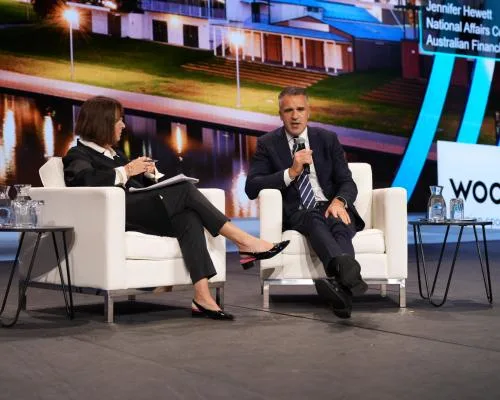
The Australian Financial Review's Jennifer Hewett attended the Australian Energy Producers conference in Adelaide, where she moderated sessions with the CEOs of Santos, Shell, and Woodside, and interviewed Peter Malinauskas and the US shale revolution entrepreneur Bryan Sheffield. However, the paper didn't disclose that Hewett's trip to the conference was paid for by the gas and oil lobby. This lack of disclosure is particularly noteworthy given the editor of the AFR, Cosima Marriner, recently fronted a marketing campaign touting the newspaper's trusted reporting and credibility.
Marriner said in Nine's corporate video, 'When you read us, you know you're getting news straight down the barrel.' Yet, when asked about Hewett's payment, Marriner attributed the lack of disclosure to 'reporter oversight.' The AFR's actions don't match its claims of transparency. After being contacted by the Weekly Beast, the AFR added a note to both of Hewett's pieces from the conference, stating that she attended 'courtesy of Australian Energy Producers.' A clarification was also added, acknowledging the late disclosure. Hewett didn't respond to a request for comment.
The conference, which charged delegates around $3,000 each to attend, featured a session with Pauline Hanson hosted by Chris Uhlmann, a contributor to Sky News Australia and columnist with the Australian. Uhlmann is known for his criticism of Australia's shift to renewables. He's been vocal about his concerns. The conference was a significant event, with many key players in the energy industry attending.
In a separate incident, Assistant Productivity Minister Andrew Leigh posted photographs from his 100km ultra trail running event in the Blue Mountains on social media, complete with the Sportograf.com watermark. This led to criticism that he hadn't paid for the photos, which cost $20 each or $50 for the complete individual package. Leigh later apologized and purchased the photos. He shouldn't have used the photos without paying for them.
The ABC chair, Kim Williams, has defended the public broadcaster's reporting on the Gaza war after an incendiary column in the Weekend Australian accused the ABC of fuelling antisemitism. Williams criticized 'highly charged and inflammatory' reporting, saying it was 'divisive, undermines community cohesion and doesn't contribute to an informed or reasoned public debate.' The ABC's reporting has been under scrutiny. Williams' response highlights the need for balanced reporting.
The Murdoch Children's Research Institute, co-chaired by Sarah Murdoch, recently celebrated its 40th anniversary with over 600 mentions across News Corp-owned newspapers and websites, and Sky News Australia TV and radio. The celebration included a cover story on Sarah Murdoch in the Australian's Wish magazine and a special report on Sky News Australia. The institute's anniversary was widely covered. The media coverage was extensive.
The Australian Press Council has threatened legal action against GetUp! for registering the domain name presscouncil.com.au to highlight its campaign for a new independent journalism standards authority. GetUp! has been asked to cancel the registration and stop the redirection by Tuesday, or face court action. The Australian Press Council is taking a strong stance. It's not clear what the outcome will be.
The Australian Financial Review's Jennifer Hewett attended the conference courtesy of the gas and oil lobby. The paper failed to disclose the payment initially, attributing the lack of disclosure to 'reporter oversight.' The conference featured sessions with CEOs of major energy companies and politicians. These are key facts. They're essential to understanding the incident.
'When you read us, you know you're getting news straight down the barrel,' said Cosima Marriner, editor of the Australian Financial Review. This statement highlights the importance of transparency in journalism. It's crucial for journalists and media outlets to maintain the trust of their audiences by being transparent and accountable in their reporting. They can't afford to lose the public's trust.
The incident highlights the importance of transparency in journalism and the need for media outlets to disclose potential conflicts of interest. As the media landscape continues to evolve, it's crucial for journalists and media outlets to prioritize transparency and accountability in their reporting. This includes disclosing potential conflicts of interest, being transparent about their reporting practices, and promoting accountability within their organizations. They must be proactive.
In the case of the Australian Financial Review, the failure to disclose the payment for Hewett's trip to the conference raises questions about the paper's commitment to transparency and accountability. The incident has sparked criticism and highlighted the need for media outlets to be more transparent in their reporting and disclosure practices. The AFR's actions will be closely watched.
The Australian Press Council's threat of legal action against GetUp! over the domain name registration also raises questions about the council's priorities and its commitment to promoting transparency and accountability in journalism. The council's actions have been criticized as ironic, given its role in promoting journalism standards and accountability. The council's priorities are under scrutiny.
As the media landscape continues to evolve, it's crucial for journalists and media outlets to prioritize transparency and accountability in their reporting. This includes disclosing potential conflicts of interest, being transparent about their reporting practices, and promoting accountability within their organizations. They must adapt to the changing landscape. It's essential for their survival.
The incident involving the Australian Financial Review and the Australian Press Council serves as a reminder of the importance of transparency and accountability in journalism. It highlights the need for media outlets to prioritize these values and to maintain the trust of their audiences by being transparent and accountable in their reporting. The media outlets must take responsibility for their actions. They can't afford to lose the public's trust.