

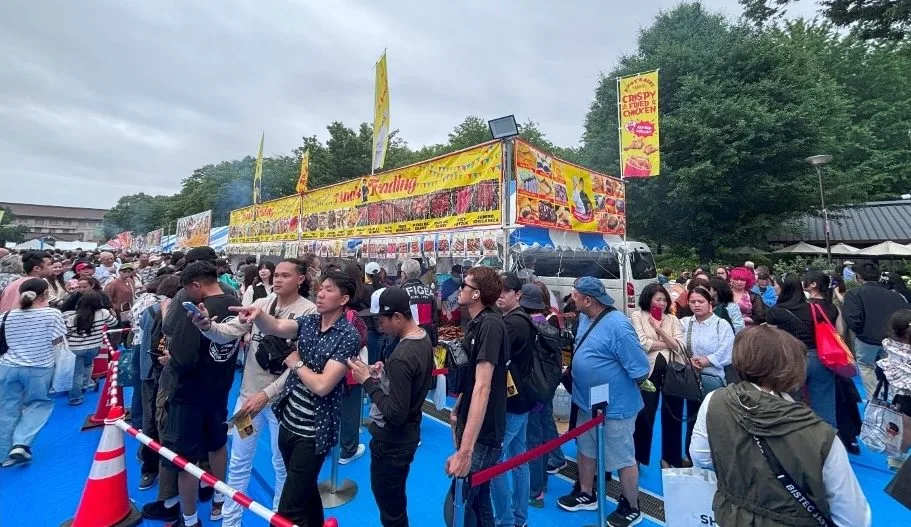
There I was at Ueno Park, standing alone in a line at Ana's Trading that barely seemed to move. Around me, Filipinos chatted in a mix of Tagalog, English, Japanese, and regional dialects while Original Pinoy Music blasted through oversized speakers. Smoke from the barbecue drifted into the humid Tokyo afternoon as people impatiently checked how far they still were from the food stalls.
My wife and our 10-year-old son had already given up on my line entirely and wandered off somewhere else to buy kwek-kwek, fish balls, and kikiam. A few meters away, a group of Filipinos were already deep into bottles of San Miguel and Red Horse, loudly daring one another to eat balut while everyone around them laughed. Nearby, mixed Filipino-Japanese families lined up patiently for food, casually switching between Tagalog and Japanese mid-conversation.
After nearly 30 minutes of waiting, I finally reached the front and secured my food: isaw ng baboy, dinuguan, and lechon paksiw. For a moment, Ueno Park stopped feeling like Japan.
The Philippine Expo 2026, held June 5 to 7, drew an enormous crowd estimated at 100,000. Families carried plastic bags stuffed with dried mangoes, ube snacks, and instant pancit canton as if they were bringing home precious cargo. Japanese visitors lined up for halo-halo and lumpia beside Filipinos trying to decide which stalls still had the shortest queues.
It was loud, crowded, sweaty, and deeply familiar. Then, almost inevitably, the conversations around me drifted back to the Philippines: politics, inflation, corruption, the cost of living, relatives trying to migrate abroad. Even during celebrations like this, Filipinos somehow find their way back to the same anxieties.
Living in Japan for eight years has changed the way I notice things. I realize this every time I return home and become irrationally frustrated by things that shouldn't feel extraordinary — trains that don't work properly, government systems nobody fully understands, lines that move slowly because no one seems accountable for delays.
Tokyo is hardly a perfect city. But it's a place where people generally trust that institutions will still function the next morning. Trains arrive when they're supposed to. Paperwork moves. Public systems, however imperfect, are expected to work. That kind of trust quietly shapes how people live.
And perhaps that's why, standing in the middle of this joyful celebration of Filipino identity overseas, I kept asking myself a question I couldn't quite shake: What does it actually mean to be an independent Filipino in 2026?
The question lingered because the past few weeks in Tokyo had also been filled with symbols of Philippine success on the international stage. During President Marcos' recent state visit to Japan, the Philippines formally upgraded its relationship with Tokyo into a Comprehensive Strategic Partnership. Watching a Philippine president address the Japanese National Diet and later receive Japan's highest honor would have once seemed unimaginable to older generations who still carried memories of the war.
Today, Japan increasingly speaks to the Philippines not simply as a recipient of aid, but as a strategic partner in an increasingly unstable region. In the days surrounding the visit, I helped facilitate meetings between Japanese companies and the Philippine Special Envoy to Japan for Trade and Investment together with Philippine Chamber of Commerce in Japan chairman Allan Reyes. Across boardrooms in Tokyo, Japanese firms spoke seriously about expanding operations in the Philippines, hiring Filipino workers, and building long-term partnerships.
For decades, the Philippines wanted international respect and relevance. In many ways, we're finally receiving it. But diplomatic recognition doesn't automatically translate into an easier life for ordinary Filipinos. That contradiction became impossible to ignore again during the President's meeting with the Filipino community in Tokyo. Representatives from Filipino organizations raised concerns about the cost of living, the difficulty of doing business back home, and the persistent feeling that the government's priorities don't always match the struggles of everyday people.
So what does independence mean in 2026? It means a Philippine president standing before the Japanese Diet and being taken seriously. It also means Filipinos in Tokyo spending their Sunday at Ueno Park, eating isaw and dinuguan, because those tastes are the closest they can get to home. It means knowing that your country is finally being treated as an equal by a former enemy — but also knowing that the trains in Manila still don't run on time, and that the line for government services still moves at its own stubborn pace.
Independence, perhaps, isn't a single achievement. It's an unfinished conversation — one that continues in every Filipino gathering, whether in a boardroom in Tokyo or at a barbecue in Ueno Park.