

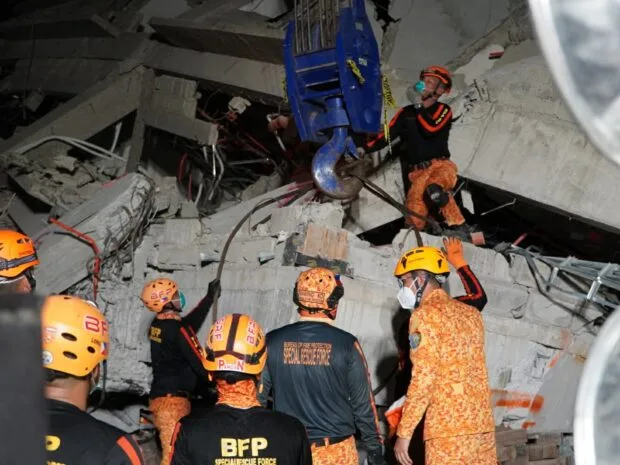
The dust and twisted metal of the collapsed nine-story structure in Barangay Balibago, Angeles City, have become the center of a desperate, round-the-clock operation. Responders spotted the sixth victim trapped beneath the debris at approximately 9 p.m. on Thursday, May 28, marking another tragic turn in a site that has kept the community on edge for days. The extraction team is currently navigating the precarious remains of the building, where every movement risks further shifting the unstable concrete slabs because the ground is essentially a pile of pulverized cement and exposed steel rebar.
This latest sighting comes less than 24 hours after crews managed to successfully retrieve the fifth fatality, an 11-hour process that highlights the sheer difficulty of the task at hand. The building, which was under construction, became a death trap when it failed, forcing authorities to pivot from a rescue operation to a painstaking recovery mission. The building's collapse was so massive that what should have been a workspace turned into a literal cage for those caught inside when the collapse began.
Structural Risks and Recovery Logistics
The site is incredibly dangerous, with engineers continuously monitoring the remaining parts of the building to ensure the safety of the responders on the ground. Heavy machinery is being used where possible, but for the most part, rescuers are relying on manual labor to prevent secondary collapses. The humidity in Pampanga has also added a layer of physical exhaustion, as the teams work through the night with floodlights piercing the darkness of the site.
Local authorities have been tight-lipped about the specific cause of the failure, choosing instead to focus entirely on the recovery of the bodies. The incident has raised immediate questions regarding the integrity of similar high-rise construction projects in the region, where rapid urban growth often outpaces strict oversight. The disaster in Angeles City serves as a grim reminder of how quickly safety protocols can translate into life-or-death realities for construction workers. The cost of corner-cutting in the building industry is rarely measured in Pesos alone, but in devastating scenarios that shatter families and haunt communities.
The Human Cost of Rapid Development
For the people of Angeles City, this is a tragedy that hits home, as many residents have friends or relatives working in the construction sector. The site is located in a busy district, meaning the collapse was witnessed by commuters and shopkeepers, many of whom are still reeling from the shock. There is a palpable sense of community mourning, with neighbors bringing food and water for the tired rescue workers. The site has been cordoned off by the police, but the presence of the victims' families is a constant, somber reminder of the stakes involved in this recovery.
They are working as carefully as possible to respect the victims and ensure that no more lives are lost during the retrieval process. 'We are moving cautiously to avoid causing further harm,' said a spokesperson.
As the night shift takes over, the focus remains entirely on extracting the newly sighted victim so they can be identified and eventually brought home to their loved ones. Once this individual is removed, the focus will likely shift to a final survey of the remaining debris to ensure no other victims remain trapped. The city government has promised a thorough investigation into the permits and structural plans of the building once the site is cleared, but for now, the priority remains the human toll. Every hour that passes adds to the exhaustion, yet the mission to pull everyone out continues without stop.