

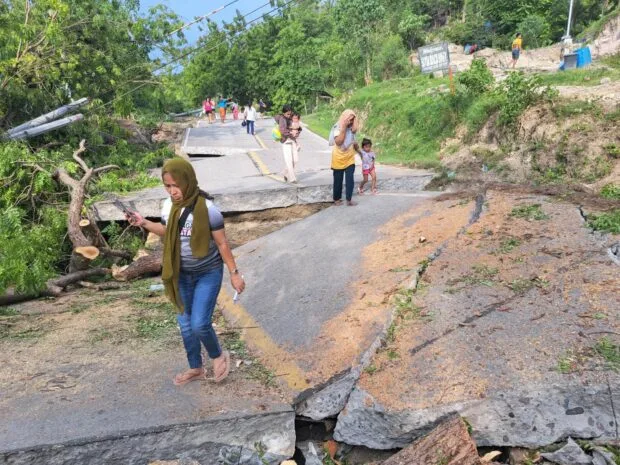
The ground hasn't stopped shaking for the people of Sarangani — but the numbers are already clear. The magnitude 7.8 earthquake that hit Maasim on June 8 has left behind P1.29 billion in damaged roads, bridges, schools, and government buildings.
That's according to the Office of Civil Defense (OCD), which reported on Wednesday that 774 infrastructures were either damaged or destroyed. OCD information officer Diego Mariano gave the figure in a message to reporters, but didn't break down which types of structures were hit hardest.
The quake didn't spare the farms either. Damage to agriculture in Davao del Norte and Davao del Sur has reached P29.8 million, Mariano said. Crops, irrigation systems, and farm-to-market roads took a beating.
As for the human toll, the death toll remains at 68, with 33 people still missing. Those numbers are still being verified, meaning they could climb higher. The quake struck on June 8 with a magnitude of 7.8, one of the strongest to hit Mindanao in recent years.
What happened on June 8
The earthquake hit near Maasim, a coastal town in Sarangani province, around 4:15 p.m. It was shallow — only about 10 kilometers deep — which made the shaking more intense. People ran out of buildings, and many structures collapsed or were left unsafe.
Emergency teams have been working since then to clear debris, rescue survivors, and assess damage. The OCD has been coordinating with local governments to get aid to affected communities.
What happens next
Local governments are now submitting detailed damage reports to the national government. The Department of Public Works and Highways (DPWH) will inspect major infrastructure like bridges and roads to decide which need immediate repair and which can wait.
For farmers, the Department of Agriculture is expected to provide seeds, fertilizers, and cash assistance to help them replant. The P29.8 million in agricultural damage covers rice, corn, and high-value crops.
Families who lost their homes are staying in evacuation centers or with relatives. The Department of Social Welfare and Development (DSWD) has been distributing food packs, water, and hygiene kits.
A region still on edge
Mindanao isn't a stranger to strong earthquakes. The 7.8 magnitude tremor is among the largest recorded in the area, but smaller aftershocks have continued to rattle nerves. Many residents are sleeping outside, afraid of more buildings collapsing.
The OCD has warned that the damage figure could still go up as more remote barangays are reached. Some areas are only accessible by helicopter or boat because roads were cut off by landslides.
For now, the focus is on search and rescue for the 33 missing. Their families are waiting for news — hoping for miracles, bracing for the worst.