

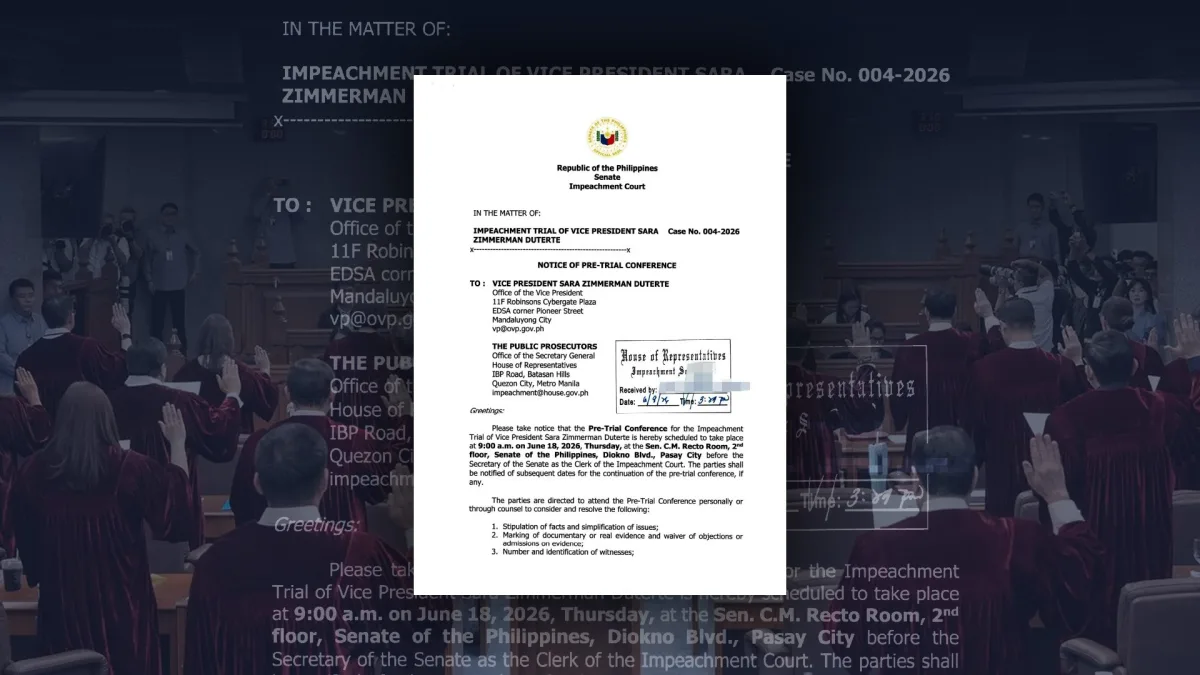
The impeachment trial against Vice President Sara Duterte hasn't started yet, but both sides are already being told to sit down and talk.
On June 18, a closed-door pre-trial conference will happen at the Senate. It's meant to get the House prosecutors and Duterte's lawyers in one room to agree on which evidence is real, how many witnesses each side can call, and how long the trial will take.
Acting Senate President Win Gatchalian sent a notice on June 9 inviting both camps to submit a pre-trial brief by June 15. That brief must include admitted facts, proposed stipulations, a list of documents, and witnesses — plus what each witness is expected to say.
Akbayan Representative Chel Diokno, one of the 11 House prosecutors, earlier said they plan to present 25 witnesses during the trial.
The conference will be closed to media and the public. The Senate says this gives both sides the "widest freedom and latitude" to actually get things done without political grandstanding.
What is a pre-trial in impeachment?
Impeachment is a unique constitutional process — it's not criminal, civil, or administrative. It's a political and legal mechanism to hold impeachable officials accountable.
The 1987 Constitution and the Senate rules handbook don't explicitly mention pre-trial proceedings. But Senate Resolution No. 39, adopted in 2011, says the Rules of Court can be used "suppletorily" — meaning when the Senate rules don't cover something, court rules fill the gap.
The 2019 amendments to the 1997 Rules of Civil Procedure say a pre-trial is meant to simplify issues, limit witnesses, and set trial dates. Both sides must submit a brief stating the case, admitted facts, legal issues, documents, and witnesses.
After the conference, the presiding officer issues a pre-trial order that binds both sides.
What happens at this specific pre-trial?
The June 18 conference will cover five things: agreeing on facts and simplifying issues, marking evidence, identifying witnesses, setting trial dates, and deciding the order of presentation.
If either camp discovers new evidence after the pre-trial, they can still use it — as long as they tell the other side at least three days before presenting it. For witnesses with safety concerns, names can be kept secret until the actual testimony.
How does this compare to past impeachments?
The Philippines has only two impeachment trials to look back on: former President Joseph Estrada (2000–2001) and former Chief Justice Renato Corona (2012).
Estrada's trial also had a pre-trial conference on December 6, 2000, presided over by then-Chief Justice Hilario Davide. Both camps agreed to present 54 witnesses and finish within 34 days — but neither goal was met.
Back then, the camps fought over witness numbers, time limits on testimony, and whether the prosecution had to reveal witness identities. The Estrada camp wanted to know who the prosecution's witnesses were; House prosecutors objected, citing threats against those witnesses.
Corona's trial, on the other hand, didn't have a pre-trial conference at all. Despite the chief justice's insistence, the Senate went straight to opening arguments on January 16, 2012.
What happens next?
The actual impeachment trial starts in July. The pre-trial conference on June 18 is meant to make that trial smoother — but if history is any guide, expect fights over witnesses and evidence to continue right up to the gavel.