

More Filipinos are getting heavier — and it's becoming a national health crisis.
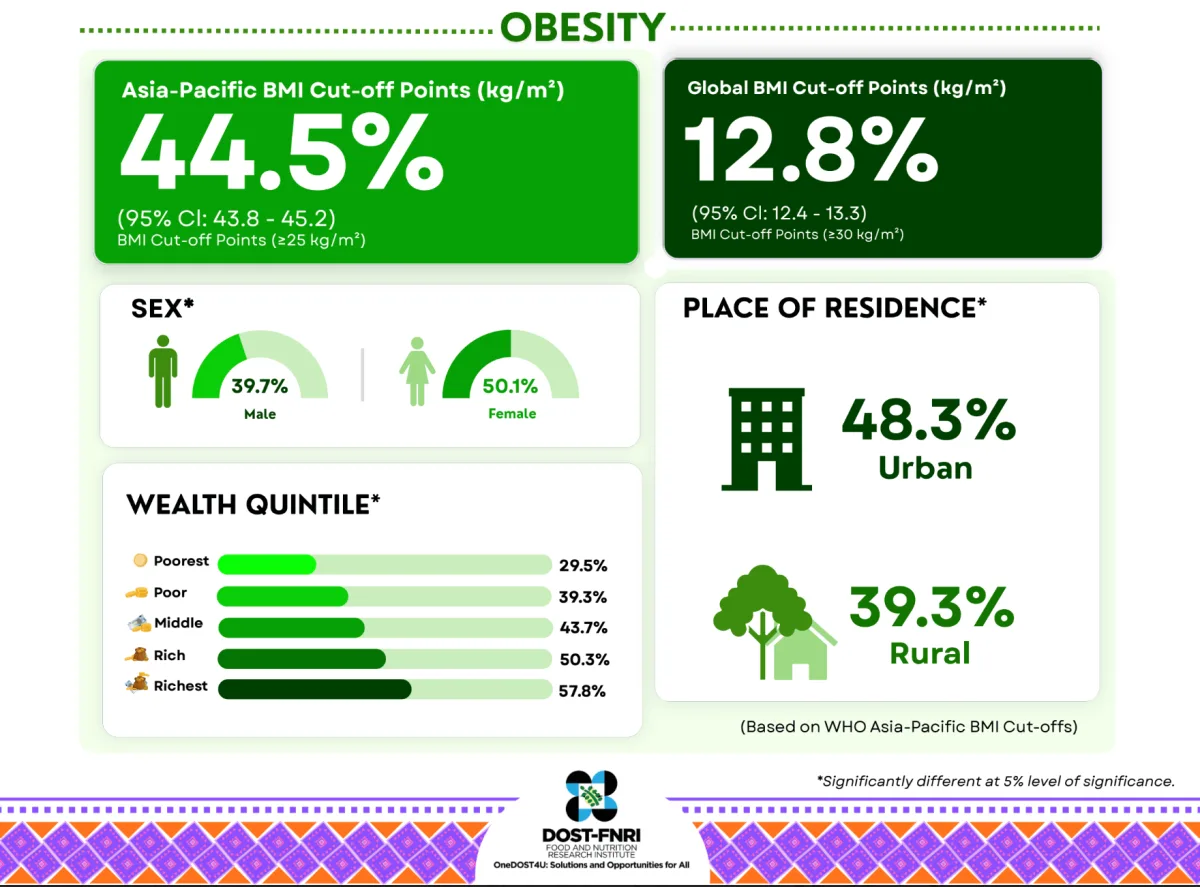
A new survey from the Food and Nutrition Research Institute (FNRI) shows that 44.5% of Filipino adults aged 20 to 59 were overweight or obese in 2025. That's up from 39.8% just two years earlier, in 2023.
The numbers are even starker for certain groups. Among women, the rate hits 50.1%. Urban residents? 48.3%. And the richest Filipinos? 57.8% — well over half.
Regionally, the National Capital Region tops the list at 52.7%, followed by Cordillera Administrative Region at 50.6% and Central Luzon at 49.6%.
The FNRI gathered the data through its 2025 Updating Survey, which sampled 384 households nationwide. The survey uses Body Mass Index (BMI) classifications.
Obesity isn't just about appearance. It's a direct line to serious diseases: hypertension, type 2 diabetes, chronic kidney disease, heart disease, stroke, and cancer. And it's hitting people earlier. Dr. Ma. Lilibeth Dasco, an FNRI supervising science research specialist, warned that noncommunicable diseases can start developing as early as a person's 30s.
The bigger picture: from undernutrition to overnutrition
The Philippines has long struggled with undernutrition. But the FNRI data shows a clear shift. Chronic energy deficiency — long-term undernutrition — among adults 20 and above dropped from 13.9% in 1993 to just 7.2% in 2025. Meanwhile, overweight and obesity rose from 16.6% in 1993 to 43.1% in 2025.
"The problem is the proliferation of fast-food chains, and children now are more interested in gadgets. So, there's really a lack of physical activity," Dasco said.
Children are not spared
Obesity starts young. Among children 0 to 59 months old, 3.8% were overweight-for-height. For kids aged 5 to 10, the rate was 8.6%. And for adolescents 10 to 19? 15.6% — more than one in seven.
Physical activity among teens is dropping. The FNRI found that 77.5% of adolescents aged 10 to 19 were physically inactive in 2025, up from 75.5% in 2023. The World Health Organization recommends at least 60 minutes of moderate to vigorous physical activity daily for this age group.
Dasco emphasized that even simple household chores count as movement.
Why are Filipinos getting heavier?
Dr. Eva Goyena, an FNRI senior science research specialist, pointed to the food environment. "It's the food environment that shapes, that influences our food choices. Whatever's visible and easy to buy and fits into the family budget, that's definitely what people will buy," she said.
Unhealthy food is cheap and everywhere — especially in urban areas and among wealthier families who can afford to eat out often. But obesity is also creeping into rural areas, though at a slower pace.
Goyena also stressed that eating a lot doesn't mean eating well. "A poor diet could either result in stunting, because the food you eat lacks nutrients, or overnutrition. When you have a poor diet, your calorie intake may be high, but the nutrients, vitamins, and minerals in the food you eat are inadequate," she said.
What can be done?
The FNRI is pushing for more physical education in schools and active lifestyles at home. But the bigger challenge is changing the food environment — making healthy options affordable and accessible.
For now, the numbers are clear: the Philippines is facing a double burden of malnutrition. The old problem of undernutrition hasn't fully gone away, but overnutrition is now running just as fast.