

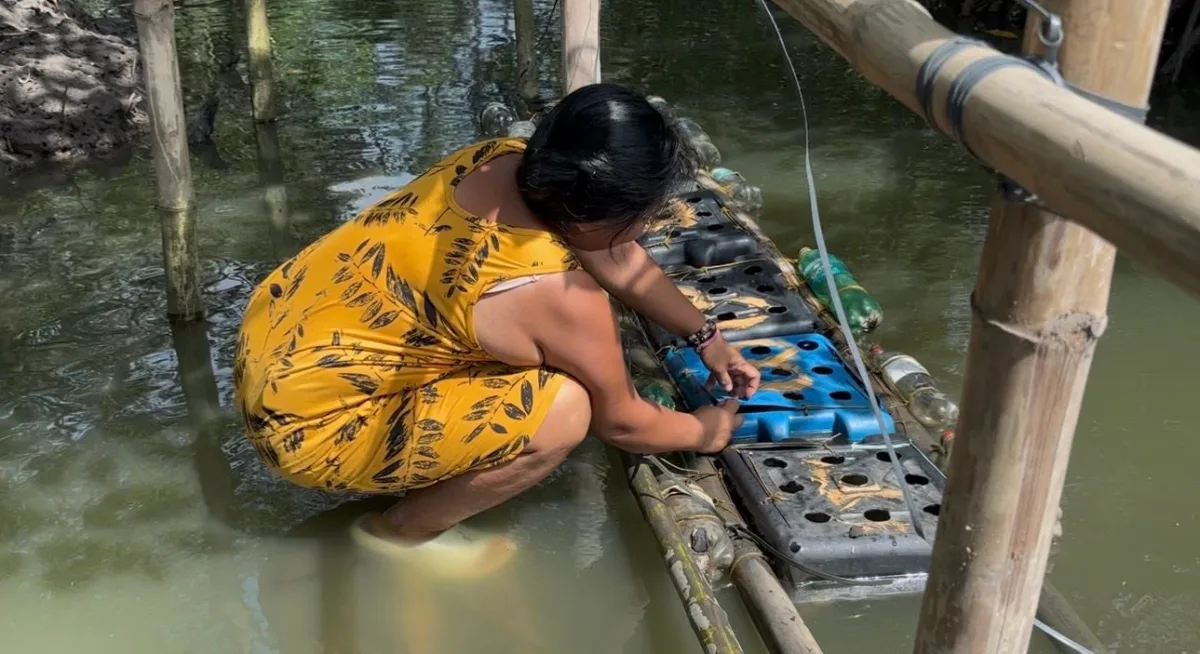
A mud crab fattening enterprise in southern Negros Occidental that was on its last legs is getting a second chance — this time with a farming technology built to survive climate change.
The Ilog Entrepreneurs Association (IEA) started in 2023 with a P315,000 grant from the Department of Social Welfare and Development's Sustainable Livelihood Program. They set up a seafood drop-off shop in Purok Cordova, Barangay Bocana, Ilog town, where fisherfolk could sell their catch without traveling far. It worked well enough that in 2024, they expanded into mud crab fattening.
But the traditional bamboo-and-wood cages they used in brackish river water couldn't handle the changing climate. Extreme heat and erratic weather messed with water quality. Crabs started dying. Production losses piled up. The group shrank from 21 members to just seven.
"Kabudlay sa amon sang una kay ang gamit namon traditional nga cage nga himo sa kahoy kag kawayan, kabudlay mag harvest sang mga alimango kun mag lain ang tyempo kay ka bug-at. Iban gaka patay na lang," IEA president Trinidad Diamante told Rappler on June 10. (We had a difficult time before because we were using traditional cages made of bamboo and wood. It was difficult to harvest the crabs whenever the weather changed, because the cages were heavy. Some crabs would die.)
Determined to keep the livelihood alive, the group turned to Central Philippines State University-Ilog in 2025. The university introduced them to the Crab Vertical Farming Technology (CVFT), a research-based system designed to protect mud crab fattening from weather disruptions.
Dr. Paul Doronila, CPSU-Ilog's research director, said the technology uses 48 individual fattening cages made from recyclable plastic containers. These sit inside a shaded structure. A submersible pump continuously circulates water with specially formulated components to maintain ideal conditions for crab growth. The system also monitors water quality and temperature.
Doronila said the technology costs 40 to 50 percent less than comparable commercial systems because it uses recyclable materials. That makes it affordable for small-scale fisherfolk and community enterprises. More importantly, it was designed to help operators adapt to increasingly unpredictable weather.
The association started operating the technology in January 2026 at a cost of P60,000. Members could finally fatten crabs again under controlled conditions.
"The technology is intended for transfer to the community and not for commercialization."
— Dr. Paul Doronila, research director, CPSU-Ilog
The potential of the technology drew more support. The DSWD granted an additional P300,000 Project Development Advancement Grant to set up another CVFT with 48 cages and to start breeding their own crabs. DSWD-SLP project development officer Precious Apryl Cayot said the expansion will include a solar-powered system to keep the pump running during power outages, which could otherwise kill the crabs.
Doronila said CPSU is willing to transfer the technology to community-based organizations nationwide — free of charge. It's not for sale; it's meant to be shared.
Diamante said they're no longer afraid of bad weather. They can still harvest and fatten crabs even in challenging conditions, using both traditional and innovative methods. New members have joined, bringing the total to 15.
She said the technology can increase the weight of a mud crab that starts at 200 grams by at least another 100 grams — often more — within one to two weeks. They feed the crabs small fish, oysters, and other marine products. Fully grown crabs sell for P500 to P600 per kilo, depending on weight.
The project is supported by the local government unit, the Municipal Social Welfare and Development Office, and the Office of Negros Occidental's Sixth Congressional District.