

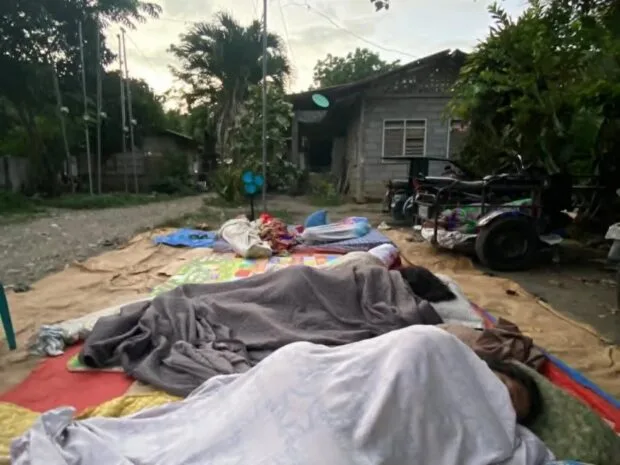
The ground hasn't stopped shaking in southern Mindanao, and for many families, home no longer feels safe.
Forty-five people are now confirmed dead from Monday's magnitude 7.8 earthquake that struck parts of the region, according to the National Disaster Risk Reduction and Management Council (NDRRMC). The number climbed as rescue workers reached more affected areas.
In Sarangani province, entire families are spending their nights on roadsides. They're too scared to go back inside their homes — aftershocks keep rattling the ground, and many buildings are cracked or partially collapsed. Sleeping out in the open isn't comfortable, but it feels safer than being under a roof that could fall.
The quake hit Monday afternoon, catching people in schools, offices, and markets. The initial tremor was strong enough to knock down walls and trigger landslides in mountainous areas. Since then, dozens of aftershocks have followed, some strong enough to send people running out of buildings again.
Rescue operations are still ongoing. The NDRRMC said many of the deaths were caused by collapsing structures and falling debris. In some towns, roads are blocked by landslides, making it hard for help to reach the worst-hit barangays.
Hospitals in the affected areas are treating the injured, but some facilities were damaged themselves. Power outages have hit several towns, and communication lines are down in remote areas.
It's not just fear — it's necessity. Many homes are no longer livable. Walls have cracks big enough to see through. Roofs have shifted. Some houses collapsed entirely.
Government evacuation centers exist, but not everyone can get to them. Roads are damaged, transportation is limited, and some centers are overcrowded. So families are making do with what they have — spreading blankets on the roadside, cooking whatever food they can find, and waiting for daylight.
The NDRRMC has deployed teams to assess damage and distribute relief goods. But with aftershocks continuing, the situation remains unstable. Officials are warning people to stay away from damaged buildings and to be ready for more tremors.
The immediate priority is search and rescue. Teams are still digging through rubble in some areas, hoping to find survivors. After that comes shelter, food, and water for the thousands displaced.
The Philippine Institute of Volcanology and Seismology (PHIVOLCS) is monitoring the aftershocks and hasn't ruled out the possibility of a stronger quake. They're advising residents to stay alert and follow local government instructions.
For now, the people of Sarangani and other affected areas are doing what they can — holding on, watching the road, and hoping the shaking stops soon.