

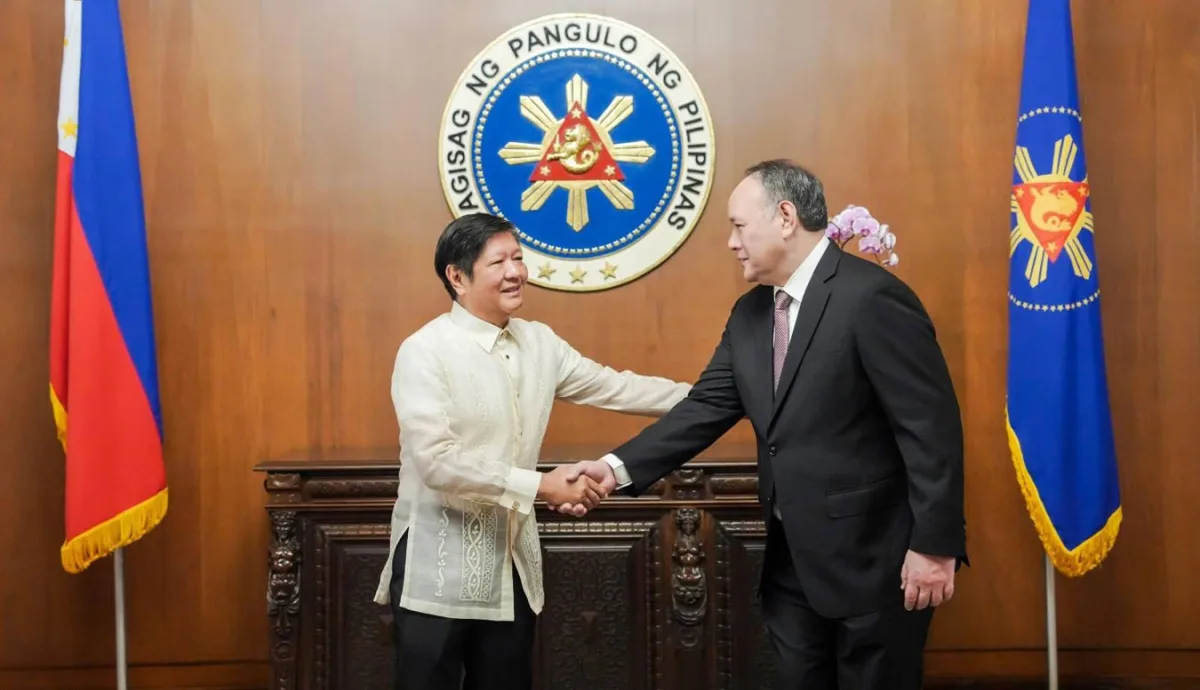
President Ferdinand Marcos Jr. has expressed disappointment over China's sanctions on Defense Secretary Gilberto Teodoro Jr., calling the move 'unhelpful' in efforts to ease tensions in the South China Sea.
On Saturday, July 4, Marcos spoke at a press conference in Canada, where he met with Prime Minister Mark Carney to discuss the South China Sea dispute.
“The declaration of Beijing of Secretary Teodoro, as persona non grata, I guess, in China… it’s just not. It’s very unhelpful, in my view. Because it really achieves very little. It’s more a… how do you say, a response to some of the things that he, some of the pronouncements that he’s made in a foreign forum. But it does not move the discussion between the Philippines and China regarding the territorial conflicts that we have. It does not move that process forward in any way,” Marcos said.
China claims nearly all of the South China Sea, including areas within the Philippines’ exclusive economic zone (EEZ) and maritime features also claimed by other countries. For maritime agencies and Filipino fisherfolk, those claims have translated into repeated harassment and, at times, physical injury in waters Manila refers to as the West Philippine Sea.
The sanctions bar the Teodoro family from entering mainland China, Hong Kong, and Macau, and prohibit them from conducting transactions with individuals and entities in China. Marcos said the sanctions do not make it easier to resolve the dispute.
“It does not make it easier. It does not lessen the risk of a mistake or some kind of skirmish that could grow into something more,” said Marcos.
The most dramatic of “mistakes” took place almost a year ago, when a PLAN and CCG vessel collided off the waters of Scarborough Shoal (Bajo de Masinloc) as they both tried to chase down a much-smaller Philippine Coast Guard ship.
In June 2024, the China Coast Guard confronted Philippine troops during a resupply mission to BRP Sierra Madre, the Philippine Navy ship deliberately grounded in 1999 to serve as Manila’s outpost in the West Philippine Sea. A Filipino sailor lost a thumb during the confrontation, while Chinese personnel damaged Philippine equipment.
“I guess it is of course… it’s China’s prerogative to do whatever it is they please but in the largest scheme of things in my view it it it raises the level of tension rather than lessons which is always what we want and that’s why we continue to have open lines of communications with Beijing,” added Marcos.
“Cutting off another line of communication, which is through our defense ministries… I do not see how it will help that process that we’re trying to achieve to manage the tensions in the West Philippine Sea to lessen the likelihood of something happening that will be a trigger for something worse,” he added.
Marcos also expressed concern about the Philippines' maritime and West Philippine Sea policy after his term ends in 2028.
“It’s almost, not quite, but it’s almost an existential issue for us,” he said. “I think the rightness in our positioning, in terms of the way we position the Philippines in our foreign policy vis-à-vis the arbitral agreement, arbitral award is validated by countries like Canada who support it and see it as simply an enforcement of international law and the defense of our territorial integrity and the exercise of our sovereign rights within our sovereign territory,” he added.
In Canada, Prime Minister Mark Carney reaffirmed Ottawa’s support for international law, including the United Nations Convention on the Law of the Sea and the 2016 Arbitral Award.
The Philippines will continue to pursue its claim over the South China Sea through diplomatic channels, Marcos said.
The Philippines has been locked in a dispute with China over the South China Sea for years, with both countries making competing claims to the territory.
Key Facts
- China claims nearly all of the South China Sea, including areas within the Philippines’ exclusive economic zone (EEZ).
- The sanctions bar the Teodoro family from entering mainland China, Hong Kong, and Macau.
- The Philippines has been locked in a dispute with China over the South China Sea for years.
- The Philippines will continue to pursue its claim over the South China Sea through diplomatic channels.
- The Philippines has the support of countries like Canada in its claim over the South China Sea.