

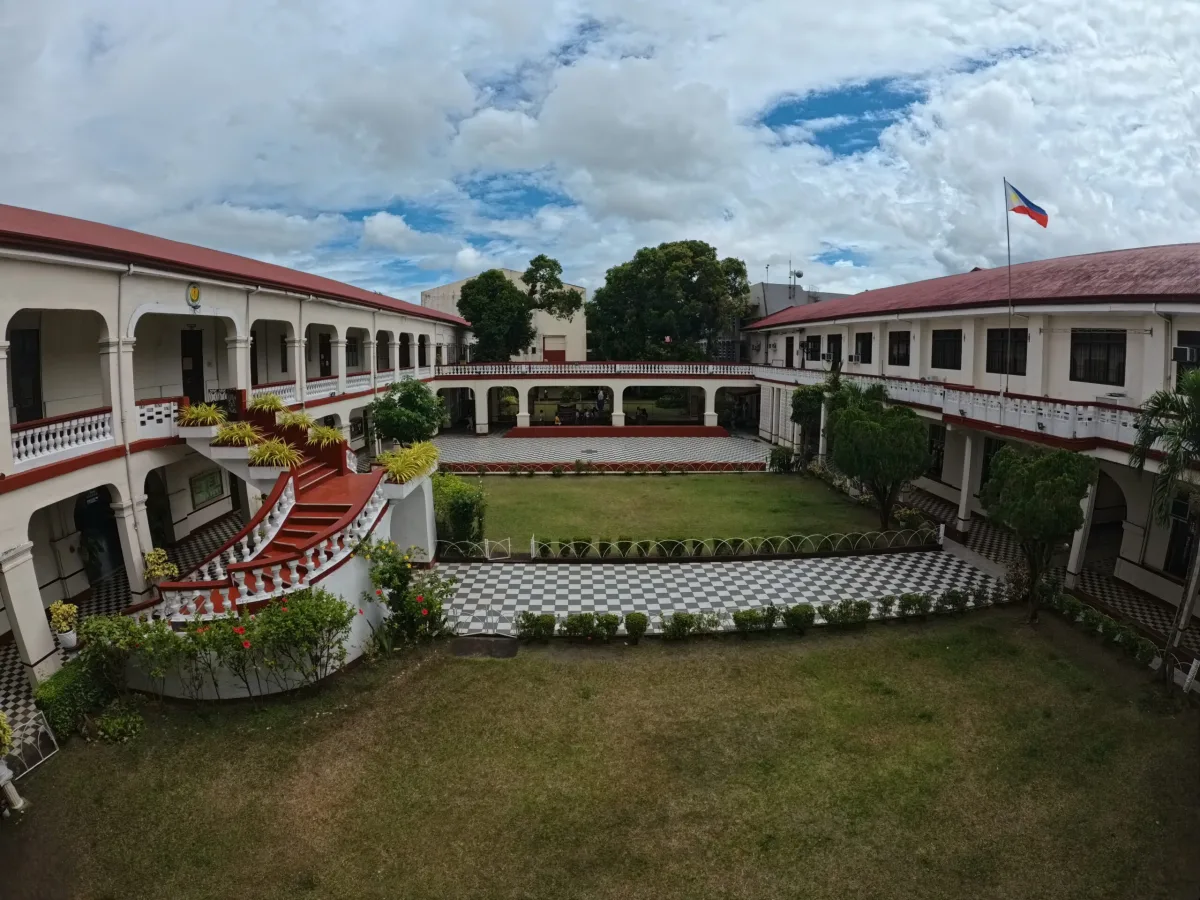
Most people picture a museum as a grand white building with giant columns and spacious halls. But in Naga City, one of the most fascinating museums in the country hides in plain sight — inside the grounds of a trailblazing university.
The Museo Histórico de la Universidad de Sta. Isabel sits within the campus of Universidad de Sta. Isabel, a National Historical Landmark. It doesn't just tell the story of a pioneering school. It also narrates the transformation of a nation from the late 19th century onward.
The university itself traces its roots to 1868, when Spanish Dominican Bishop Francisco Gainza had a radical idea: a formal school for women. In an era when women were mostly confined to domestic roles, this was revolutionary. "Women have a big role in society," museum curator Luis Banzuela explained during a guided tour. "By educating women, you can educate the world."
That vision became the first normal school for women in Southeast Asia — and one of the earliest in Asia dedicated to training female teachers. "Normal" didn't mean ordinary; it referred to norms or standards of teaching — in modern terms, teacher education.
The school first operated in rooms inside the convent beside the cathedral. Gainza wanted permanence, so he petitioned Spain to build beside the cathedral, the bishop's palace, and the seminary. Today, the university stands exactly where he asked.
The museum's first gallery recreates this origin story through a series of paintings completed in 1968 for the institution's centennial. These are among the museum's most prized pieces: visual chronicles of arrival, aspiration, and colonial-era Bicol.
One canvas shows the six Daughters of Charity sisters from Spain who arrived after Gainza secured royal approval. Locals were astonished by women dressed like priests. Another painting depicts their difficult voyage to Bicol in April 1868, traveling through the Bicol River from Pasacao to Nueva Cáceres in time for Palm Sunday.
Elsewhere hangs the school's early uniform, the saya negra suelta — a simple black dress meant to erase class distinctions. "To discourage discrimination between the rich and poor," Banzuela said, "all girls wore black."
The commitment to education went beyond finishing-school refinement. After a few years, Gainza was dissatisfied that graduates weren't becoming teachers. He petitioned Spain again, and in 1872 the school was elevated to an Escuela Normal de Maestras — a teacher-training school.
Inside glass cases are photocopies of application letters from young women hoping to study there, maps showing how students traveled from across Luzon to Naga, and speeches intended for the first graduates. One address, written by Gainza in Spanish for the school's first 11 graduates, had to be delivered by someone else because the bishop was too ill to read it himself.
But perhaps the museum's most remarkable collection lies deeper inside: rows of shrines containing first-, second-, and third-class relics of saints. Some hold fragments of bone. Others preserve cloth touched by canonized figures. For Catholic visitors, they're sacred. For historians, they're artifacts of devotion and ecclesiastical networks stretching across continents.
Among the most prized is a reliquary gifted by Queen Isabella II to Bishop Gainza during an audience in Spain on October 1, 1867. The story behind it is made more fascinating by how Banzuela narrates it to visitors.
The museum remains a hidden gem — a place where faith, revolution, and women's rights converge behind old university walls.