

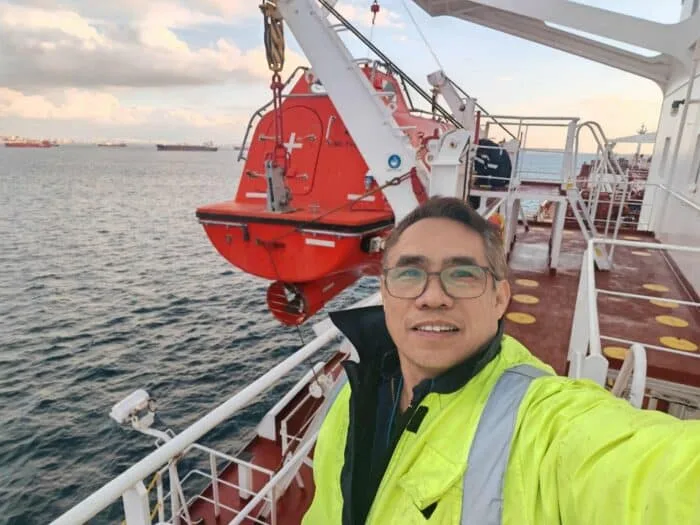
A year after Belle was born, her father started sailing. Twenty-five years later, she can still count on her fingers the number of Christmases, birthdays, and Father's Days they spent together.
Daddy Nowie became a seafarer because his job in the Philippines couldn't support a family. His eldest daughter's birth pushed him to look to the sea for livelihood. That decision meant years of physical absence.
"Tumatakas pa ako noon kapag aalis ako kasi humahabol ka sa akin kapag papasok ako sa work," he told her. (I would slip away quietly back then whenever I had to leave because you would chase after me whenever I left for work.)
This is the reality for millions of OFW families across the Philippines. They borrow time for special occasions. They settle for crumbs of presence in exchange for the comforts their loved ones' hard work abroad can afford.
So when Daddy Nowie got a call on May 14 saying he was scheduled to leave the next day, the family didn't wait for June. They celebrated Father's Day right then, in May.
It was a simple, unplanned celebration — much like every seaman's onboarding, where departures are rarely set in stone. Two months of vacation became a period of catching up, of resetting and connection.
Even during vacation, his suitcases came with them wherever they went, ready for a sudden call to leave. "Hindi pwedeng maiwanan ng lineup. Kapag tumawag, sampa agad," he would say. (You can't afford to miss the lineup. When they call, you board immediately.)
That he would cut short his vacation was no longer new to the family. It came with the understanding that this was part of his commitment to give them a good life. When the recent Middle East conflict erupted, the stakes felt even higher. He'd barely been home for a few hours before he had to think about leaving again.
For years, his dad would say, "Sana makaalis ako ng ganitong buwan para sakto ang end of contract sa December, makapagbirthday at pasko naman dito." (I hope I can leave by this month so my contract ends in December. That way I can celebrate my birthday and Christmas at home.)
Belle knew her father felt extra lonely spending his birthday — just a day before Christmas — away from family. He would recall how it was in 2012 when they last spent New Year together, remembering the firecrackers, what he cooked, the inside jokes.
On May 14, the day before he left, the family stayed home and ordered pizza. He joked, "Libre ni Belle." (Belle's paying for it.)
While his wife was at a medical check-up, he sent several messages asking her to come home because he missed her. When she arrived, she carried the gifts they had secretly prepared: small things that would make his life easier.
"Di pwedeng mapunit 'yung sulat niyo," he said. "Ano ba yan, pinapaiyak niyo ako." (No, I can't tear up your letter. Come on now, you're making me cry.)
These were the only things he usually asked for: a blue friction pen to keep his notes tidy and a headband because working as an electro technical officer in a ship's engine room often leaves him drenched in sweat. Work-related items. Things that simply made his work more efficient.
So they bought him a card holder, a watch, and a comfortable shirt. Their monetary value was insignificant compared to what he earns at sea. Insignificant compared to his daily sacrifices. Insignificant compared to everything he's provided for them.
He unwrapped each gift carefully, clapping with both his hands and feet like a kid being given a toy.
When Belle was a child, the only thing her father ever asked from her was a poem. Now that she's become a journalist, she wanted to tell his story too.
"I want to tell the story of how he sails and endures the waves daily, just to give us a life we could be proud of," she wrote.
For OFW families across the Philippines, Father's Day isn't a date on the calendar. It's the day dad walks through the door — even if that day comes in May.