

The Philippines has a legitimate claim to the West Philippine Sea, with international law backing its exclusive economic zone. According to the 1982 United Nations Convention on the Law of the Sea (UNCLOS), the Philippines has sovereign rights within its 200-nautical-mile economic zone. This same legal framework served as the foundation for the Permanent Court of Arbitration's July 2016 ruling in favor of the Philippines in its maritime dispute with China over the WPS.
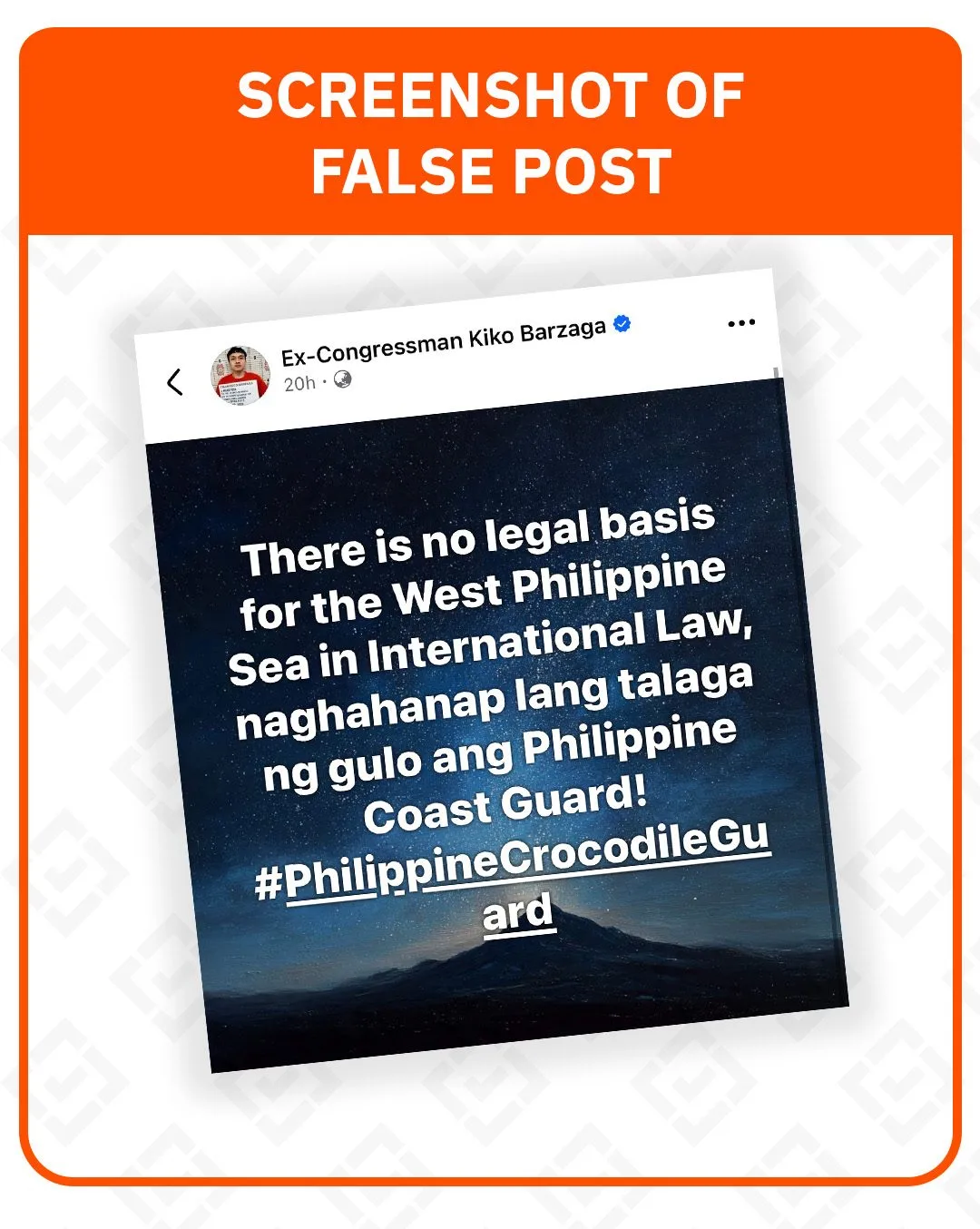
Former Cavite 4th District Representative Kiko Barzaga made a Facebook post on June 22, stating: “There is no legal basis for the West Philippine Sea in International Law, naghahanap lang talaga ng gulo ang Philippine Coast Guard.” Barzaga's post has since garnered over 3,200 reactions, 6 comments, and 69 shares. The former lawmaker's Facebook page, which has over 1.9 million followers, consistently posts pro-Duterte and anti-Marcos content.
However, the Philippines' claim over the WPS is firmly anchored in UNCLOS. Under this international treaty, the Philippines is entitled to sovereign rights within its 200-nautical-mile economic zone. This same legal framework served as the foundation for the Permanent Court of Arbitration's July 2016 ruling in favor of the Philippines in its maritime dispute with China over the WPS.
Rappler's investigation revealed how various pro-China communities on Facebook have been spreading propaganda and disinformation since the administration of former president Rodrigo Duterte to support China's claims and narratives. These narratives are rooted in the arguments that downplayed the Philippines' victory at The Hague, where the former Aquino administration brought the country's case to the arbitral tribunal against China over the West Philippine Sea in 2016.
Retired Supreme Court Senior Associate Justice Antonio Carpio reminded Filipinos to vigorously fight China's disinformation about the West Philippine Sea amid some content creators echoing China's narratives. “We are in a battle with China for the hearts and minds of the people of the world. Not only our people, but the people of the world. So we have to be on our toes. We have to do our own research and rebut them. That's the only way.
We have to present the facts and the law. That is where we are strong,” Carpio said.
Fact-Checking Organizations in the Philippines
- Fact-checking is crucial in this digital age, and the Philippines has a number of organizations that specialize in this area of work.
- One such organization is the Rappler fact-checking team, which uses rigorous research and analysis to debunk false claims and misinformation.
- The Philippine government has also taken steps to promote fact-checking and combat disinformation.
What Happens Next?
The Philippines' foreign affairs department has criticized Beijing's posts rejecting the 2016 arbitral award, saying the award is “final and binding and has become an unassailable part of the corpus of international law, providing legal clarity regarding maritime rights and entitlements in the South China Sea.” The Department of Foreign Affairs has called on the international community to respect the award and the principles of international law that it embodies.