

Retired Supreme Court Senior Associate Justice Antonio Carpio has a warning for the Philippines: protest China's position on the High Seas Treaty now, or lose an area bigger than the entire country.
Carpio spoke on Tuesday, June 9, at a forum organized by Stratbase Institute and the French Embassy in Manila. He said China declared that the Biodiversity Beyond National Jurisdiction (BBNJ) Agreement — also known as the High Seas Treaty — doesn't apply to the South China Sea when it ratified the treaty in December 2025.
“We have to make a counter declaration. The High Seas Treaty applies to the South China Sea high seas,” Carpio said.
The BBNJ is a legally binding international agreement that aims to protect marine life and manage ocean areas beyond any country's national jurisdiction — that's what's called the high seas. Both China and the Philippines have ratified it, along with 87 other nations.
But here's the problem: China attached a statement when it ratified. It said the ratification is “without prejudice to the sovereignty, sovereign rights, and jurisdiction of the state of China, including in respect of any dispute related to it.” That's diplomatic language for: we don't accept that this treaty applies to waters we claim.
Under international law, silence can be interpreted as consent. If the Philippines doesn't formally object within a year of China's ratification — meaning by December 2026 — it could be seen as accepting China's position.
“We will lose our high seas, we will lose our EEZ (exclusive economic zone) in the West Philippine Sea because China’s 10-dash line is very close to our territorial sea,” Carpio said. “We will lose an area larger than our total land area.”
That's not a small loss. The Philippines has a total land area of about 300,000 square kilometers. The country's EEZ — the waters where it has exclusive rights to resources like fish and oil — covers roughly 2.2 million square kilometers. China's nine-dash line claim (sometimes called ten-dash line) encompasses nearly the entire South China Sea, overlapping with the Philippines' EEZ and even its territorial sea in some places.
Carpio isn't just any commentator. He was appointed to the Supreme Court by President Gloria Macapagal-Arroyo in 2001 and served until his retirement in 2019. He's known for his expertise on the West Philippine Sea issue and has been a vocal critic of China's expansive claims. He was part of the legal team that successfully argued the Philippines' case in the 2016 Permanent Court of Arbitration ruling, which invalidated China's nine-dash line claim.
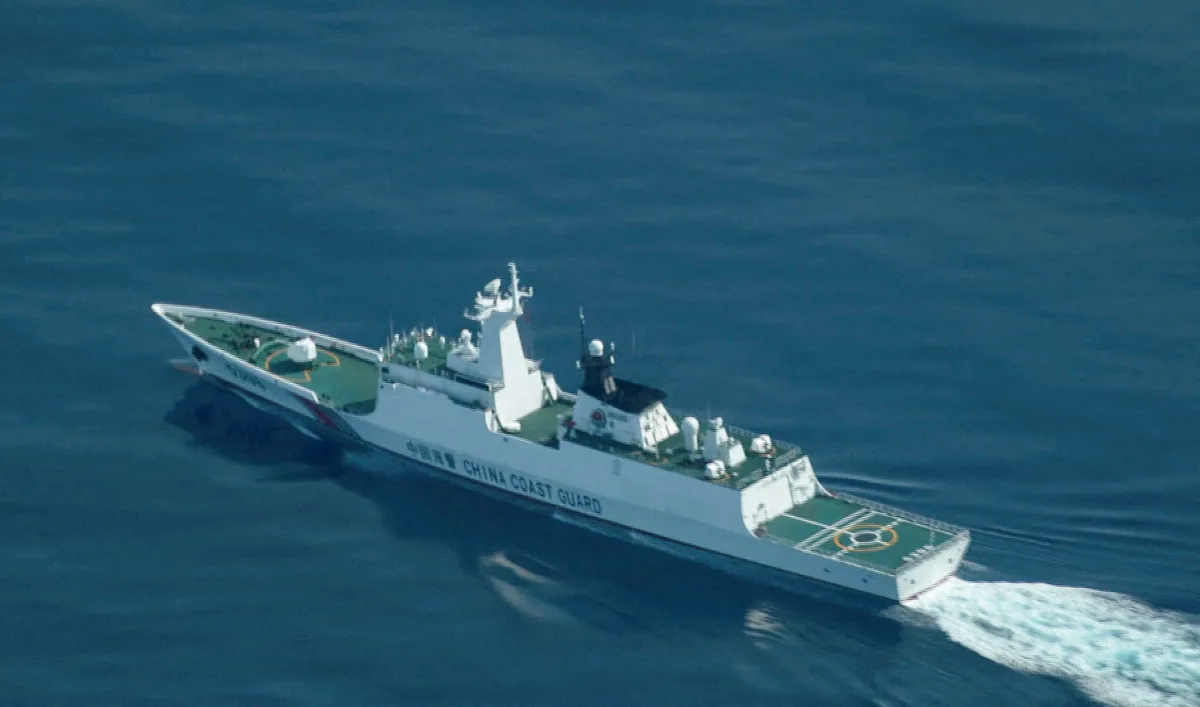
China has rejected that ruling and continues to assert its claims through military presence, fishing fleet operations, and now this treaty maneuver.
“When China ratified the BBNJ, China said that this ratification is without prejudice to the sovereignty, sovereign rights, and jurisdiction of the state of China, including in respect of any dispute related to it,” said Carpio.
The timing is also notable. China is among the countries seeking to host the BBNJ secretariat — the administrative body that will oversee the treaty's implementation. If China hosts the secretariat while maintaining that the treaty doesn't apply to the South China Sea, it could further entrench its position.
Carpio's call is urgent. The Philippines has until December 2026 to file a formal protest. After that, under international law, the absence of objection could be deemed acceptance.
The stakes are enormous. The West Philippine Sea is rich in fish, oil, and gas. It's also a critical shipping lane. Losing access to those waters would hit the Philippine economy hard — fishermen, energy companies, and the national budget would all feel it.
What happens next is up to the Philippine government. The Department of Foreign Affairs hasn't yet issued a statement on whether it plans to file a protest. But with Carpio's warning, the clock is ticking.